
Hyperliquid (HYPE) traded lower Monday, stalling after a 10% gain last week and easing from its extended rally above $89 the previous day. HYPE-focused exchange-traded funds recorded their fifth consecutive weekly inflow, pointing to steady institutional demand even as the token’s technical setup warns of downside risk with bullish momentum stretched thin. HYPE held above $86 at press time, maintaining a broadly bullish bias after last week’s advance, with buyers now facing a test between extending the rally toward $100 and absorbing profit-taking near recent highs.
HYPE ETFs See Fifth Straight Inflow
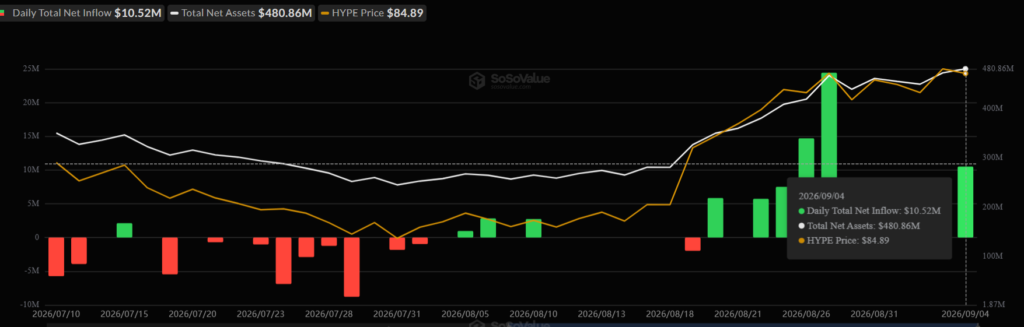
SoSoValue data shows HYPE ETFs recorded $12.27 million in inflows last week, down sharply from $56.86 million the previous week, though the total still marks a fifth consecutive week of positive flows. James Seyffart, a Bloomberg ETF analyst, said on X that leading financial institutions hold HYPE exposure through these funds, naming firms including Wealth High Governance, OLP Capital, UBS, Bank of Montreal and Jane Street among the holders. That institutional interest comes as U.S. President Donald Trump has said he plans to bring Hyperliquid onshore, a development that would expand the exchange’s regulated footprint in the United States.
Big Funds Hold Stakes in HYPE
Exposure to the decentralized exchange’s native token reflects sustained demand from large institutional investors positioning ahead of potential U.S. regulatory clarity. The mix of holders spans both traditional banks and quantitative trading firms, a signal that HYPE has moved beyond a purely retail-driven trade. Even with last week’s slowdown in fresh inflows relative to the prior week’s total, the streak of positive weekly flows underscores that institutional allocators have not reversed course despite the token’s recent pullback from its highs:
- HYPE ETFs have now posted five straight weeks of net positive inflows, per SoSoValue
- Disclosed institutional holders span major banks, trading firms and asset managers rather than a single concentrated buyer
Charts Point to $100 or a Pullback
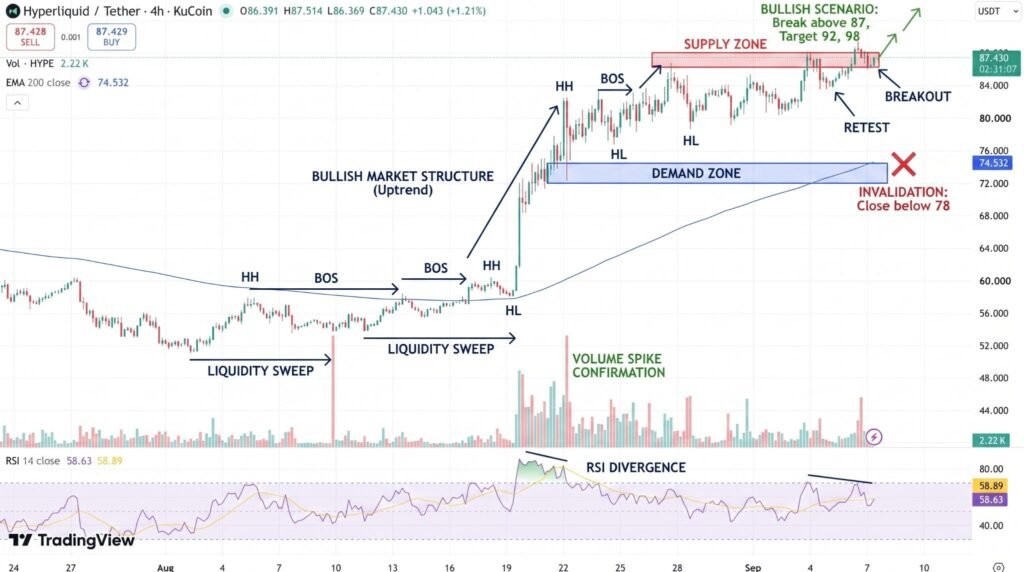
HYPE holds above $86 at press time Monday, maintaining a clear bullish bias after advancing 10% last week and remaining well above its 50-day exponential moving average at $71.55, its 100-day EMA at $65.05, and its 200-day EMA near $56.64. Fibonacci retracements from the swing between $76.93 and $51.20 sit comfortably beneath current prices, offering a cushion on pullbacks, though HYPE has struggled to clear the 127.2% Fibonacci extension at $85.94, a sign of profit-taking pressure. The Relative Strength Index sits near 64 on the daily chart, still bullish but easing from overbought territory, while the MACD has slipped marginally below its signal line, pointing to a brief loss of upside momentum. HYPE has formed a near-term upward-sloping channel with a lower boundary near $82.40; a confirmed break below that level could extend a correction toward the $76.93 Fibonacci anchor, with deeper pullbacks testing the 50-day EMA at $71.55 and the 78.6% Fibonacci retracement at $70.51. A decisive close above the trendline near $89.61, by contrast, could open a path toward the 161.8% extension at $98.95 and the $100 psychological level.
Conclusion
HYPE’s setup is genuinely two-sided: institutional demand has stayed positive for five straight weeks even as the pace of inflows cooled sharply from $56.86 million to $12.27 million, while the chart shows a token holding a firmly bullish structure that has nonetheless failed twice to clear resistance near $86. Whether HYPE resolves that tension toward $100 or toward the $71.55 support zone will likely hinge on whether institutional flows reaccelerate or continue slowing, since the technical levels on both sides of current price are already well defined. This article is for informational purposes only and does not constitute financial advice; cryptocurrency markets can experience sharp price movements.
Sources & Methodology
Primary-source standard: Market-moving facts should link to original data releases, regulator notices, company filings or official project announcements whenever available. Secondary reporting is used for additional context, not as a substitute for original evidence.
Page last reviewed: