
Robinhood Markets is receiving higher Wall Street price targets as its prediction-market business becomes a larger part of the brokerage’s growth strategy. Goldman Sachs raised its HOOD price target to $142 from $124 while maintaining a Buy rating, citing the early performance of Rothera, Robinhood’s prediction-market joint venture with Susquehanna International Group. Jefferies separately lifted its target to $140. The revisions follow rapid growth in event-contract trading and Robinhood’s latest agreement to expand prediction-market distribution through Crypto.com and OG.com.
Rothera Supports Goldman’s $142 Target
Goldman Sachs analyst James Yaro said Rothera has quickly established itself among the third- to fifth-largest prediction-market exchanges globally by trading volume. Goldman estimates the business generated approximately $150 million in annualized revenue during its first quarter of operation.
Rothera is a CFTC-licensed exchange and clearinghouse independently managed through Robinhood’s joint venture with Susquehanna. Robinhood began routing selected contracts to the platform in June, initially covering World Cup and professional baseball markets.
Goldman expects Rothera to generate approximately $307 million in revenue in 2027 under its base case. Its bull-case estimate reaches roughly $906 million, while the bear case is about $91 million. These figures are Goldman forecasts rather than guidance issued by Robinhood.
Robinhood’s own numbers confirm that prediction markets have become a significant source of customer activity. The company reported 13.6 billion event contracts traded during the second quarter, while more than 5 billion contracts were traded during the 2026 World Cup alone.
The company expanded that business again on September 8 through a multi-year agreement with Crypto.com and OG.com. Robinhood will route selected football contracts through OG.com’s federally regulated exchange and take minority equity stakes in both OG.com and Crypto.com.
Wall Street Raises HOOD Expectations
Jefferies analyst Daniel Fannon separately increased his Robinhood target to $140 from $127, maintaining a Buy rating after meeting CFO Shiv Verma. The firm highlighted strong net deposits, increasing Robinhood Gold adoption and the company’s expanding product pipeline.
The revisions follow several other bullish Wall Street calls. Morgan Stanley recently upgraded HOOD to Overweight and increased its target to $150 from $124, while Piper Sandler raised its target to $145. These targets represent analyst expectations rather than guaranteed future share prices.
Robinhood’s underlying business has also expanded. In its second-quarter results, the company said Rothera had processed more than 3.5 billion contracts since launch. Robinhood Legend exceeded $100 million in annualized revenue, while its Gold Card business also surpassed $100 million in annualized revenue.
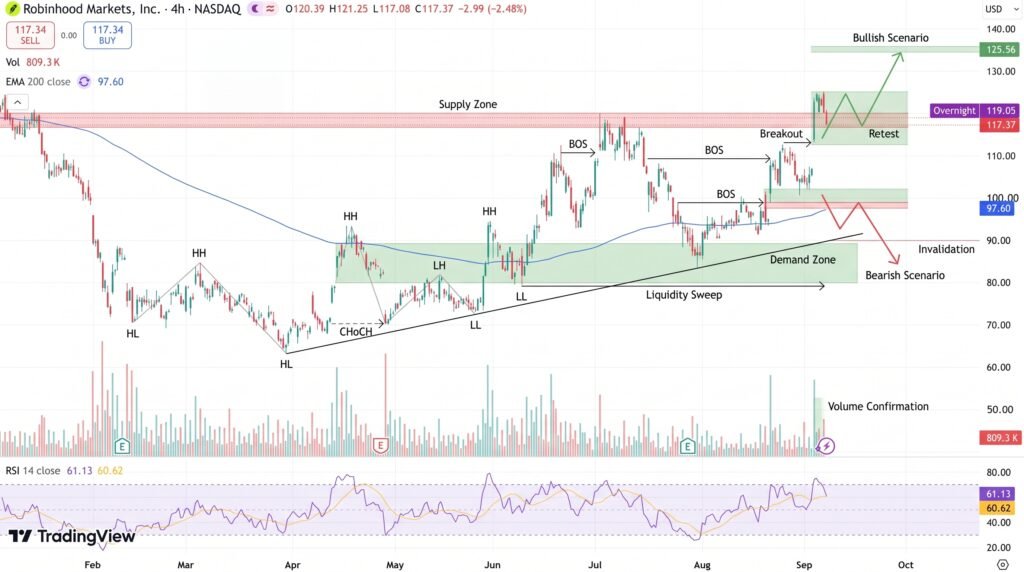
HOOD initially gained about 1.6% in premarket trading on September 8 following Goldman’s target increase, but the stock later reversed and closed the regular session down 3.9%. The move highlights the difference between positive analyst research and actual short-term market performance.
Conclusion
Goldman’s $142 Robinhood target is increasingly tied to the company’s expansion beyond traditional brokerage services. Rothera’s estimated $150 million annualized first-quarter revenue, billions of prediction contracts traded and Robinhood’s new OG.com partnership provide evidence that event markets are becoming a meaningful part of the platform.
Jefferies, Morgan Stanley and Piper Sandler have also raised their expectations, but the higher targets depend on Robinhood sustaining customer growth and converting new products into durable revenue. Rothera’s early performance is encouraging, although investors will need future financial results to determine how much prediction markets ultimately contribute to Robinhood’s earnings.
Sources & Methodology
Primary-source standard: Market-moving facts should link to original data releases, regulator notices, company filings or official project announcements whenever available. Secondary reporting is used for additional context, not as a substitute for original evidence.
Page last reviewed: