The silver price remains caught between competing technical signals, with traders watching whether XAG/USD can reclaim the upper end of its recent range. The latest market data show spot silver around $66.26, after reaching an intraday high near $66.69 on September 9. The metal had closed at $65.59 on September 8 after trading as high as $67.19 during that session.
The supplied five-hour technical setup places silver around $67.37 and inside the Ichimoku Cloud, with the cloud extending roughly from $66.45 to $67.52. Trading inside that band indicates that neither buyers nor sellers have established firm short-term control.
The chart also presents mixed momentum. The MACD has generated a bullish crossover, while price remains above the 50-period moving average near $67.12 and the 200-period average near $63.23 in the supplied setup. Those signals preserve the broader bullish structure but do not confirm a breakout.
The Average Directional Index at 13.05 adds another warning. An ADX at that level indicates weak trend strength, making range trading and false breakouts more likely until directional momentum improves.
$67.50 defines the first breakout
The key upside area is $67.50-$68.10, where the top of the Ichimoku Cloud and the SuperTrend resistance near $67.98 converge. A decisive move through that zone, preferably accompanied by stronger trading volume, would provide better evidence that buyers are regaining control.
Below the market, $66.00 remains the important near-term support in the supplied technical model. A sustained break beneath it would weaken the range structure and bring $65.15 and the $63.20 region into focus.
The main levels are:
- Current market area: Around $66.26
- Cloud resistance: $67.50
- SuperTrend resistance: $67.98
- Key support: $66.00
- Major lower support: $63.20
The $63.20 region carries additional technical significance because it aligns closely with the 200-period moving average and the 50% Fibonacci retracement cited in the setup.
Volume must confirm the next move
The bull-flag pattern in the supplied chart is about 80% developed, suggesting that price compression could eventually give way to a larger move. However, declining volume reduces the reliability of a breakout attempt.
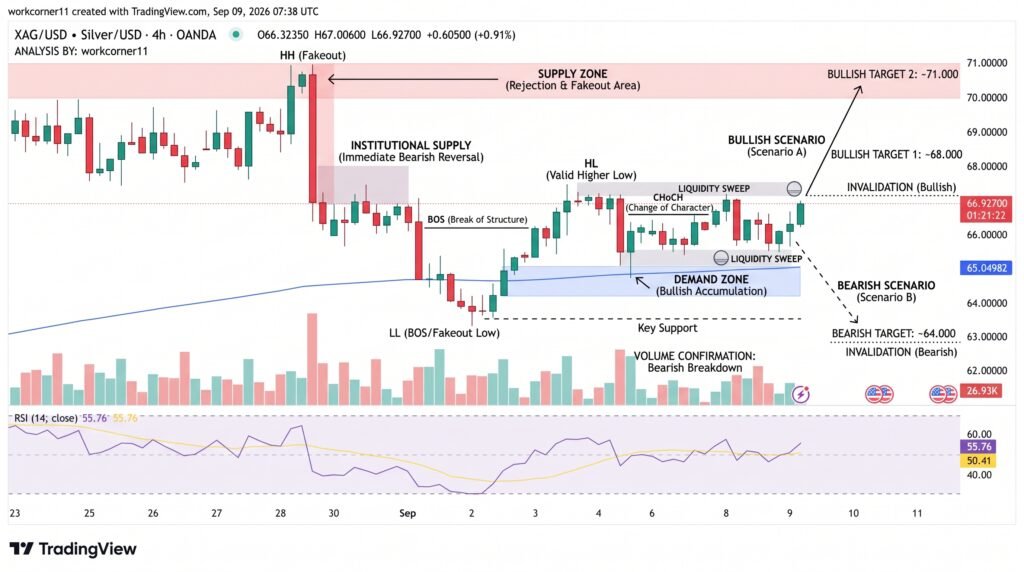
SILVER Price Chart – Source: Tradingview
For buyers, a move above $67.50 followed by acceptance above $68 would improve the technical structure. For sellers, rejection near the cloud top or a break below $66 would strengthen the bearish case.
The broader market also matters. Silver remains sensitive to movements in the U.S. dollar, Treasury yields and Federal Reserve policy because these factors affect precious-metals valuations. A softer dollar and lower yields can support silver, while renewed strength in U.S. rates can pressure the metal.
Current market history shows why caution is warranted. Silver fell to $63.32 on September 2, then climbed to $67.48 on September 3 before closing near $66.98. That wide range demonstrates how quickly XAG/USD can move when momentum changes.
Until price leaves the cloud decisively, the setup remains rangebound. Traders are likely to get a clearer signal from either a volume-backed break above $67.50-$68.10 or a sustained move below $66.00.
Conclusion
Silver remains in a technical consolidation phase, with the Ichimoku Cloud showing limited directional conviction. The immediate upside test is $67.50-$68.10, while $66.00 is the key downside boundary. A confirmed break above resistance would strengthen the bull-flag setup and shift attention toward higher levels. A break below $66 would instead expose $65.15 and the $63.20 support zone. Weak ADX and declining volume argue against chasing moves inside the range. For now, confirmation from price and volume remains more important than the individual indicator signals.
Sources & Methodology
Primary-source standard: Market-moving facts should link to original data releases, regulator notices, company filings or official project announcements whenever available. Secondary reporting is used for additional context, not as a substitute for original evidence.
Page last reviewed: