Silver is consolidating between $65.00 and $68.00 on the five-hour chart, with the source snapshot showing the metal at $67.02, just below key resistance. The sideways structure reflects indecision as buyers attempt to extend the recovery while sellers continue defending the upper boundary.
The $65.00 area remains the main support zone, backed by a Fibonacci retracement and trendline confluence. At the other end of the range, $68.00 has repeatedly attracted selling pressure, with upper wicks highlighting failed attempts to establish a sustained breakout.
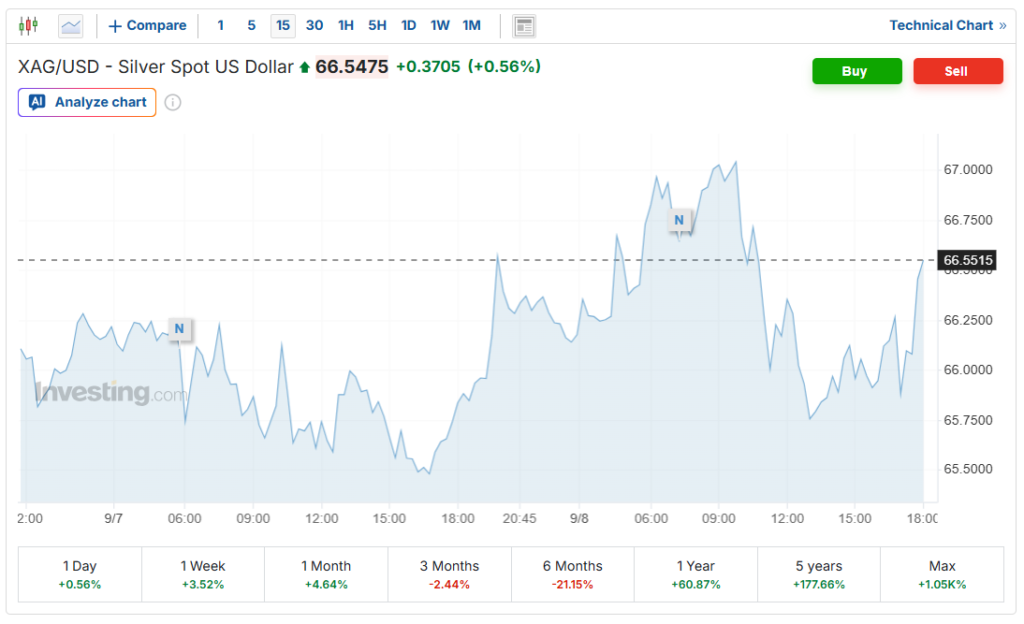
Silver’s broader recovery structure remains intact while price holds above the 200-period SMA at $63.03. However, the market is still lacking a decisive directional signal, making the range boundaries more important than moves in the middle of the band.
Current technical levels include:
- $67.02: Source snapshot and immediate price area.
- $68.00: Key resistance and breakout threshold.
- $65.00: Major range support.
- $64.50: Bullish invalidation level.
- $63.03: 200-period SMA and longer-term trend reference.
Momentum remains mixed near $67
Momentum indicators offer a divided picture. The MACD remains bullish, suggesting buying pressure is building, but the ADX at 15.57 points to a weak trend environment. That combination supports the view that silver is consolidating rather than following a strong directional trend.
Declining volume around $66.83 adds to the caution. Lower participation can accompany range exhaustion, but it does not by itself confirm that a major breakout is imminent. Traders would need stronger price and volume confirmation before treating a move outside the range as a durable trend shift.
The current structure also favors watching confluence rather than relying on a single indicator. When Fibonacci levels, trendlines and moving averages converge around the same area, that zone can become more significant for price discovery.
For now, the middle of the range offers limited technical clarity. A move toward either extreme should provide a more meaningful test of market conviction.
$64.50 break threatens the uptrend
The bullish case strengthens if silver can clear $68 and hold above the resistance zone. A confirmed breakout would signal that buyers are gaining control and could shift attention toward higher levels beyond the current range.
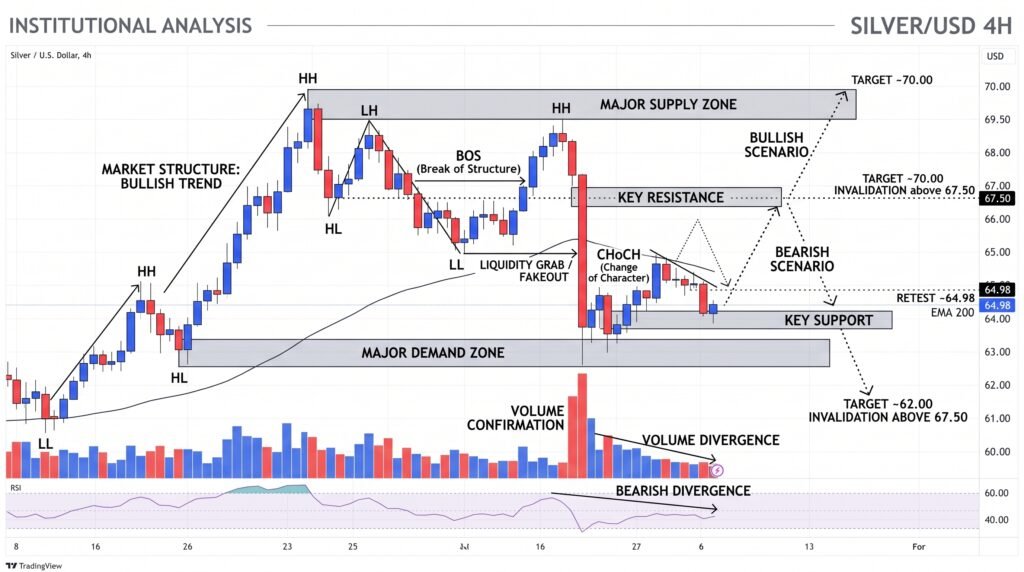
However, repeated spikes above $68 that quickly reverse would increase the risk of another bull trap. Sellers have already demonstrated their ability to reject prices near the range ceiling, so a brief move above resistance should not automatically be treated as a confirmed breakout.
On the downside, $64.50 is the critical invalidation level. A sustained break below it would put the broader recovery at risk and give bears a stronger technical argument.
The five-hour setup therefore remains primarily range-bound:
- Above $68: Bullish breakout confirmation becomes more credible.
- $65–$67.50: Choppy mid-range where patience may be preferable.
- Below $64.50: Bullish structure becomes vulnerable.
- Below $63.03: The 200-period SMA becomes a key downside reference.
With silver currently trading around the upper half of its range, the next decisive move beyond $65–$68 is likely to provide a clearer directional signal than continued price action inside the band.
Conclusion
Silver remains trapped between $65.00 support and $68.00 resistance, with $67.02 keeping the metal close to the upper boundary of the range. The bullish MACD suggests improving buying pressure, but an ADX of 15.57 signals that trend strength remains weak. A sustained break above $68 would strengthen the bullish outlook, while a move below $64.50 would threaten the broader recovery structure. Until either boundary breaks decisively, consolidation remains the dominant setup for XAG/USD.
Sources & Methodology
Primary-source standard: Market-moving facts should link to original data releases, regulator notices, company filings or official project announcements whenever available. Secondary reporting is used for additional context, not as a substitute for original evidence.
Page last reviewed: