
Key Points
- Cardano lost more than 6% on September 15 and remains below the important $0.20 level.
- Weak momentum and softer speculative positioning are adding pressure to ADA’s short-term outlook.
- Failure to recover $0.20 could leave the $0.165 region exposed, while reclaiming the former support would reduce immediate downside pressure.
Cardano is struggling to regain its footing after a sharp selloff pushed ADA below $0.20, weakening a technical area that had repeatedly influenced price action during August and September. ADA dropped more than 6% on September 15, falling from around $0.2085 to roughly $0.195, with an intraday low near $0.193. The cryptocurrency remained close to $0.19–$0.195 on Wednesday, leaving traders focused on whether buyers can quickly reclaim $0.20 or whether the breakdown develops into another leg lower.
ADA Loses an Important Price Zone
The latest decline represents more than a single weak trading session. Cardano has struggled to maintain the recovery that briefly pushed the token above $0.22 earlier this month.
Historical market data shows ADA reached approximately $0.223 on September 9 before falling back below $0.21 and eventually breaking $0.20. The September 15 session produced another acceleration in selling, with trading volume increasing alongside the decline.
That leaves the $0.199–$0.201 region as an important area to monitor. This zone contains several technical reference points, including the 50-day and 100-day exponential moving averages cited in current technical analysis. Once support breaks, the same region can become resistance as traders who bought near the previous floor use rebounds to reduce exposure.
Momentum indicators also remain weak. The Relative Strength Index is around the mid-40s, while MACD readings continue to indicate negative momentum. These signals do not guarantee further losses, but they show that buyers have yet to establish a convincing reversal.
Cardano Network Activity Adds Pressure
Price weakness is occurring alongside concerns about activity across the Cardano ecosystem. Transaction activity and fee-based network revenue have declined from recent August levels, reducing one source of fundamental demand for the network’s native ADA token. Lower activity does not automatically determine ADA’s market price, but persistent weakness would be important because transaction growth, application usage and fees provide measures of actual blockchain demand.
This makes network activity particularly relevant if ADA attempts another recovery. A price rebound accompanied by improving transactions and decentralized application activity would provide a different fundamental backdrop from a rally driven mainly by broader cryptocurrency-market sentiment. Cardano’s longer-term development roadmap therefore remains important even while short-term traders concentrate on price levels.
Futures Market Shows Reduced Risk Appetite
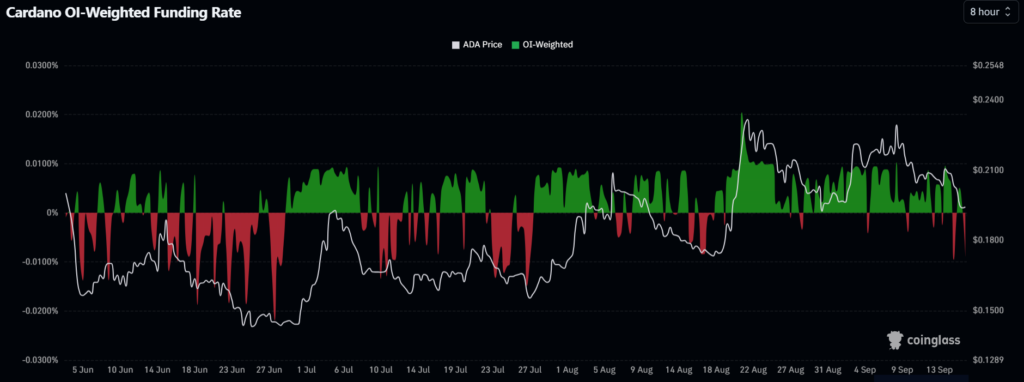
Derivatives positioning also indicates that traders have become more cautious. Open interest has weakened from recent levels, suggesting that some leveraged positions have been closed during the decline. Heavy long liquidations during the selloff further indicate that bullish leveraged positions were caught as ADA broke support.
Funding rates have remained slightly positive rather than deeply negative. That distinction matters because it suggests the derivatives market has weakened without reaching the type of extreme bearish positioning sometimes associated with heavily crowded short trades. In practical terms, derivatives data currently points more toward reduced speculative confidence than an outright capitulation event.
$0.165 Becomes the Main Downside Level
The technical picture has deteriorated after ADA moved beneath the cluster around $0.20. The next significant support identified through Fibonacci analysis sits around $0.1647. A move from approximately $0.194 to that level would represent a decline of roughly 15%.
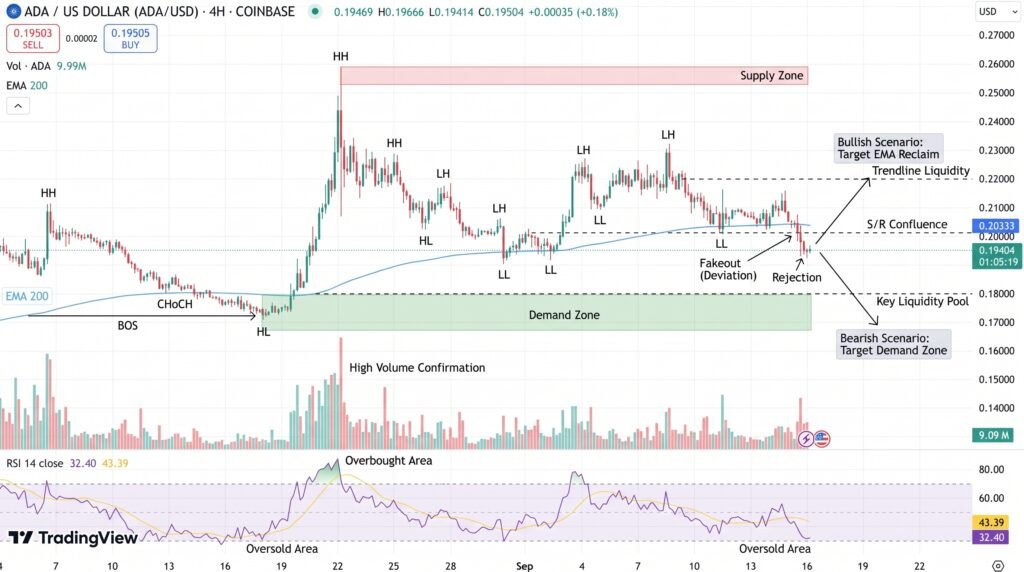
That should be viewed as a technical downside scenario rather than a guaranteed target. ADA would still need sustained selling pressure and failure to recover recently broken support before the $0.165 area becomes a more immediate test.
On the upside, the first challenge is straightforward: Cardano needs to recover $0.20. Holding above that region would weaken the immediate bearish setup and could shift attention toward higher resistance. The much higher 200-day EMA around $0.244 remains a more substantial barrier for any broader trend reversal.
Conclusion
Cardano’s September 15 selloff damaged its short-term technical structure by pushing ADA decisively below the closely watched $0.20 region. Weak momentum, softer derivatives positioning and concerns about network activity provide additional reasons for traders to remain cautious.
The next move largely depends on whether ADA can reclaim $0.20. Failure to do so keeps downside risk elevated and leaves the $0.165 support region within the technical map. A sustained recovery above $0.20, particularly alongside stronger network activity and derivatives demand, would provide the first meaningful evidence that the latest breakdown is losing momentum.
Sources & Methodology
Primary-source standard: Market-moving facts should link to original data releases, regulator notices, company filings or official project announcements whenever available. Secondary reporting is used for additional context, not as a substitute for original evidence.
Page last reviewed: