
Bitcoin is trading near $76,700 as investors assess the impact of the Federal Reserve’s latest rate increase and ongoing tensions across the Middle East. The cryptocurrency has shown limited reaction to the Fed’s decision, while broader risk sentiment has received some support from signs of easing tensions involving Yemen’s Houthis. Crypto markets are also still adjusting to the U.S. Senate’s failure to advance the CLARITY Act, leaving regulation as another major theme for digital-asset investors.
Fed Hike Keeps Bitcoin Under Pressure
The Federal Reserve raised the federal funds target range by 25 basis points on September 16 to 3.75%-4.00%, in line with market expectations. The move was the central bank’s first rate increase since July 2023. New projections showed policymakers still see scope for another increase in 2026, keeping monetary policy restrictive.
Fed Chair Kevin Warsh also emphasized that inflation remains too high, reinforcing expectations that borrowing costs could stay elevated for longer. Higher interest rates can reduce demand for non-yielding assets such as Bitcoin by increasing the relative appeal of cash and fixed-income investments.
Bitcoin, however, has so far remained relatively stable. Investing.com reported the cryptocurrency at about $76,492 early Thursday, with the market showing limited immediate reaction to the Fed decision.
- Bitcoin: Around $76.5K-$76.7K
- Fed target range: 3.75%-4.00%
- Fed move: +25 basis points
- Key macro focus: Future Fed rate path
Middle East Risk Shapes Sentiment
Risk assets received some relief after Reuters reported that U.S. officials had held talks with Iran-backed Houthi representatives in Oman. The group indicated that its previous ceasefire with Washington remained in place and that it would not attack U.S. or Israeli ships, although broader regional tensions remain unresolved.
Falling oil prices also helped ease some inflation concerns. Reports that Saudi Arabia was rerouting crude through Oman suggested potential relief for disrupted supply routes, although the market remains sensitive to any renewed escalation involving Iran, Saudi Arabia or shipping through regional waterways.
For Bitcoin, changes in oil prices and geopolitical risk matter because they can influence inflation expectations, bond yields and broader appetite for riskier assets. A renewed energy shock could strengthen expectations for tighter monetary policy and increase pressure on speculative markets.
Crypto Regulation Remains a Catalyst
The crypto market is also recovering from the Senate’s rejection of a procedural motion to advance the CLARITY Act. The Senate vote was 49-50, falling well short of the 60 votes required to move the bill forward. Reuters described the result as a significant setback for the industry’s effort to establish a broader U.S. market structure framework.
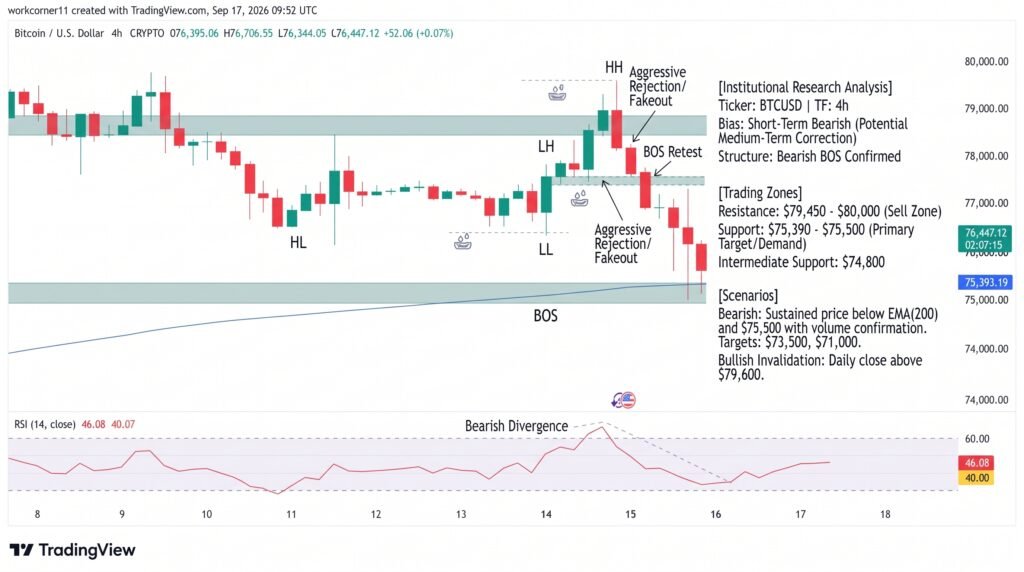
Bitcoin Price Chart – Source: Tradingview
Despite that setback, major cryptocurrencies moved higher Thursday. Investing.com reported Ethereum up 1.4%, XRP 0.3%, Solana 2.4%, Cardano 1% and BNB 1.6%. Dogecoin gained 1%, while the TRUMP token rose 4.1%.
Conclusion:
Bitcoin remains rangebound near $76,700 as traders balance a newly restrictive Fed backdrop against shifting geopolitical risk and uncertainty over U.S. crypto regulation. The Senate’s CLARITY Act setback removes a near-term legislative catalyst, while easing tensions around Yemen have offered some relief to broader risk sentiment. The next major Bitcoin move will depend on how markets price additional Fed tightening, whether Middle East tensions escalate again and whether regulatory momentum returns.
Sources & Methodology
Primary-source standard: Market-moving facts should link to original data releases, regulator notices, company filings or official project announcements whenever available. Secondary reporting is used for additional context, not as a substitute for original evidence.
Page last reviewed: