The US Dollar Index (DXY) is easing modestly after reaching its highest level since late July, but the index remains above the psychologically important 100.00 mark. The pullback comes as U.S. Treasury yields retreat following the Federal Reserve’s latest policy decision, encouraging some profit-taking in the US dollar. Still, the Fed’s latest projections point to another rate increase in 2026, while geopolitical tensions continue to provide support for the greenback.
Fed Outlook Keeps Dollar Supported
The Federal Reserve raised the federal funds target range by 25 basis points to 3.75%-4.00% on September 16, marking its first rate increase since July 2023. The decision was unanimous, and updated projections showed a majority of policymakers still expect at least one additional increase this year.
The move had initially pushed the DXY sharply higher. FXStreet reported that the index climbed above 100.00 after the decision and reached around 100.30 during Thursday’s Asian session before giving back some gains as bond yields declined.
The decline in yields has limited the dollar’s latest advance, but the broader rate backdrop remains supportive. The 10-year U.S. Treasury yield fell to around 4.99% on Thursday, while the two-year yield slipped to roughly 4.71%.
- DXY: Above 100.00
- Fed target range: 3.75%-4.00%
- Key resistance: 100.18
- Immediate support: 99.79
DXY Technical Levels in Focus
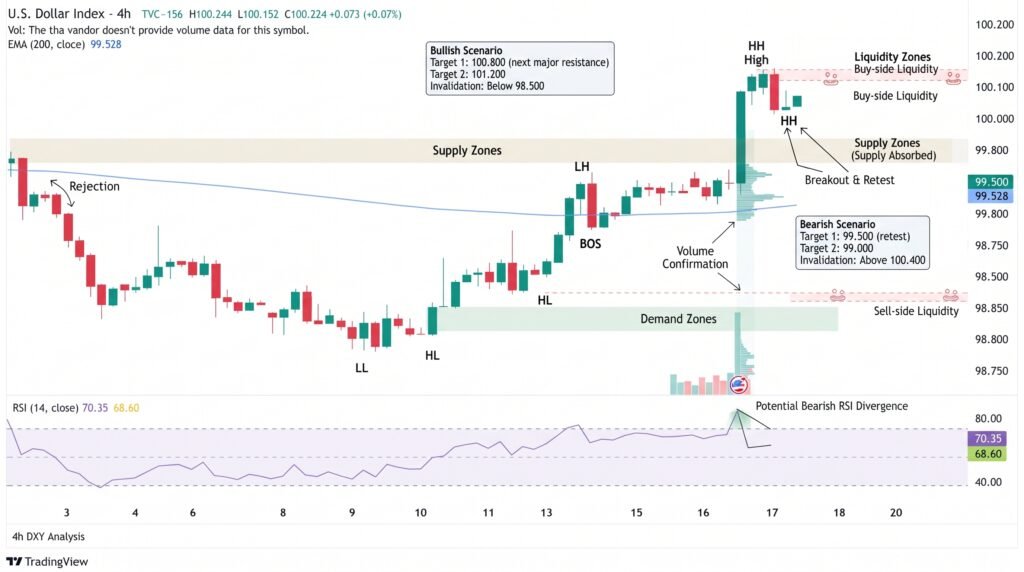
The technical structure remains constructive after DXY broke above its 100-day EMA near 99.67. The index is now testing the 50% Fibonacci retracement around 100.18, making that level the first major resistance to watch.
A sustained move above 100.18 would expose the 61.8% retracement near 100.56, followed by resistance around 101.11 and the recent swing high near 101.80. These levels define the next upside reference points if the dollar resumes its advance.
On the downside, a failure to hold above 100.18 could produce a corrective move toward the 38.2% Fibonacci retracement at 99.79. Below that, the 100-period EMA near 99.67 and the 23.6% retracement around 99.32 form a broader support area. The structural floor remains near 98.55. A sustained break below that level would materially weaken the recent recovery structure.
Data and Geopolitics Add Volatility
The U.S. economic calendar offers several potential catalysts Thursday, including Initial Jobless Claims, the Philadelphia Fed Manufacturing Index and housing-market data. Stronger-than-expected figures could reinforce expectations for restrictive Fed policy, while weaker data could encourage further profit-taking in the dollar.
Geopolitical developments also remain important. Renewed fighting involving Iran-backed Houthis and Saudi Arabia has kept a risk premium in financial markets, while oil-price movements continue to influence inflation expectations. Reuters reported that falling oil prices have recently reduced some support for the dollar, although tensions across the Middle East remain unresolved.
For the DXY, the balance is therefore between a hawkish Federal Reserve and softer Treasury yields. A break above 100.18 would strengthen the bullish technical structure, while a decline below 99.79 would increase the probability of a deeper correction toward 99.67 and 99.32.
Conclusion:
The US Dollar Index remains above 100.00 after reaching a late-July high, although falling Treasury yields have triggered some profit-taking. The Fed’s 3.75%-4.00% policy range and projections for another 2026 hike continue to provide fundamental support. Technically, 100.18 is the first major resistance, followed by 100.56 and 101.11, while 99.79 and 99.67 are the key downside references. U.S. economic data and developments in the Middle East could determine whether DXY extends its advance or begins a deeper pullback.
Sources & Methodology
Primary-source standard: Market-moving facts should link to original data releases, regulator notices, company filings or official project announcements whenever available. Secondary reporting is used for additional context, not as a substitute for original evidence.
Page last reviewed: