The EUR/USD pair is holding near 1.1475 in early European trading Tuesday, recovering modestly as markets respond to hopes for renewed U.S.-Iran diplomacy. However, the pair remains below its 100-day simple moving average at 1.1545, keeping the near-term technical structure under pressure. Traders are also monitoring comments from Federal Reserve officials, including John Williams, Philip Jefferson and Thomas Barkin. Meanwhile, political developments in Germany are adding another source of uncertainty for the Euro.
Fed Signals Keep Dollar Supported
The US Dollar remains supported by expectations that the Federal Reserve could maintain a restrictive policy stance. The Dollar Index has held above the psychologically important 100.00 level, while traders are looking to further Fed commentary for clues about the path of interest rates.
Federal Reserve officials Williams, Jefferson and Barkin are scheduled to speak Tuesday, placing Fed interest rates at the center of the currency market’s attention.
At the same time, hopes for progress in US-Iran talks are helping improve broader risk sentiment. Iranian President Masoud Pezeshkian is expected in New York for the United Nations General Assembly, while President Donald Trump has indicated he could meet his Iranian counterpart.
- EUR/USD reference price: 1.1475
- Immediate support: 1.1445
- 100-day SMA: 1.1545
- RSI: 36
German Politics Add Euro Pressure
Political uncertainty in Germany is another factor limiting confidence in the Euro. Recent regional election results have increased pressure on Chancellor Friedrich Merz’s governing coalition and raised questions about the political outlook in Europe’s largest economy.
The developments matter for EUR/USD because Germany remains the euro area’s largest economy. Political uncertainty can affect expectations for fiscal policy, economic growth and investor confidence.
The broader euro-area outlook, however, is not uniformly weak. The European Central Bank said in its September projections that the euro-area economy had been more resilient than previously expected, with second-quarter 2026 growth surprising on the upside. The ECB also highlighted uncertainty linked to the Middle East conflict and energy prices.
This leaves the Euro facing competing forces: improving economic resilience on one side and political, energy and geopolitical risks on the other.
1.1545 Caps the EUR/USD Recovery
The daily chart keeps a bearish near-term structure while EUR/USD trades below the 100-day SMA and the Bollinger middle band. The pair is positioned in the lower half of the Bollinger envelope, while the 14-day RSI at 36 remains above the traditional oversold threshold.
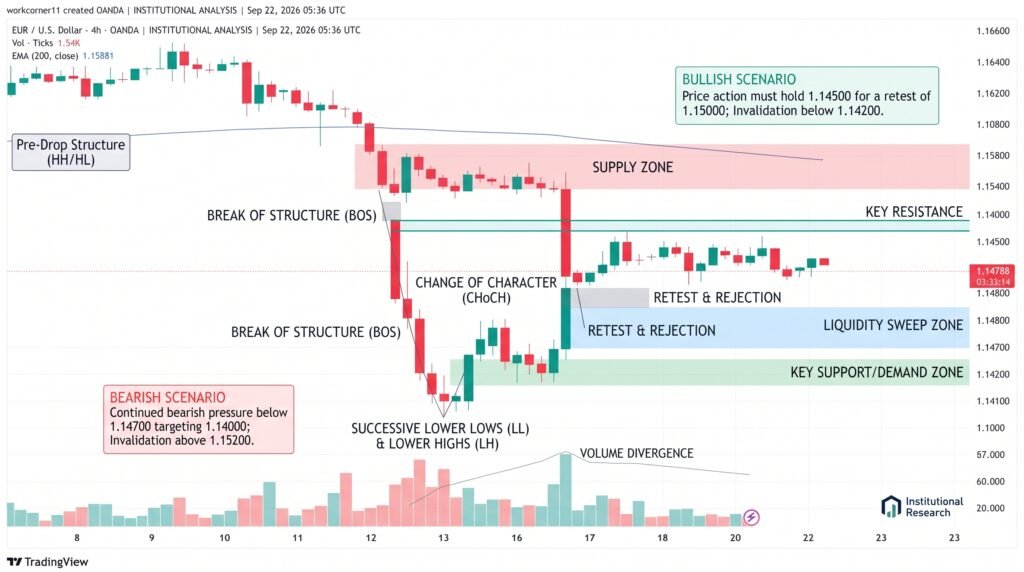
Immediate support is located around the lower Bollinger Band at 1.1445. A sustained break below that level could expose the July 14 low at 1.1378, followed by the July 28 low at 1.1353.
On the upside, 1.1545 is the first major resistance at the 100-day SMA. A daily close above that level could shift attention toward the Bollinger middle band near 1.1575, followed by the Sept. 9 high at 1.1654 and the upper Bollinger Band near 1.1700.
Conclusion
EUR/USD remains above 1.1450 but below the 100-day SMA at 1.1545, leaving the technical structure tilted lower in the near term. Fed commentary, U.S.-Iran diplomatic developments and German political uncertainty are likely to influence the pair’s next move. A break below 1.1445 would expose 1.1378 and 1.1353, while a sustained move above 1.1545 would bring 1.1575 and 1.1654 into focus. With RSI at 36, downside momentum remains evident but has not yet reached traditional oversold territory.
Sources & Methodology
Primary-source standard: Market-moving facts should link to original data releases, regulator notices, company filings or official project announcements whenever available. Secondary reporting is used for additional context, not as a substitute for original evidence.
Page last reviewed: