
The GBP/USD pair is trading near 1.3385 in early European trading Tuesday, recovering modestly after slipping below the 1.3400 psychological level. Sterling is gaining around 0.15% as the US Dollar eases ahead of high-level U.S.-Gulf discussions and broader geopolitical developments. The US Dollar Index is near 100.35. Meanwhile, traders are assessing the Federal Reserve’s latest rate decision and awaiting the next UK business-activity data.
Dollar and UK Data Set the Tone
The Dollar remains supported by the Federal Reserve after policymakers raised the federal funds target range by 25 basis points to 3.75%-4.00% on Sept. 16. The Fed said inflation remains elevated and that the latest move was intended to support a return toward its 2% inflation objective.
Higher U.S. interest rates can support the Dollar by maintaining a yield advantage over currencies whose central banks have less restrictive policies. For GBP/USD, this leaves Sterling sensitive to changes in expectations for future Fed and Bank of England policy.
Attention now turns to the UK’s September Purchasing Managers’ Index, due Wednesday. S&P Global’s September flash PMI data are part of a broader release schedule covering major economies, with the surveys providing an early indication of business activity and price pressures.
- GBP/USD price: around 1.3385
- Dollar Index: around 100.35
- Immediate resistance: 1.3467
- Recent low: 1.3336
Sterling Faces Policy and Energy Risks
Sterling has recently remained under pressure as investors reassess the outlook for UK interest rates. Reuters reported on Monday that the Pound was hovering near a seven-week low after the Federal Reserve’s rate increase strengthened the Dollar, while energy prices and central-bank policy remained key market drivers.
The Bank of England held its Bank Rate at 3.75% last week, while warning that persistent energy-price pressures could keep inflation elevated. The Monetary Policy Committee voted 6-3 to maintain the rate, with the split highlighting differing views over the inflation outlook.
Energy prices remain particularly relevant for the UK because higher imported energy costs can increase inflation and influence expectations for monetary policy. S&P Global has also warned that renewed energy-price pressures are raising inflation risks across major economies.
1.3467 Caps the GBP/USD Recovery
On the daily chart, GBP/USD retains a bearish near-term structure while trading below the 20-day Exponential Moving Average at 1.3467. The pair has also fallen below its previously rising support trend line, with the break area around 1.3495 now acting as an additional resistance zone.
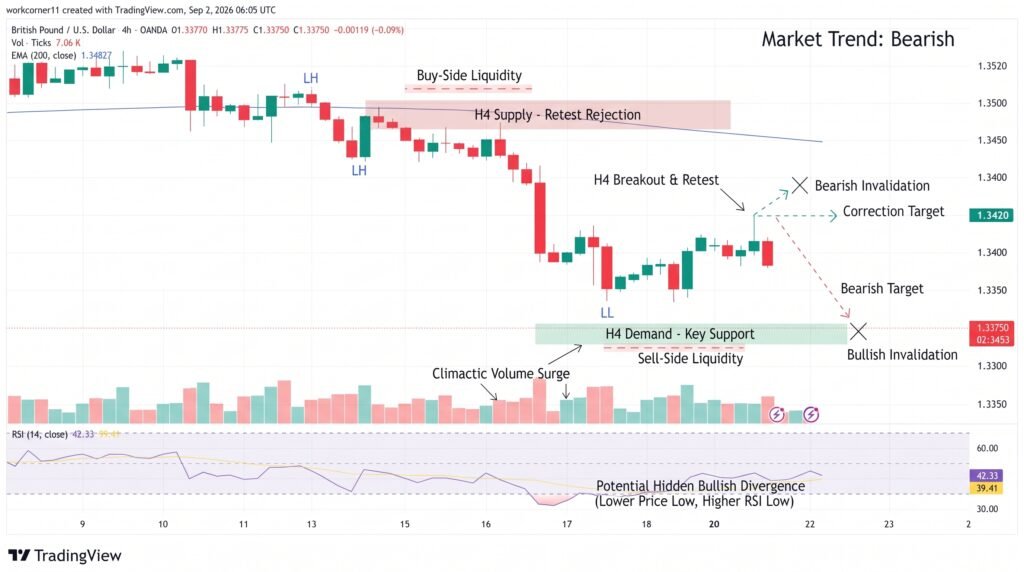
The 14-day Relative Strength Index stands at 37.7, remaining above the traditional oversold threshold of 30. The reading indicates that selling pressure remains present, although downside momentum has moderated from more extreme levels.
On the upside, 1.3467 is the first resistance to watch. A recovery above this level could bring 1.3495 into focus, where the broken trend line may test buyers.
On the downside, 1.3336 is the immediate structural floor. A sustained break below that level could expose the 1.3300 psychological support area.
Conclusion
GBP/USD remains below 1.3400 despite Tuesday’s modest recovery, leaving the broader short-term structure under pressure. The 20-day EMA at 1.3467 and broken trend-line level near 1.3495 define the main upside barriers, while 1.3336 and 1.3300 provide the key downside references. The Federal Reserve’s restrictive policy stance, Bank of England expectations, energy prices and Wednesday’s UK PMI data could all influence the next directional move. A sustained break of either technical boundary would provide clearer evidence of the pair’s next trend.
Sources & Methodology
Primary-source standard: Market-moving facts should link to original data releases, regulator notices, company filings or official project announcements whenever available. Secondary reporting is used for additional context, not as a substitute for original evidence.
Page last reviewed: