
EUR/USD is trading around 1.1355 during Wednesday’s European session, recovering modestly as the US Dollar loses some momentum following comments from New York Federal Reserve President John Williams. The euro is up about 0.13%, but the broader technical structure remains under pressure. Traders are now watching incoming US and European data for clues about the next moves from the Federal Reserve and European Central Bank. The immediate chart focus is between 1.1312 support and the 1.1464 20-day EMA, leaving the pair at an important technical decision point.
Fed Bets Shift After Williams Comments
The dollar’s recent advance has slowed after Williams argued that there was no urgency to raise interest rates again immediately following the September policy decision. He nevertheless left the possibility of another increase open if the economy performs as expected.
According to the CME FedWatch tool cited in the source material, the probability of an October Fed rate hike fell to 44.8% from 70.9% on Monday. That shift has reduced some of the upward pressure on the dollar and provided modest support for the euro.
MUFG analysts said Williams’ comments pushed back against market expectations for another hike as soon as October. The remarks do not eliminate the possibility of further tightening, however, leaving upcoming US inflation and labor-market data important for the dollar outlook.
For EUR/USD, the main macro drivers include:
- Fed policy: Affects US yields and dollar demand
- ECB policy: Determines the euro area’s interest-rate outlook
- US inflation: Shapes expectations for future Fed decisions
- German inflation: Provides an important signal for ECB policy
German Inflation Could Move Euro
Attention now turns to Germany’s preliminary September Harmonized Index of Consumer Prices (HICP), scheduled for release during the European session. The supplied forecast calls for annual inflation to accelerate to 3.1% from 2.9%, while monthly prices are expected to rise 0.5%, compared with 0.2% previously.
The German report matters because Germany is the euro area’s largest economy, making its inflation data an important input into expectations surrounding ECB monetary policy.
A stronger inflation reading could influence expectations for the ECB’s future policy path, while a softer result could reduce pressure for tighter policy. The market response will also depend on how German data interact with changing expectations for the Federal Reserve.
1.1312 Defines the Technical Risk
The technical picture remains bearish in the near term. EUR/USD trades below its 20-day exponential moving average at 1.1464, which currently acts as the main overhead barrier.
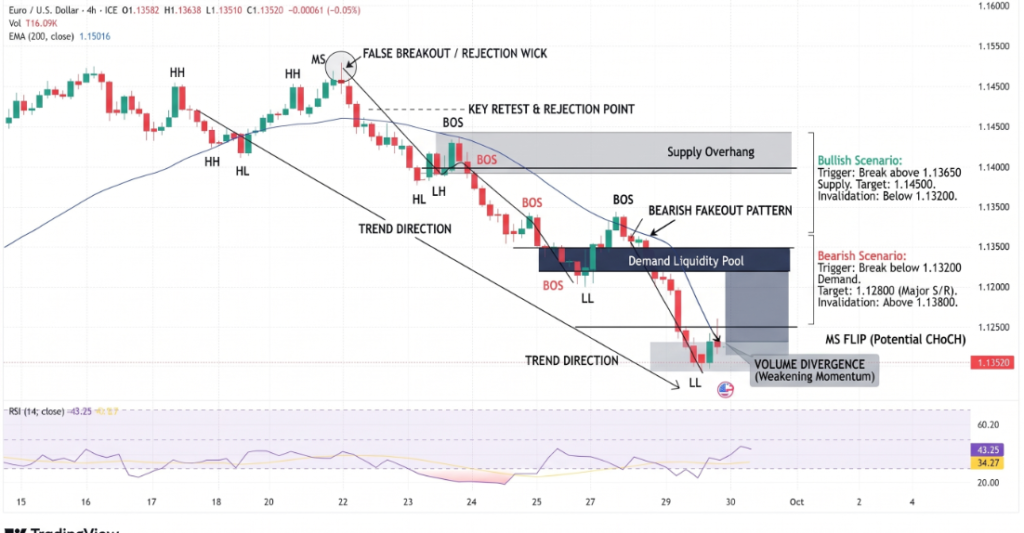
The Relative Strength Index (RSI) is around 27, placing the pair in technically oversold territory. That condition can limit immediate downside momentum, but it does not by itself establish a reversal while price remains below the moving average.
The key levels are:
- 1.1464: 20-day EMA and initial resistance
- 1.1355: Current price area
- 1.1312: September 29 low and key support
A daily close above 1.1464 would improve the short-term technical picture and could signal a corrective recovery. However, the broader downtrend would require stronger evidence before being considered reversed.
Conversely, a decisive break below 1.1312 would expose EUR/USD to another leg lower and confirm that sellers have regained control after the recent stabilization attempt.
Conclusion
EUR/USD is holding around 1.1355, but the pair remains below its 1.1464 20-day EMA, keeping the near-term structure under pressure. The 1.1312 September 29 low is the immediate downside level, while German inflation and shifting Federal Reserve rate expectations could determine whether the pair can stabilize. A break above 1.1464 would strengthen a corrective rebound, whereas a decisive move below 1.1312 would deepen the bearish technical setup.
Sources & Methodology
Primary-source standard: Market-moving facts should link to original data releases, regulator notices, company filings or official project announcements whenever available. Secondary reporting is used for additional context, not as a substitute for original evidence.
Page last reviewed: