Ripple (XRP) and Stellar (XLM) are extending their weekly declines as weaker derivatives positioning, elevated US Treasury yields and a firm US Dollar weigh on risk appetite. XRP trades near $1.422 after falling more than 6% this week, while XLM is around $0.199 after losing more than 9%. Both tokens are approaching important moving-average support, leaving traders focused on whether buyers can defend these levels or whether the correction will accelerate.
Derivatives Signal Growing Pressure
Positioning in the cryptocurrency derivatives market has weakened, adding to the cautious tone around XRP and XLM. CoinGlass data shows XRP’s long-to-short ratio at 0.96, meaning short positioning has moved ahead of longs. XLM’s ratio remains slightly more constructive at 1.09, but the margin is narrow.
Funding rates have also turned negative. XRP’s funding rate stood at -0.0022%, while XLM’s was -0.0060%. Negative funding means short-position holders are paying longs and can signal bearish positioning, although extremely negative funding can also indicate that short trades are becoming crowded.
The combination leaves both cryptocurrencies vulnerable if spot market demand fails to absorb further selling.
Fed and Yields Weigh on Altcoins
The macro backdrop remains unfavorable for speculative assets. The Federal Reserve’s September meeting minutes showed that officials unanimously supported a 25-basis-point rate increase, taking the federal funds rate target range to 3.75%-4%. Most participants also judged that another increase could be appropriate before year-end if inflation remains persistent.
US Treasury yields have moved sharply higher. The 10-year yield recently reached about 5.35%, its highest level in roughly 24 years, increasing the relative appeal of interest-bearing assets and tightening financial conditions for cryptocurrencies.
The US Dollar Index (DXY) has also remained firm, while renewed Middle East tensions are encouraging defensive positioning. Reports that the Pentagon instructed US Central Command to prepare for potential renewed operations against Iran add another layer of uncertainty for risk-sensitive assets.
- 10-year Treasury yield: around 5.35%
- Fed target range: 3.75%-4%
- XRP weekly decline: more than 6%
- XLM weekly decline: more than 9%
XRP and XLM Outlook: Key Levels
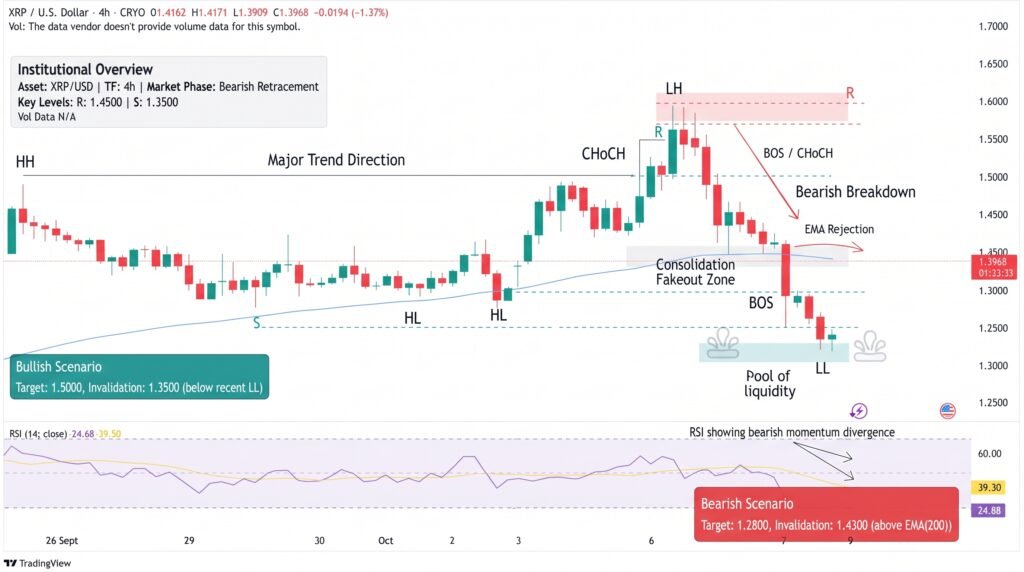
XRP is holding above its 50-day EMA near $1.400, with the 200-day EMA at $1.389 and the 100-day EMA at $1.336. However, an RSI near 45 and a negative MACD show that momentum remains weak. A break below $1.389 could expose $1.336 and then $1.300. Further losses could bring $1.000 into view. On the upside, resistance is near $1.671, followed by $1.900.
XLM is testing its 50-day EMA around $0.199, while the 200-day and 100-day EMAs sit near $0.194 and $0.191. A sustained break below this cluster could expose $0.187, followed by $0.177 and $0.142. Resistance stands near $0.234.
Conclusion
The XRP price forecast and XLM price forecast remain tilted toward caution as both tokens test important technical support. XRP needs to defend the $1.389-$1.400 area, while XLM must hold the $0.191-$0.199 zone to prevent a deeper correction. Stronger buying could shift sentiment toward $1.671 for XRP and $0.234 for XLM, but continued weakness in derivatives positioning, elevated Treasury yields and a firm dollar could keep pressure on both assets.
Sources & Methodology
Primary-source standard: Market-moving facts should link to original data releases, regulator notices, company filings or official project announcements whenever available. Secondary reporting is used for additional context, not as a substitute for original evidence.
Page last reviewed: