
EUR/USD recovered toward 1.1175 during Tuesday’s European session after falling to a 17-month low near 1.1150, but the rebound has not changed its broader bearish technical outlook. A hawkish Federal Reserve, elevated US Treasury yields and concerns about France’s fiscal position continue to weigh on the euro. Investors are now focused on September US inflation figures, due Wednesday, which could influence expectations for the Fed’s next policy decisions. Recent market pricing points to a possible December rate increase, keeping the dollar supported despite signs that the euro-dollar decline may be stretched.
Fed Policy Keeps Dollar in Focus
Cleveland Fed President Beth Hammack reinforced the case for restrictive monetary policy on Monday, warning that inflation could become entrenched if policymakers do not act decisively. She has argued that broad-based price pressures and strong demand may require tighter financial conditions. Her remarks strengthened the market’s focus on the risk of interest rates staying higher for longer.
According to the CME FedWatch Tool, traders assigned an 80.6% probability to unchanged rates at the next meeting and an 84.7% probability of a rate increase in December, based on the figures reported Tuesday. These expectations can shift quickly as fresh economic data arrives.
The upcoming US releases are therefore central to the near-term outlook:
- Wednesday: September Consumer Price Index (CPI) report.
- Thursday: Producer Price Index (PPI) and retail sales data.
A hotter-than-expected inflation reading could reinforce the dollar by strengthening expectations for restrictive Fed policy. Softer figures, however, could ease rate concerns and give EUR/USD room to recover.
French Budget Risks Weigh on Euro
The euro faces a separate challenge from France’s fiscal outlook. The government’s proposed €43 billion in savings is expected to face parliamentary debate, but uncertainty remains over whether lawmakers will agree on meaningful measures. A prolonged impasse could intensify concerns about public debt and political stability, undermining confidence in the single currency.
ING analysts have also highlighted bearish positioning in EUR/USD across speculative accounts and the foreign-exchange options market. Although crowded short positions can increase the risk of a sharp rebound, the bank’s outlook points to a potential decline toward the 1.1100–1.1120 region if the broader macroeconomic picture remains unfavorable for the euro.
EUR/USD Technical Levels to Watch
The daily chart retains a bearish structure, with the pair trading below its 100-day simple moving average (SMA) and the middle Bollinger Band. The 14-day Relative Strength Index (RSI) stands at 25.5, indicating oversold conditions. This suggests selling pressure remains strong, although a short-term recovery cannot be ruled out.
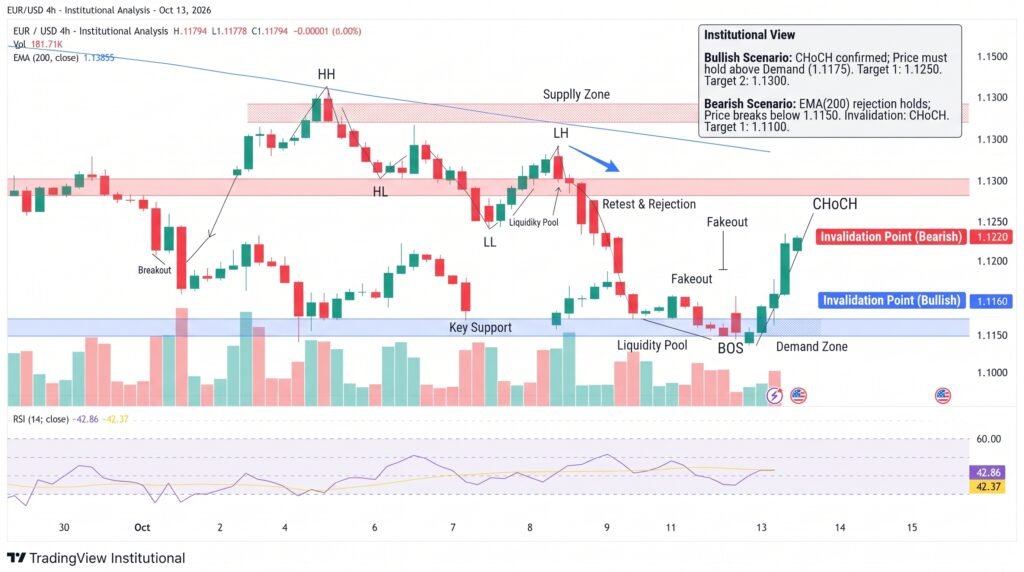
Key technical levels include:
- Support: 1.1105, followed by 1.1050 and 1.1000.
- Resistance: 1.1243, followed by 1.1325 and the 100-day SMA at 1.1485.
- Extended downside target: 1.0951 if selling accelerates below 1.1000.
Conclusion
EUR/USD remains vulnerable while it trades below key moving averages, with Fed hawkishness and French fiscal uncertainty limiting the euro’s recovery. The oversold RSI raises the possibility of a corrective bounce, but a sustained improvement would require stronger price action and supportive US inflation data. A break below 1.1105 could expose lower support, while a move above 1.1243 would provide an early sign that selling pressure is easing.
Sources & Methodology
Primary-source standard: Market-moving facts should link to original data releases, regulator notices, company filings or official project announcements whenever available. Secondary reporting is used for additional context, not as a substitute for original evidence.
Page last reviewed: