Zcash (ZEC) climbed above $1,300 on Thursday, extending its weekly advance to approximately 15% as institutional inflows and rising derivatives activity strengthened the recovery. The privacy-focused cryptocurrency attracted $15.18 million in reported ETF inflows on Wednesday, while futures open interest reached $2.89 billion, its highest level since late September. The combination points to renewed market participation, although rising leveraged positions can also amplify volatility. Technically, ZEC’s momentum favours further gains, with the September peak near $1,698 emerging as a potential target if buyers overcome resistance.
Zcash ETF Inflows Signal Renewed Demand
Institutional interest in Zcash appears to be recovering after a period of sustained withdrawals. Data attributed to SoSoValue showed that Grayscale’s Zcash-focused exchange-traded fund (ETF) recorded $15.18 million in inflows on Wednesday, compared with $1.61 million the previous day. The latest figure marked the fund’s largest daily inflow in approximately 30 days, following three consecutive weeks of net outflows.
The rebound comes nearly a month after Grayscale’s fund underwent a three-for-one share split on September 28. A stock split adjusts the number of shares and their individual prices without automatically changing the underlying value of an investor’s holdings. The recent inflow increase, rather than the split itself, provides the more direct signal of changing investor demand.
Activity in cryptocurrency derivatives markets has also strengthened. According to CoinGlass, ZEC futures open interest rose to approximately $2.89 billion, up from $2.25 billion on Monday. Open interest measures the notional value of outstanding futures contracts that have not been closed or settled.
The latest figures suggest that market participation is increasing across both investment products and derivatives. However, open interest alone cannot establish whether traders are predominantly bullish or bearish.
ZEC Technical Analysis Supports Recovery
ZEC traded around $1,309 at the time of the reported Thursday update, extending its recovery for a third consecutive day. On the four-hour chart, the cryptocurrency remained above its 50-period exponential moving average (EMA) at $1,210 and its 200-period EMA at $1,235. These indicators track average prices over different periods and help traders assess the prevailing trend.
Momentum indicators also supported the bullish outlook. The relative strength index (RSI) hovered near 64, indicating positive buying momentum without reaching the commonly used overbought threshold of 70. Meanwhile, the moving average convergence divergence (MACD) remained in positive territory.
Important levels to monitor include:
- $1,300: Immediate support and a key psychological price level.
- $1,235: The 200-period EMA, offering a secondary support reference.
- $1,210: The 50-period EMA, marking a deeper potential support zone.
- $1,698: The September 26 peak and a major upside resistance target.
Zcash Price Forecast: Is $1,698 Next?
The immediate outlook remains constructive while ZEC holds above $1,300 and its moving averages continue to support the recovery. A sustained move through resistance could bring the September high near $1,698 into focus. A confirmed breakout above that peak would strengthen the case for a new annual high, although it would not guarantee further gains.
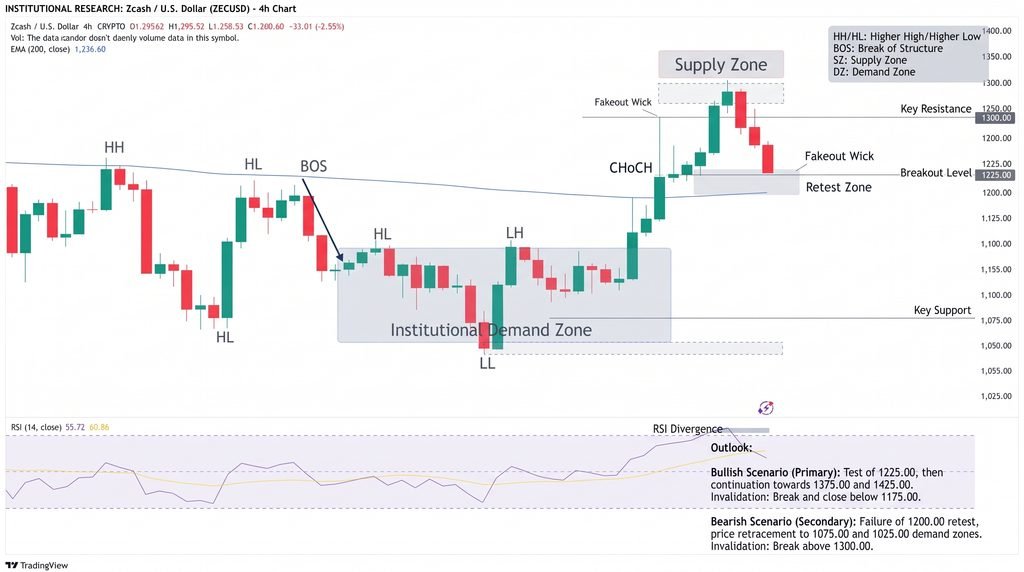
Conversely, a failure to hold $1,300 could prompt profit-taking and expose the moving-average support zone between $1,210 and $1,235. Falling below that area would weaken the current bullish structure.
Conclusion
Zcash’s 15% weekly gain, stronger ETF inflows and $2.89 billion in futures open interest point to renewed interest in the cryptocurrency. The next test is whether buyers can defend $1,300 and overcome resistance toward $1,698. Traders should also monitor leverage and market volatility before interpreting the recovery as the start of a sustained uptrend.
Sources & Methodology
Primary-source standard: Market-moving facts should link to original data releases, regulator notices, company filings or official project announcements whenever available. Secondary reporting is used for additional context, not as a substitute for original evidence.
Page last reviewed: