
EUR/GBP is attempting to recover near 0.8390 after falling to a 17-month low around 0.8370, as oversold technical conditions encourage a modest rebound. The euro has lost more than 2.7% from its late-September highs, while stronger UK inflation and economic growth have supported the pound. However, the recovery faces immediate resistance at 0.8400, and the broader trend remains bearish. Investors are watching comments from Bank of England Governor Andrew Bailey and European Central Bank policymaker Fabio Panetta for fresh clues about the outlook for interest rates.
Euro Rebounds as Pound Stays Firm
The euro’s latest recovery follows several weeks of selling against sterling. A slightly improved appetite for risk has helped the single currency stabilize, but persistent energy costs and concerns about France’s public finances continue to limit demand.
French fiscal uncertainty remains a particular challenge for the euro. Elevated government borrowing costs and political difficulties surrounding budget measures have raised questions about the country’s ability to bring its deficit under control. Higher oil prices add another complication by increasing energy costs and potentially prolonging inflationary pressures across Europe.
Sterling, meanwhile, has received support from stronger-than-expected UK inflation data and recent economic growth figures. These developments have reinforced expectations that the Bank of England could consider another rate increase at its November meeting. However, a rate hike is not guaranteed, and policymakers must weigh persistent inflation against the risk of slowing economic activity.
Bailey’s remarks could influence expectations for the next policy decision. In the euro area, comments from Panetta and the European Commission’s preliminary consumer-confidence report may offer further insight into economic conditions and household sentiment.
EUR/GBP Technical Levels to Watch
The technical outlook remains negative despite Thursday’s modest rebound. The four-hour Relative Strength Index (RSI) has recovered from deeply oversold territory but remains below 40, indicating that selling pressure continues. The Moving Average Convergence Divergence (MACD) indicator has turned marginally positive, suggesting short-term stabilization without confirming a broader trend reversal.
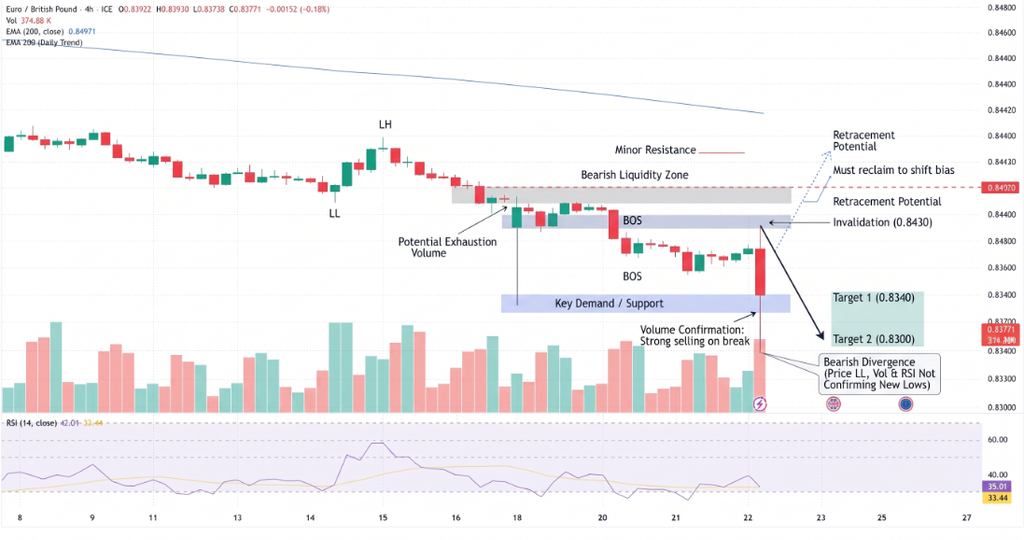
The key levels for traders are:
- 0.8400: Immediate resistance and the first hurdle for buyers.
- 0.8430: Resistance near the October 19–20 highs.
- 0.8373: Recent low and immediate downside support.
- 0.8355: May 2025 low and a potential downside target.
- 0.8320: April 2025 low and a deeper support reference.
A sustained move above 0.8400 could open the way toward 0.8430. However, failure to break resistance would leave the pair vulnerable to renewed selling. A clear decline below 0.8373 could expose 0.8355, followed by 0.8320.
Conclusion
EUR/GBP is showing signs of short-term stabilization, but the broader outlook remains tilted to the downside. Oversold conditions can trigger a rebound without ending a sustained decline, particularly when the pound retains support from inflation and interest-rate expectations. Traders should watch 0.8400 for evidence that buyers are regaining control and 0.8373 for signs of renewed weakness. A decisive break of either level could help determine the pair’s next move.
Sources & Methodology
Primary-source standard: Market-moving facts should link to original data releases, regulator notices, company filings or official project announcements whenever available. Secondary reporting is used for additional context, not as a substitute for original evidence.
Page last reviewed: