
Dogecoin (DOGE) remains under pressure near $0.080 despite renewed whale accumulation and the launch of Dogecoin Labs. Large holders have reportedly added 170 million DOGE since Tuesday, while the new organization aims to expand the cryptocurrency’s payment and application ecosystem. However, cautious derivatives positioning and weak technical indicators suggest that buying interest has yet to translate into a sustained recovery. Traders are watching $0.077 support, with resistance between $0.085 and $0.088 potentially limiting near-term gains.
Whales Accumulate as Labs Launches
Data from Santiment indicates that wallets holding between 1 million and 100 million DOGE accumulated approximately 170 million tokens since Tuesday. This buying may help absorb selling pressure, although wallet movements alone cannot confirm a lasting price reversal. Large holders can accumulate for different reasons, and their activity does not guarantee higher prices.
A separate development arrived on October 21, when Dogecoin Labs announced its formation in partnership with the Dogecoin Foundation. Led by CEO Jordan Jefferson, the organization will bring several products under one structure to expand DOGE’s practical uses.
Dogecoin Labs will operate MyDoge, DogeOS and Such App, combining a consumer wallet, application infrastructure and merchant payment tools. MyDoge reports more than 500,000 users, while Such App supports merchant invoicing and in-person QR payments. DogeOS opened its public testnet on September 30.
The initiative aims to connect developers, consumers and businesses, potentially increasing demand for DOGE through payments and applications. However, adoption remains a longer-term objective, and the launch itself does not establish that token demand will rise immediately.
Derivatives Signal Cautious Sentiment
Market positioning remains mixed. According to the supplied CoinGlass data, Dogecoin’s long-to-short ratio stands at 0.80. A reading below one indicates that short positions or bearish positioning outweigh long positions under the metric used.
Funding rates, meanwhile, have turned positive, reaching 0.0055%. In perpetual futures markets, positive funding generally means traders holding long positions pay those holding shorts. This can indicate some demand for bullish exposure, but it does not necessarily signal a price rebound.
Key factors shaping sentiment include:
- Whale accumulation: 170 million DOGE reportedly added since Tuesday.
- Long-to-short ratio: 0.80, reflecting bearish positioning.
- Funding rate: Positive at 0.0055%, suggesting some demand for leveraged longs.
- Market pressure: Reported spot and futures selling continues to cloud the outlook.
These conflicting signals suggest that traders remain divided over whether DOGE can establish a durable recovery.
DOGE Technical Levels and Outlook
DOGE trades below its major exponential moving averages (EMAs), keeping the short-term technical outlook bearish. The 100-day EMA near $0.085 and 50-day EMA around $0.086 form the first significant resistance zone. The broken ascending trendline near $0.088 adds another barrier, while the 200-day EMA near $0.092 represents a higher hurdle.
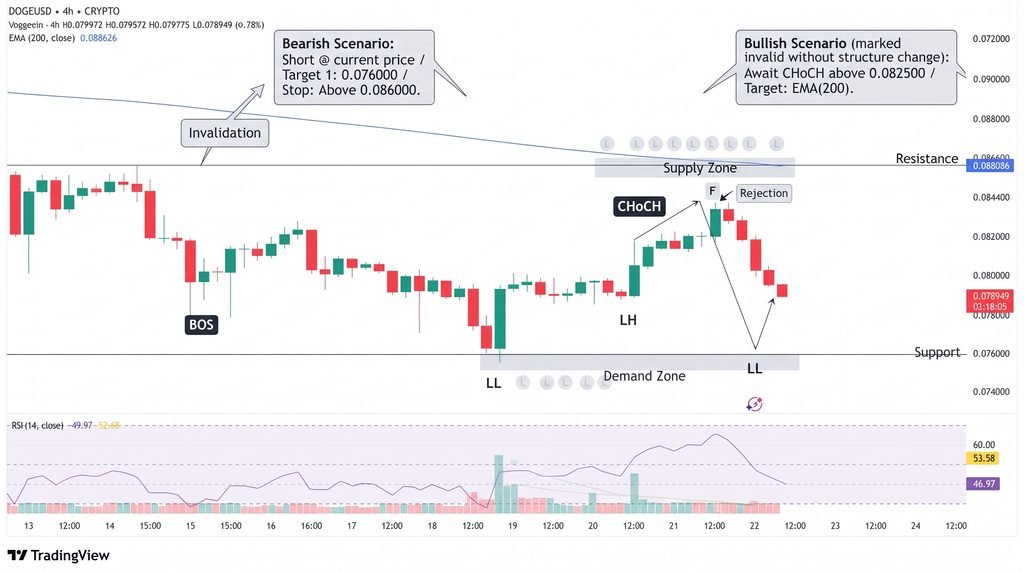
The Relative Strength Index (RSI) remains below 50, and the Moving Average Convergence Divergence (MACD) line sits below zero. Both readings suggest subdued momentum rather than a confirmed bullish reversal.
On the downside, $0.077 is the immediate support level. A decisive break below it could deepen losses. Conversely, a sustained move above $0.086 could improve recovery prospects, with $0.088 and $0.092 becoming subsequent resistance levels.
Conclusion
Dogecoin’s outlook remains cautious despite whale accumulation and the formation of Dogecoin Labs. The initiative could strengthen the ecosystem over time, but traders still need evidence of sustained demand and improving price momentum. Holding $0.077 would help DOGE stabilize, while reclaiming $0.085–$0.088 would provide an initial recovery signal. Until those resistance levels give way, the risk of renewed selling remains significant.
Sources & Methodology
Primary-source standard: Market-moving facts should link to original data releases, regulator notices, company filings or official project announcements whenever available. Secondary reporting is used for additional context, not as a substitute for original evidence.
Page last reviewed: