
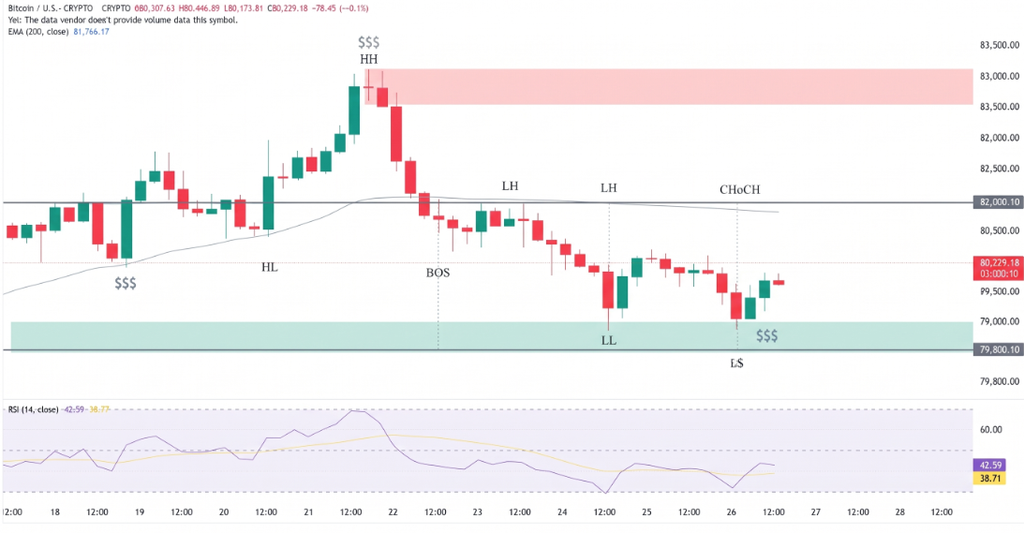
Bitcoin traded near $80,560 on Monday, October 26, after losing roughly $2,000 over the weekend as investors remained cautious about rising energy costs, falling technology stocks and a crowded calendar of central bank decisions. The world’s largest cryptocurrency rose 0.3% to $80,560.70 at 05:46 ET (09:46 GMT), but remained close to the lower boundary of its recent $80,000–$87,000 trading range. The modest recovery offered little evidence of a sustained improvement in risk appetite as traders awaited fresh signals on inflation and interest rates.
Oil Prices Keep Crypto Under Pressure
Oil prices retreated on Monday after reaching six-month highs, with diplomatic efforts involving Iran raising hopes of easing regional tensions. However, crude remained expensive. Brent futures traded around $114.82 a barrel and U.S. West Texas Intermediate near $101.19, according to Reuters, leaving investors concerned about renewed inflation pressure and the potential effect on economic growth. Reuters oil-market report
Higher energy prices can complicate the outlook for cryptocurrencies. If expensive oil keeps inflation elevated, central banks may have less room to cut interest rates. That could sustain higher borrowing costs and government bond yields, making speculative assets such as Bitcoin less attractive to some investors.
The decline in global technology shares has added another headwind. Crypto markets often respond to changes in broader risk appetite, even though Bitcoin does not always move in the same direction as equities. With few positive catalysts emerging, Bitcoin has struggled to recover from its weekend losses, while weakness has spread across other digital assets.
Fed, ECB and BoJ Set the Tone
Monetary policy decisions are likely to shape trading through the week. The Federal Reserve concludes its two-day meeting on October 28, followed by the European Central Bank on October 29 and the Bank of Japan on October 30. Markets broadly expect policymakers to keep rates unchanged, making their guidance on inflation and future policy especially important. Central-bank calendar
Investors will also assess U.S. third-quarter gross domestic product and September personal income and outlays data, including the Personal Consumption Expenditures price index. These releases could influence expectations for future Federal Reserve decisions.
Key developments to watch include:
- October 28: Federal Reserve rate decision and press conference.
- October 29: ECB decision and U.S. GDP and inflation data.
- October 30: Bank of Japan policy decision.
A more hawkish message—signaling that rates may remain elevated or rise later—could pressure Bitcoin further. A softer outlook could support a recovery, although market positioning and geopolitical developments would remain important.
Conclusion: Bitcoin Defends $80,000
Bitcoin’s immediate outlook remains fragile as it trades near the bottom of its month-long range. The $80,000 level is the first major area to watch: a sustained break below it could expose the market to deeper losses, while a recovery would need to regain momentum toward the $87,000 resistance zone to improve the near-term picture.
For now, oil prices, inflation risks and central-bank guidance are likely to drive sentiment. Traders should watch whether Bitcoin can hold support and how markets respond to this week’s policy decisions before treating Monday’s modest advance as a durable rebound.
Sources & Methodology
Primary-source standard: Market-moving facts should link to original data releases, regulator notices, company filings or official project announcements whenever available. Secondary reporting is used for additional context, not as a substitute for original evidence.
Page last reviewed: