
The Japanese yen weakened against most major currencies on Monday, allowing the US dollar to advance 0.17% to around 157.77. The move came despite several factors that would normally support Japan’s currency, including falling oil prices, a more hawkish Bank of Japan (BoJ) outlook and renewed warnings from Tokyo about excessive exchange-rate volatility. Investors are weighing the prospect of further Japanese interest-rate increases against uncertainty over their timing, while monitoring the risk of government intervention. Technically, USD/JPY remains in a broad sideways range, with 156.08 and 159.04 defining key boundaries.
Yen struggles despite supportive factors
Lower energy prices should generally benefit Japan because the country relies heavily on imported oil and other fuels. West Texas Intermediate (WTI) crude fell 2.6% to around $99.50 in the market snapshot provided, potentially reducing pressure on Japan’s import bill and supporting the yen.
However, the currency has struggled to translate that advantage into gains against the dollar. The exchange rate also reflects interest-rate expectations, capital flows and demand for the US currency.
The Bank of Japan kept its policy rate unchanged at 1.25% on October 30, but Governor Kazuo Ueda reinforced the central bank’s willingness to raise rates as economic and inflation conditions evolve.
The decision was not unanimous: one policy-board member dissented in favour of a higher rate. The BoJ also highlighted inflation risks and indicated that future policy adjustments would depend on incoming data. This more restrictive outlook could support the yen over time, although the absence of an immediate increase has limited its near-term impact.
Tokyo renews currency intervention warning
Japanese Finance Minister Satsuki Katayama said on Monday that the joint foreign-exchange statement with the United States remains in force. She reiterated that authorities would respond to disorderly market movements and excessive speculation.
The comments keep intervention risks in focus as the yen trades around 157.77 per dollar. However, a warning does not mean that authorities have already entered the market or announced a specific exchange-rate threshold.
The main factors shaping the currency outlook include:
- Oil prices: Cheaper crude can reduce Japan’s energy-import costs.
- BoJ policy: Further rate increases could narrow the interest-rate gap with the United States.
- Intervention risk: Official warnings may discourage aggressive yen selling.
- US dollar demand: Shifts in investor positioning and risk sentiment continue to influence the pair.
USD/JPY technical outlook: 156.08 support
On the daily chart, USD/JPY trades near 157.77, with its nine-day exponential moving average (EMA) around 157.72. The average has remained broadly flat for more than a month, reflecting the pair’s lack of a clear directional trend.
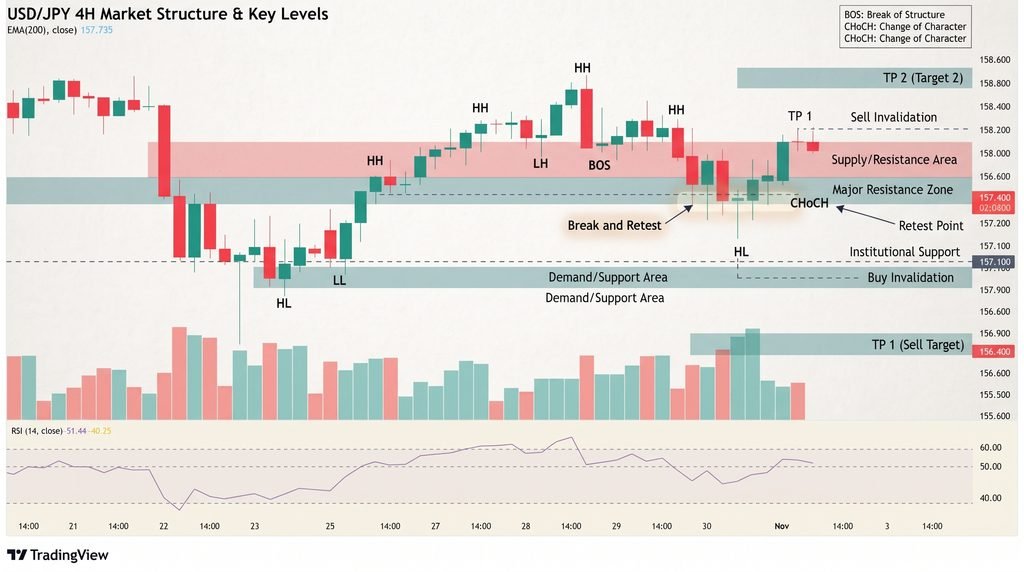
The Relative Strength Index (RSI) stands at 50.81, close to its neutral midpoint. This suggests balanced momentum rather than a strong bullish or bearish signal.
The key technical levels are:
- Support: October low at 156.08.
- Immediate reference: Nine-day EMA near 157.72.
- Major resistance: September 24 high at 159.04.
Conclusion:
USD/JPY remains supported by the dollar despite a combination of lower oil prices, a more hawkish BoJ outlook and renewed intervention warnings from Tokyo. A sustained move above 159.04 would strengthen the bullish case, while a break below 156.08 could signal a deeper correction. Until either boundary gives way, the pair’s sideways structure is likely to keep traders cautious.
Sources & Methodology
Primary-source standard: Market-moving facts should link to original data releases, regulator notices, company filings or official project announcements whenever available. Secondary reporting is used for additional context, not as a substitute for original evidence.
Page last reviewed: