
The New Zealand dollar recovered toward 0.5640 against the US dollar on Friday, October 30, after a sharp selloff following the Reserve Bank of New Zealand’s unexpected decision to keep interest rates unchanged. The Kiwi’s rebound remains limited, however, with NZD/USD trading below its 20-day exponential moving average (EMA) at 0.5658. The RBNZ’s continued tightening bias offers some support, while renewed demand for the US dollar and weak technical momentum restrict the pair’s upside.
RBNZ Pause Leaves Further Hikes Possible
The Reserve Bank of New Zealand held its Official Cash Rate (OCR) at 2.75% on October 28, against market expectations for an increase to 3.00%. The decision unsettled currency markets and triggered a sharp decline in the New Zealand dollar.
The vote was split 4–3, with three policymakers favouring an immediate 25-basis-point increase. All committee members agreed that further tightening could be required, depending on how inflation and economic conditions evolve. The decision therefore signalled a pause rather than a clear shift toward monetary easing.
Inflation remains a concern. New Zealand’s annual consumer price inflation eased to 3.7% in the September quarter from 4.1% in June, but remained above the RBNZ’s 1%-3% target range. The central bank expects inflation could rise to 4.4% in the December quarter, largely because of higher fuel costs.
Commerzbank analysts expect two additional rate increases, one in December and another in the first quarter of 2027. If that outlook materialises, the prospect of higher New Zealand interest rates could help limit further Kiwi losses.
US Dollar Demand Limits Kiwi Gains
The US dollar attracted buyers as investors assessed the outlook ahead of the November 3 midterm elections. The US Dollar Index (DXY), which measures the greenback against six major currencies, traded near 101.84 in the supplied market snapshot after recovering its earlier losses.
Commerzbank analysts have highlighted the possibility of divided government, with political control split between the White House and Congress. Such an outcome could slow legislative progress and increase uncertainty around economic policy.
However, executive powers could allow the administration to continue pursuing parts of its foreign and trade policy agenda. For currency markets, the election remains one of several factors influencing demand for the dollar.
NZD/USD Forecast: 0.5658 Resistance
On the daily chart, NZD/USD traded near 0.5637, below its 20-day EMA at 0.5658. The Relative Strength Index (RSI) stood at 43.4, below the neutral 50 mark, indicating that buying momentum remains limited.
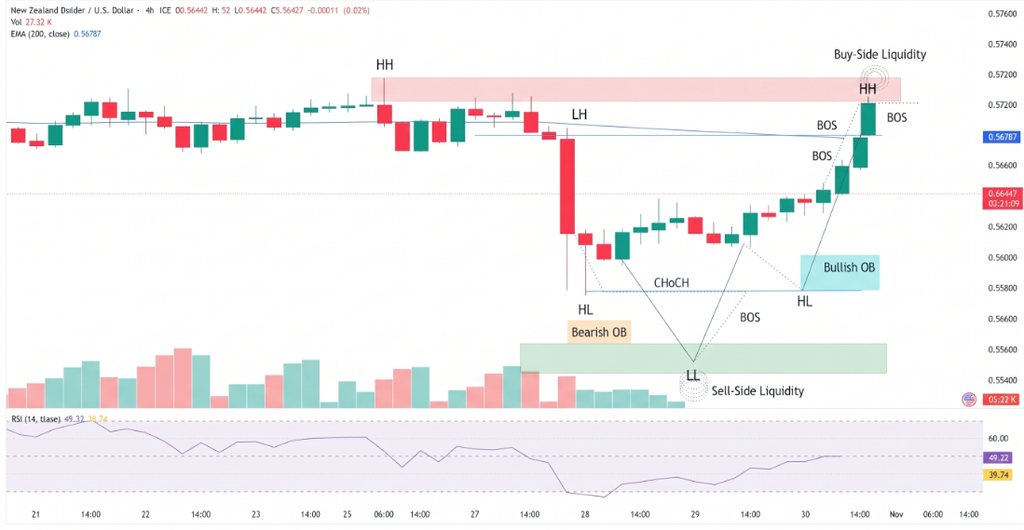
The main technical levels are:
- Immediate resistance: 0.5658, the 20-day EMA.
- Key support: 0.5584, the October 28 low.
- Bullish signal: A sustained move above 0.5658.
- Bearish signal: A break below 0.5584.
A recovery above 0.5658 could improve the short-term outlook, while failure to clear that level would leave the pair exposed to renewed selling.
Conclusion
NZD/USD is attempting to stabilize after the RBNZ-driven selloff, but its recovery remains technically constrained. The central bank’s tightening bias may provide medium-term support, although the pair needs to reclaim 0.5658 to strengthen its bullish prospects. Until then, the October 28 low at 0.5584 remains an important downside reference.
Sources & Methodology
Primary-source standard: Market-moving facts should link to original data releases, regulator notices, company filings or official project announcements whenever available. Secondary reporting is used for additional context, not as a substitute for original evidence.
Page last reviewed: