
The Australian dollar advanced about 0.3% to around $0.7010 against the US dollar on Wednesday, extending its recovery as investors assessed the Reserve Bank of Australia’s latest policy minutes and prepared for key US inflation data. The RBA’s September meeting minutes confirmed that policymakers remain willing to raise interest rates again if inflation proves persistent. However, the Australian currency’s next move may depend on Thursday’s domestic employment report and whether US inflation strengthens the case for tighter Federal Reserve policy.
RBA Minutes Support the Aussie
The Reserve Bank of Australia raised its cash rate by 25 basis points to 4.60% at its September meeting, and the minutes published on October 13 reinforced its willingness to tighten policy further if needed. Officials cited persistent inflation, stronger-than-expected activity and global cost pressures, including higher energy prices.
The policy outlook provides support for the Australian dollar because higher interest rates can make Australian assets more attractive to investors seeking yield. Yet the RBA also highlighted risks to that outlook. Faster rate increases by overseas central banks could put downward pressure on the Aussie, while falling housing prices could weigh more heavily on household spending than policymakers currently expect.
Thursday’s Australian employment report is the next major domestic catalyst. A Westpac preview forecast employment growth of 20,000 in September, following a gain of about 39,500 in August, while the unemployment rate was expected to remain at 4.6%.
A stronger jobs result could reinforce expectations for further RBA tightening and support AUD/USD. A weaker report could temper those expectations by raising concerns about employment and household demand.
US Inflation and Technical Levels
The US dollar is also under pressure ahead of September’s Consumer Price Index (CPI). Economists surveyed by Reuters expected headline inflation to rise to 3.6% annually from 3.4% in August, with a 0.6% monthly increase. Core inflation, which excludes food and energy, was forecast to reach 2.5% annually. These are estimates ahead of the release, not confirmed results.
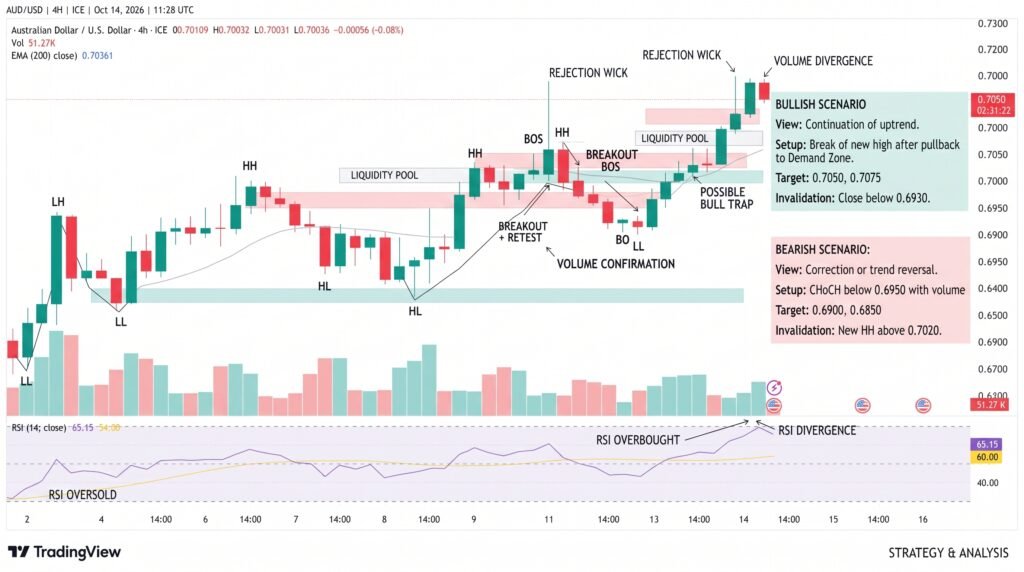
The technical picture shows AUD/USD trading near 0.7007, close to its 20-day Exponential Moving Average (EMA) at 0.7011. The pair remains below that short-term trend gauge, leaving the recovery vulnerable to renewed selling. The Relative Strength Index (RSI) has recovered toward 46, indicating that bearish momentum may be easing but has not yet turned decisively bullish.
Key levels from the supplied daily chart include:
- 0.7011: Immediate resistance at the 20-day EMA.
- 0.6987: October 13 low and initial support.
- 0.6904: October 1 low and a deeper support reference.
Conclusion:
AUD/USD is recovering, but a sustained move above 0.7011 is needed to strengthen the bullish case. A break below 0.6987 would expose the pair to further losses, with 0.6904 the next major support in the supplied analysis. The RBA’s rate outlook favors the Aussie, but employment figures and US inflation could quickly shift the balance. Until price clears resistance or breaks support, the recovery remains tentative.
Sources & Methodology
Primary-source standard: Market-moving facts should link to original data releases, regulator notices, company filings or official project announcements whenever available. Secondary reporting is used for additional context, not as a substitute for original evidence.
Page last reviewed: