The USD/CAD currency pair slipped for a second consecutive session, hovering near 1.4200 during Asian trading on Wednesday, October 14, after falling below its nine-day exponential moving average (EMA). Despite the pullback, the broader technical structure remains bullish, with the exchange rate holding above its 50-day EMA and within an ascending price channel. However, moderating momentum and a hawkish Federal Reserve outlook are shaping the near-term direction of the pair as traders assess inflation risks and the potential for further U.S. interest-rate increases.
USD/CAD Technical Outlook and Key Levels
The daily chart shows USD/CAD maintaining a broader upward bias, although the latest decline suggests buyers are losing some short-term control. The pair is trading below its nine-day EMA at 1.4221 but remains above the 50-day EMA at 1.4066. These averages help traders assess short-term price momentum and the broader trend.
The 14-day Relative Strength Index (RSI) stands at 58.5, indicating that bullish momentum remains positive but is no longer as strong as during the September rally. An RSI above 50 generally favors buyers, while readings above 70 are commonly associated with overbought conditions.
According to Scotiabank, the short-term technical outlook is bullish to neutral. Strategists have highlighted the RSI’s retreat from near 80 toward the mid-60s as evidence that upward momentum has moderated. Although this does not automatically signal a reversal, it suggests the pair may need a fresh catalyst to extend its advance.
The key levels traders are monitoring include:
- 1.4221: Nine-day EMA and immediate resistance.
- 1.4298: The 18-month high recorded on October 9.
- 1.4410: Approximate upper boundary of the ascending channel.
- 1.4500: Psychological resistance if bullish momentum strengthens.
- 1.4130: Lower channel boundary and initial downside reference.
- 1.4066: 50-day EMA and a broader trend support level.
A sustained break above 1.4298 could expose the 1.4410 region, while a move below 1.4130 would weaken the immediate bullish structure and bring the 50-day EMA into focus.
Fed’s Hawkish Outlook Supports the Dollar
Federal Reserve officials continue to emphasize the risk that inflation will remain above the central bank’s 2% target. Boston Fed President Susan Collins said on Tuesday that another interest-rate increase before the end of 2026 may be appropriate, depending on incoming economic data. She supported September’s rate increase and pointed to persistent inflation risks.
Higher U.S. interest rates can support the dollar by increasing the relative returns available on dollar-denominated assets. However, expectations are not guarantees, and incoming inflation or employment data could alter the Federal Reserve’s policy path.
Collins has also stressed that future decisions will depend on the overall economic outlook. Energy costs, investment in data-center infrastructure and resilient consumer demand remain among the factors influencing the inflation assessment.
For USD/CAD, the dollar’s direction is only part of the equation. Canadian economic data, oil prices and expectations for the Bank of Canada can also affect the pair. Because Canada is a major energy exporter, changes in crude prices can influence the Canadian dollar, although the relationship is not always consistent.
USD/CAD Forecast: What Comes Next?
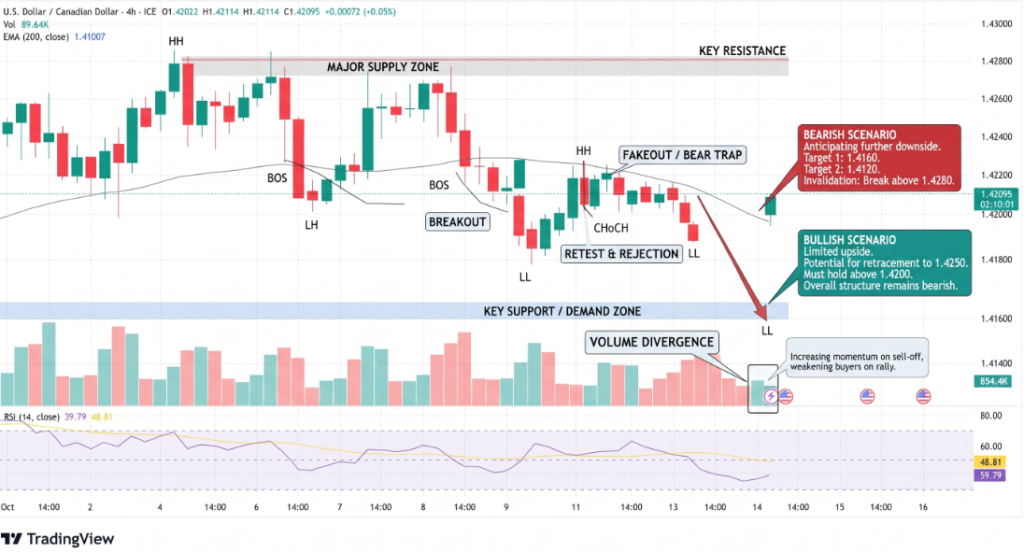
USD/CAD remains technically constructive while trading above its 50-day EMA, but the loss of the nine-day EMA shows that buyers face a near-term challenge. The next directional move will likely depend on whether the pair can regain 1.4221 or continues to retreat toward channel support.
Conclusion:
The USD/CAD forecast remains cautiously bullish, with 1.4298 serving as the major upside hurdle. A breakout could open the way toward 1.4410 and potentially 1.4500. Conversely, continued weakness below 1.4130 would put the 50-day EMA at 1.4066 in focus. A hawkish Fed may support the U.S. dollar, but moderating technical momentum and shifts in oil prices could limit further gains.
Sources & Methodology
Primary-source standard: Market-moving facts should link to original data releases, regulator notices, company filings or official project announcements whenever available. Secondary reporting is used for additional context, not as a substitute for original evidence.
Page last reviewed: