
AUD/USD came under pressure in Asian trading Monday, touching a one-and-a-half-week low around 0.7140 before recovering modestly. The pair remained near the mid-0.7100s, down about 0.25% on the day, as a stronger U.S. rate outlook supported the dollar while expectations for further Reserve Bank of Australia tightening limited losses.
The immediate pressure on the Australian dollar reflects a widening focus on central-bank policy. Markets are increasingly expecting the Federal Reserve to raise rates at its September 15–16 meeting after U.S. inflation data showed renewed monthly price pressure.
August U.S. producer prices added to that concern. The US PPI increased 0.4% in August and accelerated 5.4% from a year earlier, while energy prices rose 4.2%. The report helped push market expectations for a Fed hike higher.
The dollar is also benefiting from renewed geopolitical demand for safe-haven assets as the U.S.-Iran conflict disrupts energy markets and keeps the Strait of Hormuz at the center of supply concerns.
RBA Expectations Limit Aussie Losses
The Australian dollar has a domestic policy support that prevents the bearish move from becoming one-sided. The Reserve Bank of Australia has kept its cash rate at 4.35% after three increases earlier in 2026, while policymakers have warned that persistent inflation could require additional tightening.
Markets are increasingly positioning for another RBA increase at the September 29 meeting. ASX rate-tracker data puts the probability of a 25-basis-point hike at about 72%, which would lift the cash rate to 4.60%.
RBA Deputy Governor Andrew Hauser has also stressed that inflation remains a major concern and that rates could rise further if price pressures do not moderate. That hawkish domestic backdrop gives the Australian dollar some protection against broad U.S. dollar strength.
Australia’s economy has also shown resilience. GDP expanded 2.1% over the year to June, providing the RBA with more room to focus on inflation rather than relying solely on weaker growth to justify easier policy.
Key policy drivers include:
- Fed: markets price about an 86% chance of a hike.
- RBA: markets price about a 72% chance of a September hike.
- RBA cash rate: 4.35% before the next decision.
0.7095 Becomes Key Downside Level
The technical structure remains bearish after AUD/USD broke below the 100-period Simple Moving Average on the four-hour chart. The pair subsequently moved below the 23.6% Fibonacci retracement near 0.7150, but selling momentum has weakened around 0.7140.
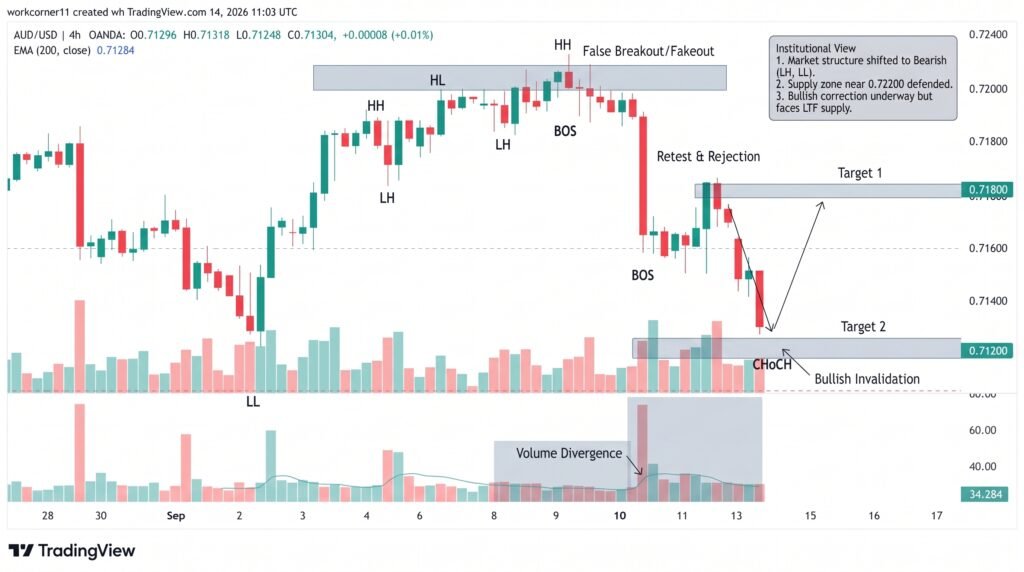
The Relative Strength Index is close to 30, placing momentum near oversold territory. That does not guarantee a rebound, but it warns that another immediate leg lower could require fresh selling pressure. Meanwhile, the MACD remains below zero, confirming that downside momentum is still dominant.
If sellers secure acceptance below the 0.7150 retracement zone, the next technical targets are the 38.2% Fibonacci level at 0.7095 and the 50% retracement at 0.7051.
On the upside, the 100-period SMA at 0.7179 is the first major barrier. A sustained break above that level would improve the short-term structure and bring the recent cycle high near 0.7239 back into focus.
Conclusion
AUD/USD remains vulnerable while higher U.S. inflation and geopolitical risk strengthen the dollar. The pair’s ability to hold around 0.7140 is important because a sustained break below 0.7150 would expose 0.7095 and then 0.7051. However, expectations for another RBA rate increase provide a fundamental counterweight. The near-term direction will depend on whether stronger Fed tightening expectations outweigh Australia’s increasingly hawkish policy outlook.
Sources & Methodology
Primary-source standard: Market-moving facts should link to original data releases, regulator notices, company filings or official project announcements whenever available. Secondary reporting is used for additional context, not as a substitute for original evidence.
Page last reviewed: