
NZD/USD fell to around 0.5780 in early European trading Monday, reaching its lowest level since July 29 as renewed U.S. dollar strength and a softer New Zealand rate outlook pressured the pair. The technical picture also remains negative after NZD/USD broke below the 0.5855–0.5850 area, where the 200-day EMA and 50% Fibonacci retracement had previously provided support.
The decline comes as markets prepare for a potentially hawkish Federal Reserve decision. Reuters reports that 85% of economists now expect a 25-basis-point Fed increase at the September 15–16 meeting, while market pricing has moved close to 90%.
Fed Outlook Weighs on NZD
The U.S. dollar has strengthened as investors reassess the Federal Reserve’s policy path after firmer inflation data and a renewed surge in energy prices. August U.S. CPI increased 0.4% month over month and 3.4% from a year earlier, while core CPI rose 0.3% monthly, reinforcing concerns that inflation could remain above the Fed’s 2% target.
The rate differential is increasingly important for NZD/USD because higher U.S. yields can make dollar-denominated assets more attractive relative to the New Zealand dollar.
The U.S. 10-year Treasury yield has also approached the 5% threshold, adding another source of support for the greenback. Reuters reported a high near 4.99% on Monday as higher oil prices and inflation concerns pushed borrowing costs upward.
At the same time, geopolitical tensions are supporting demand for the dollar as a defensive asset. Oil prices have climbed sharply as disruption risks around the Middle East threaten global energy supply. Brent was near $107.81, while U.S. crude traded around $102.94 on Monday.
RBNZ Policy Limits Kiwi Support
New Zealand’s monetary-policy backdrop is less supportive for the Kiwi. The Reserve Bank of New Zealand (RBNZ) raised its Official Cash Rate by 25 basis points to 2.75% on September 2, while the country’s latest inflation rate stands at 4.1% year over year.
With the RBNZ already operating at a relatively modest policy rate and no immediate policy decision scheduled after its September move, the New Zealand dollar lacks the same rate-driven support that could counter the U.S. dollar’s strength.
That leaves NZD/USD particularly sensitive to shifts in Fed expectations, Treasury yields and broader risk sentiment.
NZD/USD Technical Levels
The technical structure favors sellers after the pair lost the 0.5855–0.5850 confluence. That area combined the 200-day Exponential Moving Average (EMA) with the 50% Fibonacci retracement of the June-August advance, making its breakdown an important bearish signal.
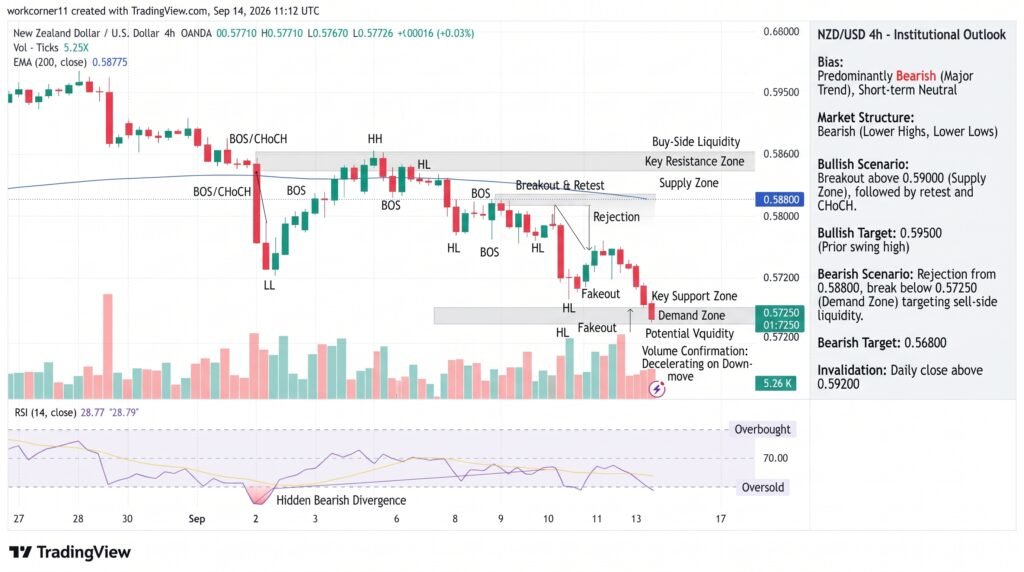
NZD/USD Price Chart – Source: Tradingview
The MACD remains negative, while the 14-day RSI is around 35. RSI is approaching oversold territory, but it has not yet produced a clear reversal signal. The combination suggests downside momentum remains intact but is becoming more stretched.
The main levels are:
- Immediate support: 0.5764
- Next support: 0.5704
- Immediate resistance: 0.5807
- Major resistance: 0.5849–0.5850
A sustained break below 0.5764, the 61.8% Fibonacci retracement, would expose 0.5704, the 78.6% retracement level. A recovery above 0.5807 would offer initial relief, but the bearish structure would remain intact unless NZD/USD reclaims the 0.5849–0.5850 resistance zone.
Conclusion
NZD/USD remains under pressure as stronger Fed tightening expectations, elevated U.S. Treasury yields and geopolitical risk favor the dollar. The pair’s break below 0.5850 has reinforced the bearish technical structure, while MACD and RSI still point to selling pressure despite increasingly stretched conditions. 0.5764 is now the critical downside test, followed by 0.5704. Unless buyers reclaim 0.5849–0.5850, rallies are likely to remain corrective within the prevailing bearish trend.
Sources & Methodology
Primary-source standard: Market-moving facts should link to original data releases, regulator notices, company filings or official project announcements whenever available. Secondary reporting is used for additional context, not as a substitute for original evidence.
Page last reviewed: