
The Australian dollar weakened on Thursday, falling 0.4% against the U.S. dollar toward the psychologically important 0.7000 level as surging oil prices and escalating Middle East tensions pressured risk-sensitive currencies. West Texas Intermediate (WTI) crude approached $99 a barrel, while the U.S. Dollar Index (DXY) recovered toward 101.66. The combination of geopolitical uncertainty and renewed dollar demand has complicated the Australian dollar’s recovery. Traders are now watching upcoming private-sector activity data and key technical levels to determine whether AUD/USD can stabilize or extend its decline.
Oil Surge and Dollar Recovery Pressure AUD
The Australian dollar underperformed most major currencies on Thursday, with the New Zealand dollar also facing pressure. Rising energy prices have unsettled financial markets by increasing concerns about inflation, global growth and the outlook for interest rates.
The latest escalation followed a drone incident at Saudi Arabia’s Shaybah oil field, where two people were killed by falling debris after air defenses intercepted a drone targeting the facility. Saudi authorities said the incident did not disrupt oilfield operations. Nevertheless, the attack added to concerns about regional energy security. Reuters coverage also reported heightened security concerns surrounding Saudi Aramco’s headquarters.
WTI crude rose above $99 a barrel on Thursday, while Brent crude climbed above $111, according to market reporting. Oil price developments are important for currency traders because sustained energy inflation can influence central-bank decisions and reduce investors’ willingness to hold risk-sensitive assets. Source: Anadolu Agency.
Meanwhile, the U.S. Dollar Index, which measures the dollar against six major currencies, recovered toward 101.66 after touching approximately 101.45. A stronger dollar generally creates additional headwinds for AUD/USD, particularly when global sentiment deteriorates.
AUD/USD Technical Analysis: 0.7000 Pivot
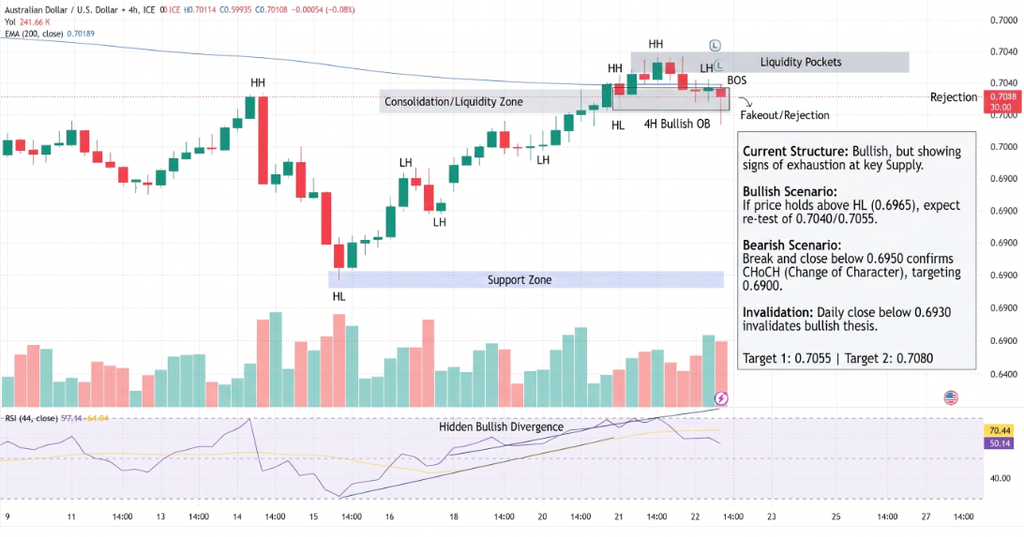
The daily chart places AUD/USD near 0.6996, almost exactly matching its 20-day Exponential Moving Average (EMA). This level has become a key short-term pivot, with neither buyers nor sellers establishing clear control.
The Relative Strength Index (RSI) stands at 48, below the neutral 50 threshold. This suggests subdued bullish momentum rather than a decisive bearish signal. The supplied analysis also identifies a completed double-bottom formation, although the sustainability of its bullish implications depends on further price confirmation.
Important levels include:
- 0.6996–0.7000: Immediate pivot and psychological resistance.
- 0.7036: Upside target if buyers regain control.
- 0.6894: October 15 low and key downside support.
A sustained daily close above 0.7000 would improve the recovery outlook, with 0.7036 becoming the next potential target. Conversely, a break below 0.6894 could signal renewed selling pressure.
Australian PMI Data and Market Outlook
The next scheduled catalyst is the October flash private-sector Purchasing Managers’ Index (PMI), due Friday. The survey measures business activity across manufacturing and services, offering an early indication of economic momentum.
Stronger-than-expected Australian data could support the Aussie by improving growth expectations. Weak readings, combined with persistent oil-price pressure and a firmer U.S. dollar, could leave the currency vulnerable.
Conclusion
AUD/USD remains under pressure near 0.7000 as rising oil prices and Middle East tensions weigh on risk appetite. The 20-day EMA and RSI readings indicate limited directional conviction, leaving the pair vulnerable to further volatility. A sustained recovery above 0.7000 could open the way toward 0.7036, while a decisive break below 0.6894 would strengthen the bearish outlook. Friday’s Australian PMI data may help determine the next move.
Sources & Methodology
Primary-source standard: Market-moving facts should link to original data releases, regulator notices, company filings or official project announcements whenever available. Secondary reporting is used for additional context, not as a substitute for original evidence.
Page last reviewed: