
Birkenstock (BIRK) shares drop in pre-market as On Holding (ONON) reports Q2 net sales of CHF 850.3M (miss vs. ~CHF 878–881M estimates) and 2026 guidance of CHF 3.47–3.56B, weighing on footwear peers.
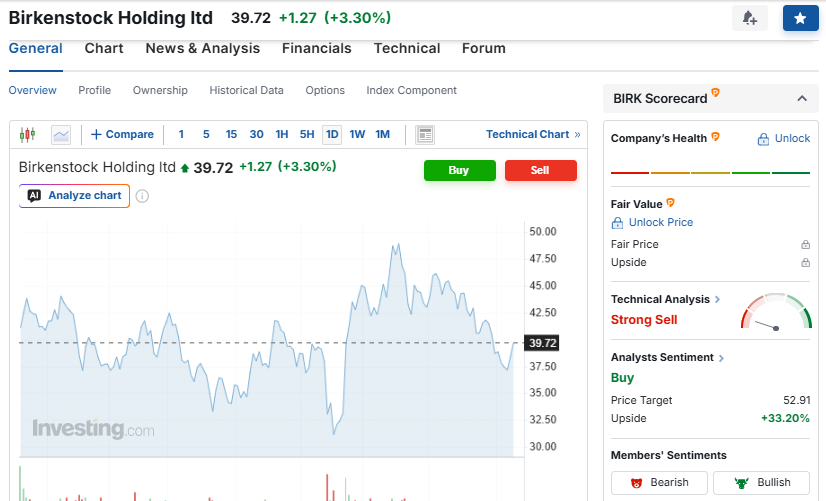
Birkenstock Holding plc (NYSE: BIRK) shares declined approximately 4% in pre-market trading on Tuesday, August 11, 2026, as reported amid weakness in peer On Holding AG (NYSE: ONON). On Holding posted second-quarter net sales of CHF 850.3 million, up 13.5% year-over-year (21.6% constant currency), but missed analyst estimates of around CHF 878–881 million. The Swiss sportswear company guided 2026 net sales to CHF 3.47–3.56 billion at current spot rates (low-20% constant-currency growth), with the midpoint below prior consensus near CHF 3.56–3.63 billion.
On Holding Q2 Sales Miss Estimates; Shares Fall 14-16%
On Holding reported Q2 (ended June 30, 2026) net sales of CHF 850.3 million versus CHF 749.2 million a year earlier. Direct-to-consumer (DTC) sales rose 26.0% (34.3% constant currency) to CHF 388.4 million and reached a second-quarter high of 45.7% of total sales. Wholesale grew a more modest 4.8% (12.7% constant currency) to CHF 461.9 million.
By region, Americas sales increased 4.5% (13.0% constant currency) to CHF 451.6 million; EMEA rose 15.4% (20.5% constant currency) to CHF 228.2 million; and Asia-Pacific jumped 43.1% (54.7% constant currency) to CHF 170.5 million, contributing more than 20% of global sales. Footwear sales grew 10.9% (18.9% constant currency) to CHF 781.6 million, apparel surged 47.7% (56.2% constant currency) to CHF 54.2 million, and accessories rose 88.3%.
Gross profit margin expanded 3.9 percentage points to 65.4%, and adjusted EBITDA margin improved to 19.8% (from 18.2%), delivering adjusted EBITDA of CHF 168.1 million. Net income swung to CHF 105.0 million (12.3% margin) from a year-earlier loss. Cash and cash equivalents reached CHF 1,205.6 million. On raised full-year gross margin guidance to at least 65.0% (from prior 64.5%) and reiterated adjusted EBITDA margin of 19.5–20.0%, while emphasizing disciplined full-price selling and managed wholesale sell-in ahead of 2027 innovations.
On Holding shares fell about 14–16% in pre-market trading following the release.
Softer Demand and Tariff Pressures Weigh on Premium Footwear Shares
Investors viewed the sales miss and guidance midpoint as signaling softer demand, particularly in the core Americas market where constant-currency growth slowed to 13% from 17% in the prior quarter. Management’s deliberate restraint on promotional activity in a competitive U.S. environment, combined with tariff absorption (without assuming refunds), raised concerns about broader premium footwear growth rates. Birkenstock, as a peer in the footwear sector with its own recent margin pressures from tariffs and FX, saw sympathetic selling as the market reassessed the sector outlook.
Birkenstock Posts €618M Q2 Revenue (+14% CC); Shares Trade Near $38–$40
Both companies operate in the premium footwear space and have faced shared headwinds including U.S. import tariffs, currency fluctuations, and selective consumer spending. Birkenstock (fiscal year ends September) reported fiscal Q2 2026 (ended March 31) revenue of €618 million, up 8% reported and 14% constant currency, with double-digit constant-currency growth across Americas (14%), EMEA (11%), and APAC (30%). Adjusted EBITDA was €198 million (32.1% margin, down 270 bps), pressured by FX (~240 bps) and tariffs (~90 bps); the company reaffirmed 13–15% constant-currency revenue growth and at least €700 million adjusted EBITDA for fiscal 2026.
Birkenstock shares have traded in a roughly $31–$54 52-week range, with recent closes near $38–$40 and market capitalization around $7 billion. On Holding has similarly navigated premium positioning, strong DTC and APAC momentum, and tariff impacts while prioritizing brand integrity over volume.
Birkenstock Q3 Results Due August 13 as Sector Eyes Tariff and Demand Trends
Birkenstock is scheduled to report fiscal Q3 2026 results on August 13, 2026. On Holding will focus on second-half DTC outperformance, controlled wholesale, and new product launches. Investors will monitor tariff developments, consumer spending trends, and whether margin resilience offsets any further growth moderation across the premium footwear group.
Sources & Methodology
Primary-source standard: Market-moving facts should link to original data releases, regulator notices, company filings or official project announcements whenever available. Secondary reporting is used for additional context, not as a substitute for original evidence.
Page last reviewed: