
Bitcoin fell below $84,000 on Wednesday as higher oil prices, rising U.S. Treasury yields and a stronger dollar reduced demand for risk-sensitive assets. Bitcoin dropped 2.3% to $83,970.60 by 05:19 ET (09:19 GMT), extending a period of consolidation after its strong third-quarter advance. The weakness spread across major altcoins, while U.S. equities remained comparatively resilient as investors continued favoring large artificial-intelligence stocks. The latest move leaves Bitcoin exposed to further volatility as markets assess inflation risks, monetary policy and the Federal Reserve’s next decision.
Bitcoin Faces Oil and Yield Pressure
The latest decline reflects a broader shift in macroeconomic conditions. Crude oil prices climbed sharply as Middle East tensions raised concerns about additional supply disruptions, while adverse weather in the Gulf of Mexico threatened U.S. production.
Higher energy prices can increase inflation pressures by raising transportation and production costs. That creates a difficult backdrop for Bitcoin, which is often treated as a high-risk asset when investors are concerned about tighter financial conditions.
U.S. Treasury yields have also moved higher. The 10-year Treasury yield recently climbed to around 5.3%, reinforcing concerns that elevated borrowing costs could persist. Rising yields increase the relative appeal of traditional fixed-income assets and can reduce investors’ willingness to hold speculative positions such as cryptocurrencies.
The key macroeconomic signals are:
- $83,970.60: Bitcoin price in early Wednesday trading.
- 2.3%: Bitcoin’s daily decline at the reported level.
- Around 5.3%: Recent 10-year U.S. Treasury yield.
OKX Draws $25B Institutional Backing
Despite the market weakness, institutional activity in the digital-asset industry remains active. OKX announced a strategic investment from Circle, Qube Research & Technologies, Ripple and Standard Chartered’s SC Ventures at a $25 billion pre-money valuation. OKX did not disclose the amount raised.
The transaction extends a strategic investment round led in March by Intercontinental Exchange, the parent company of the New York Stock Exchange. OKX said the new backing strengthens its relationships with major players across stablecoins, liquidity, custody and financial infrastructure.
The funding is notable because it shows continued institutional interest in crypto infrastructure even as token prices face pressure from unfavorable macroeconomic conditions.
Robinhood Adds $25M Bitcoin Position
Robinhood is also increasing its direct exposure to the asset. The company has added $25 million of Bitcoin to its corporate balance sheet, according to Johann Kerbrat, Robinhood’s senior vice president and general manager of crypto and international. Kerbrat said the purchase was intended to demonstrate the company’s commitment to the crypto ecosystem.
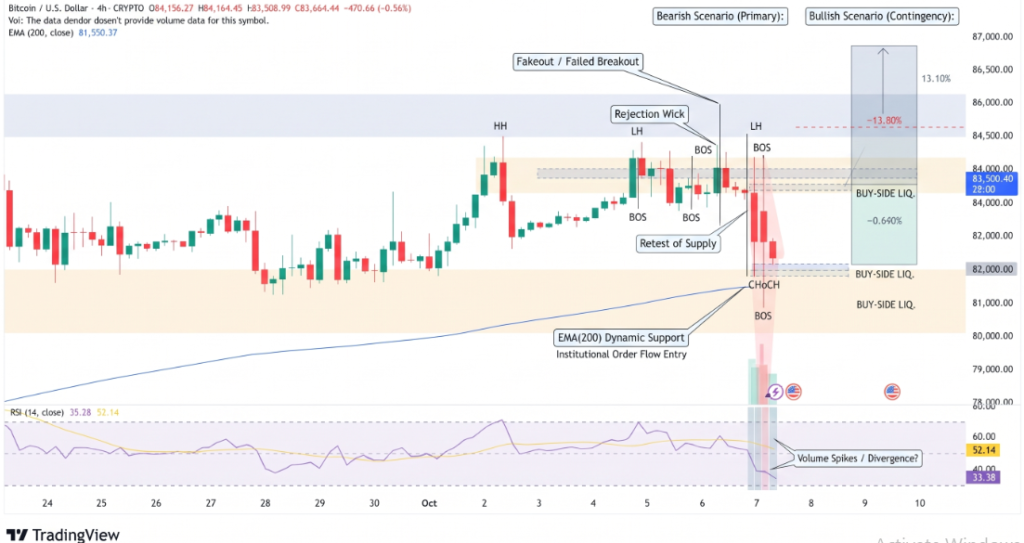
Meanwhile, weakness has spread across the broader market. Ethereum declined 3.8% to $2,607.66, XRP fell 3%, and Cardano lost about 8%. Solana and BNB also declined, while Dogecoin dropped 5.3%.
Conclusion
Bitcoin’s break below $84,000 highlights how quickly macroeconomic pressures can overwhelm crypto-specific optimism. Higher oil prices and Treasury yields remain the main near-term risks because they can reinforce inflation concerns and limit expectations for easier monetary policy. Still, OKX’s $25 billion valuation and Robinhood’s $25 million Bitcoin purchase show that institutional interest has not disappeared. Bitcoin’s next direction will likely depend on whether yields and energy prices stabilize or continue climbing.
Sources & Methodology
Primary-source standard: Market-moving facts should link to original data releases, regulator notices, company filings or official project announcements whenever available. Secondary reporting is used for additional context, not as a substitute for original evidence.
Page last reviewed: