
Bitcoin is consolidating near $77,629 as traders remain caught between support around $76,300 and resistance near $81,300. The five-hour chart shows a classic rectangle, with buyers repeatedly defending the lower boundary while sellers continue to cap rallies. The setup leaves Bitcoin vulnerable to sharp movement once price decisively escapes the range.
The broader market is also entering a crucial macroeconomic week. Bitcoin was around $77,590 Monday, up roughly 0.3%, but remained well below the $82,163 three-month high recorded on September 4.
Bitcoin Tests Range Boundaries
The five-hour chart shows BTC trading inside the $76,000-$82,000 broader consolidation zone. At $77,629, Bitcoin remains above its 200-period SMA at $72,658, which keeps the longer-term technical structure relatively constructive.
Shorter-term indicators are less decisive. Bitcoin remains below its 50-period SMA at $78,498 and the SuperTrend resistance at $78,580, leaving sellers with control of the immediate trend.
Price is also moving through the Ichimoku Cloud, a zone that often signals limited directional conviction. The MACD has turned positive, but declining volume suggests the latest improvement in momentum lacks strong confirmation.
A doji around $77,586 adds to the uncertainty. The small-bodied candle indicates that buyers and sellers were broadly balanced during the period.
The main technical levels remain:
- Support: $76,300
- Cloud resistance: $79,237.50
- Major range resistance: $81,300
Fed Outlook Raises Bitcoin Risk
Bitcoin’s consolidation comes as monetary policy has become a major source of uncertainty. U.S. August CPI increased 0.4% month over month and 3.4% year over year, while core CPI advanced 0.3% monthly. The data, combined with rising oil prices, has pushed investors toward expecting renewed Federal Reserve tightening.
Reuters reported Monday that markets were pricing roughly a 90% probability of a 25-basis-point Fed hike at the September 15–16 meeting. A Reuters poll separately found that 85% of economists expected the same move.
That backdrop can weigh on Bitcoin because higher interest-rate expectations generally lift Treasury yields and the dollar, reducing demand for risk-sensitive assets.
The macro pressure is being reinforced by energy markets. Brent crude climbed to roughly $108 a barrel, while U.S. crude approached $103, as Middle East shipping and supply disruptions intensified inflation concerns.
BTC Breakout Levels Matter Most
The technical range offers a clear framework for the next move. A sustained five-hour close above $79,237.50, corresponding to the top of the Ichimoku Cloud in the supplied setup, would be the first indication that buyers are regaining control. Strong volume would make the signal more credible.
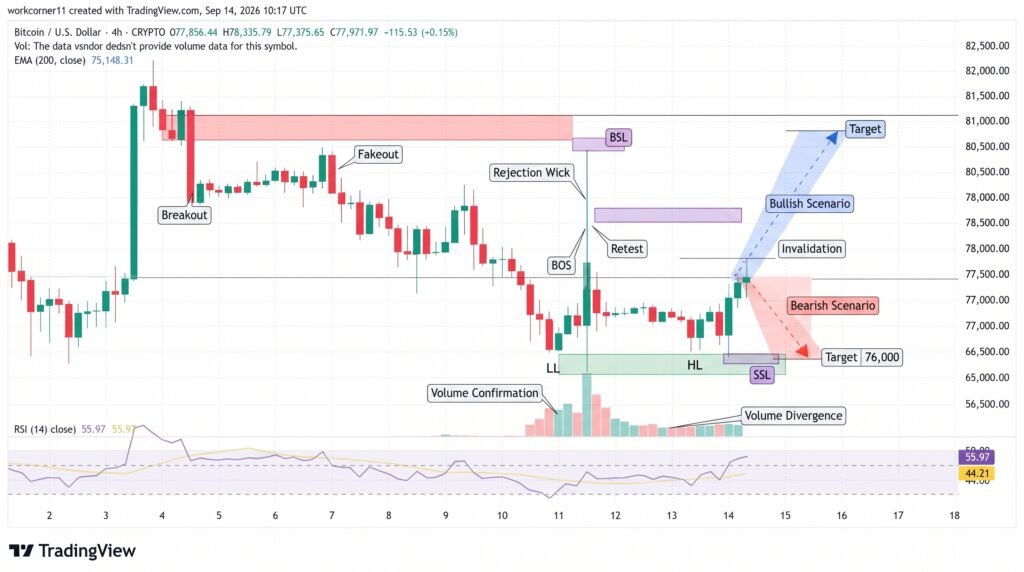
A move through $81,300 would provide stronger confirmation of a bullish breakout and could bring the September high near $82,163 back into focus.
The bearish case becomes more compelling below $76,300. A clean breakdown could expose the $72,658 200-period SMA, although the depth of any decline would depend on volume and broader risk sentiment.
The ADX at 13.6 confirms the current lack of trend strength, while an ATR near 0.92% points to relatively contained volatility compared with more aggressive Bitcoin swings.
Conclusion
Bitcoin remains trapped between $76,300 and $81,300, with the market lacking enough momentum to establish a sustained trend. The 200-period SMA near $72,658 provides broader structural support, but the 50-period SMA and SuperTrend continue to cap immediate gains. Above $79,237.50 and ultimately $81,300, the bullish case strengthens; below $76,300, downside risk increases sharply. With the Federal Reserve decision approaching and rate-hike expectations near 90%, the next confirmed breakout could define Bitcoin’s short-term direction.
Sources & Methodology
Primary-source standard: Market-moving facts should link to original data releases, regulator notices, company filings or official project announcements whenever available. Secondary reporting is used for additional context, not as a substitute for original evidence.
Page last reviewed: