
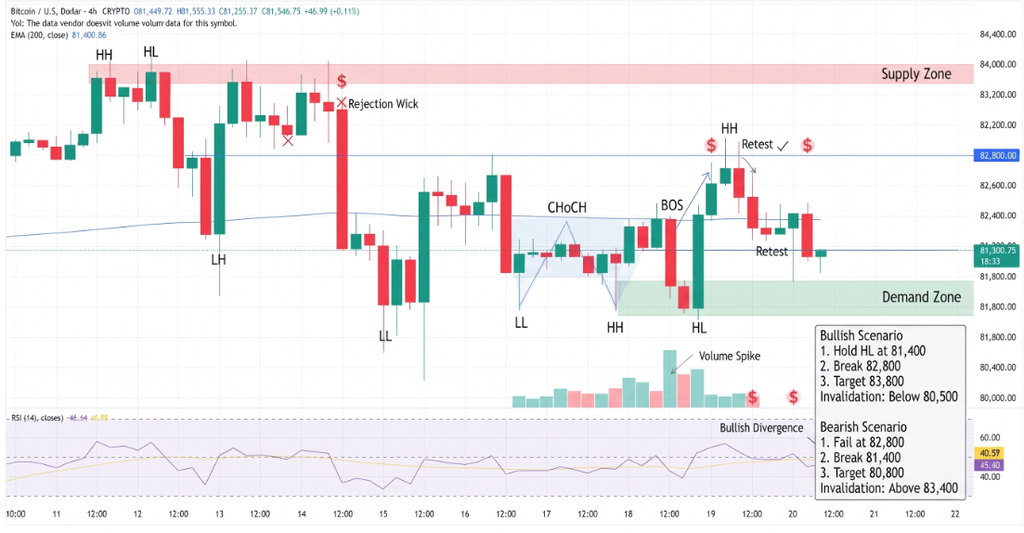
Bitcoin fell below $82,000 on Tuesday as rising oil prices and geopolitical uncertainty weakened demand for risk-sensitive assets. The world’s largest cryptocurrency traded at $81,511.20, down approximately 1.5% at 05:19 ET (09:19 GMT), after failing to maintain a recovery above $83,000 in the previous session. Investors are also reassessing the Federal Reserve’s interest-rate outlook ahead of its October 27–28 meeting. With inflation still elevated and energy prices climbing, traders face renewed uncertainty over whether monetary policy will remain restrictive for longer.
Bitcoin Faces Renewed Selling Pressure
Bitcoin’s latest decline extends its struggle to recover after retreating from levels above $85,000 earlier in October. The failure to sustain gains above $83,000 suggests that buyers remain cautious as macroeconomic risks weigh on market sentiment.
Unlike traditional safe-haven assets, cryptocurrencies are sensitive to changes in liquidity, borrowing costs and investor appetite for risk. When markets anticipate higher interest rates, investors may reduce exposure to speculative assets such as Bitcoin. However, broader market conditions—not interest rates alone—determine the direction of cryptocurrency prices.
The current decline also reflects pressure across global markets. Reuters reported on October 20 that European equities weakened as Brent crude climbed above $110 a barrel, while geopolitical tensions increased uncertainty for investors. Market coverage from Reuters highlights how energy-market disruption is affecting sentiment beyond cryptocurrencies.
Oil at $111 Raises Fed Concerns
Brent crude futures reached $111.05 a barrel, a five-month high, as attacks on Saudi Arabian infrastructure and risks to Middle Eastern energy supplies heightened concerns about potential disruptions. Higher oil prices can increase transportation and production costs, making inflation more difficult to control.
September US consumer prices rose 3.7% year over year, while core inflation—which excludes food and energy—reached 2.6%. Gasoline prices increased 9.1% during the month, accounting for more than half of the monthly rise in headline inflation, according to Reuters’ inflation report.
The Federal Reserve must weigh persistent price pressures against the economic effects of higher borrowing costs. The supplied market data put the probability of an October rate increase at 18%, with a 75% chance of a December hike. These estimates can change as new economic data emerge. The Fed’s October 27–28 meeting is therefore a key event for cryptocurrency traders.
Altcoins Slide as Risk Appetite Fades
Most major cryptocurrencies also moved lower, indicating that selling pressure extends beyond Bitcoin.
- Ethereum (ETH): Fell 2.2% to $2,385.92.
- XRP: Declined 1.4% to $1.2953.
- Solana (SOL): Lost 1.2%.
- Cardano (ADA): Dropped 2%.
- Dogecoin (DOGE): Slipped 0.8%.
The figures reflect the supplied market snapshot; prices fluctuate throughout the trading day.
Conclusion
Bitcoin’s fall below $82,000 highlights the combined influence of geopolitical risk, expensive energy and uncertainty over Federal Reserve policy. A sustained recovery will likely require improved risk sentiment, while persistent inflation and tighter financial conditions could keep pressure on crypto markets. Traders should monitor oil prices, upcoming Fed guidance and Bitcoin’s ability to reclaim $83,000 before drawing conclusions about the next trend.
Sources & Methodology
Primary-source standard: Market-moving facts should link to original data releases, regulator notices, company filings or official project announcements whenever available. Secondary reporting is used for additional context, not as a substitute for original evidence.
Page last reviewed: