
NEAR Protocol (NEAR) declined nearly 2% on Tuesday, extending the previous session’s losses despite continued institutional demand for the token. Bitwise’s spot NEAR Exchange-Traded Fund (ETF) attracted approximately $5.42 million on Monday, while NEAR traded near $4.816. The contrast highlights a market in which investment-fund inflows and network growth have yet to overcome short-term selling pressure. Traders are watching the $4.55 support area and resistance around $5.02 to determine whether the pullback remains temporary or develops into a deeper correction.
ETF Inflows Support NEAR’s Outlook
Data from SoSoValue showed that Bitwise’s NEAR ETF, trading under the ticker NRR, recorded $5.42 million in net inflows on Monday, October 19. This followed three consecutive weeks of positive weekly flows, with cumulative inflows since the fund’s September 29 launch approaching $88.5 million.
The fund gives investors exposure to NEAR through a regulated investment vehicle without requiring them to purchase and manage the token directly. However, ETF inflows do not guarantee immediate price appreciation, particularly when broader cryptocurrency markets face selling pressure.
Network activity provides another potential source of support. NEAR’s third-quarter 2026 review highlighted growth in NEAR Intents, its cross-chain transaction infrastructure, which allows users to exchange assets across supported blockchains.
Cumulative transaction volume exceeded $32 billion, while quarterly volume rose approximately 45% from the previous quarter. The network also directed more than $8 million in captured fees toward NEAR token buybacks, according to the supplied report.
Meanwhile, the total value locked (TVL) in Confidential Intents, which supports private cross-chain transactions, reached approximately $160 million at quarter-end, an increase of about 463% quarter over quarter. TVL measures the value of assets deposited in a protocol and provides one indicator of adoption, although it does not directly measure profitability or token demand.
NEAR Technical Analysis: Key Levels
NEAR traded below its short-term trend indicators on the four-hour chart, suggesting that sellers retained control of near-term momentum. The 50-period exponential moving average (EMA) stood near $5.0179, while a descending trendline provided resistance around $5.0261.
The 200-period EMA near $4.5513 remained an important support level. A sustained break above the $5.02 resistance zone could signal improving momentum, while a move below $4.55 would increase the risk of a deeper decline.
Technical indicators also reflected caution. The Relative Strength Index (RSI) stood at 43, below the neutral 50 threshold, while the Moving Average Convergence Divergence (MACD) indicator had slipped marginally beneath its signal line.
These indicators suggest weakening buying momentum, but neither confirms the direction of the next major move.
NEAR Price Forecast: Key Levels to Watch
The next move depends on whether buyers can defend support and reclaim the resistance zone. Traders should monitor the following levels:
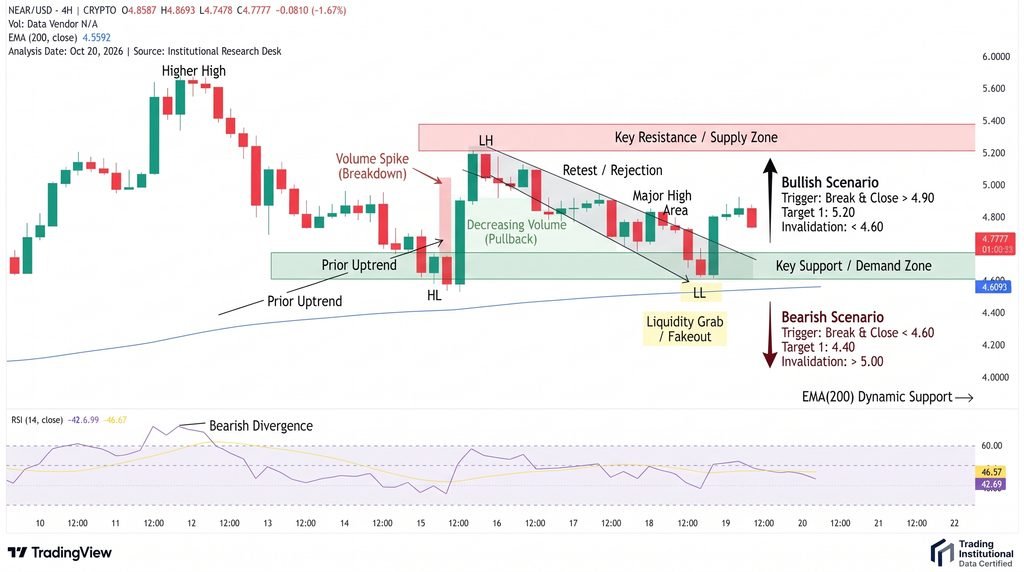
- Resistance: $5.0179–$5.0261; a breakout could expose $5.5780 and $6.00.
- Immediate support: $4.5513–$4.4440; a breakdown would weaken the current structure.
- Lower target: $3.9140 if selling pressure accelerates below support.
Conclusion
NEAR Protocol faces a short-term test as selling pressure persists despite positive ETF inflows and reported network growth. A sustained move above $5.03 could strengthen the recovery outlook and bring $5.5780 and $6.00 into focus. However, a break below the $4.44 support level could expose the token to further losses toward $3.9140. Investors should monitor ETF fund flows, NEAR network activity and technical momentum for confirmation before assuming that the broader uptrend will resume.
Sources & Methodology
Primary-source standard: Market-moving facts should link to original data releases, regulator notices, company filings or official project announcements whenever available. Secondary reporting is used for additional context, not as a substitute for original evidence.
Page last reviewed: