
The USD/JPY exchange rate slipped toward 158.00 on Tuesday after the U.S. dollar failed to break above the 200-day simple moving average (SMA) at 158.57. Expectations for another Federal Reserve rate increase have weakened, while concerns about excessive artificial-intelligence investment are adding pressure to the greenback. Despite the pullback, the pair remains within its recent trading range, with support near 157.50 limiting losses. Traders are assessing whether fading U.S. rate expectations will trigger a deeper decline or whether buyers can regain control.
Fed Rate Outlook Pressures the Dollar
The dollar has faced renewed selling pressure as investors reassess the Federal Reserve’s next policy decision. According to the supplied market data, the probability of a 25-basis-point rate increase at the next meeting fell to 17%, down from nearly 60% the previous week, based on the CME FedWatch Tool.
A basis point equals one-hundredth of a percentage point, meaning a 25-basis-point increase would raise the policy rate by 0.25 percentage point. Lower expectations for further tightening can weigh on the dollar by reducing the potential return advantage of U.S. interest-bearing assets.
Investors are also evaluating comments from Federal Reserve officials indicating that policymakers need more time to assess the effects of September’s rate increase. If the central bank leaves rates unchanged, the dollar could lose some support from monetary-policy expectations.
Concerns about the profitability of artificial-intelligence investments have created another source of uncertainty. Heavy spending on data centers, chips and computing infrastructure has supported parts of the U.S. technology sector. If investors question the returns on those investments, financial-market sentiment and demand for dollar-denominated assets could weaken.
However, the outlook also depends on incoming economic data and the Bank of Japan’s policy direction. Any widening or narrowing of the interest-rate gap between the two economies could influence demand for the currency pair.
USD/JPY Technical Analysis: Key Levels
On the daily chart, USD/JPY remains capped below the 200-day SMA at 158.57, while buyers continue defending the 157.50 area. The pair’s inability to clear the moving average suggests that sellers remain active near resistance, although the broader price structure has yet to confirm a decisive bearish reversal.
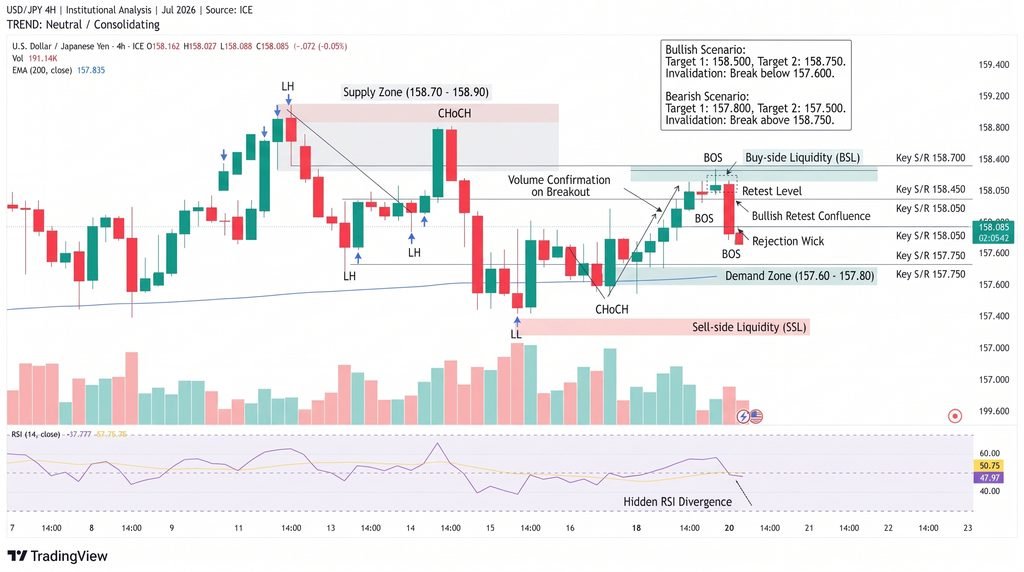
The Relative Strength Index (RSI) is holding just above 50, indicating relatively balanced momentum with a slight positive bias. Meanwhile, the Moving Average Convergence Divergence (MACD) remains marginally positive, suggesting that upward momentum has weakened rather than completely disappeared.
Traders are monitoring several important levels:
- Resistance: 158.57 at the 200-day SMA.
- First support: Around 157.50, near recent October lows.
- Higher targets: Above 158.57, resistance emerges near 159.00 and 160.40.
- Lower targets: A break below 157.50 could expose 156.40 and 155.34.
A sustained move above 158.57 would strengthen the bullish case, while a clear break below 157.50 would increase downside risks.
Conclusion
USD/JPY remains caught between weakening expectations for U.S. rate increases and support from a still-positive technical structure. The 158.57 moving average is the immediate barrier for buyers, while 157.50 remains the key level for sellers to overcome. A breakout in either direction could establish the next short-term trend. Until then, traders should monitor Federal Reserve signals, U.S. economic releases and shifts in technology-sector sentiment before anticipating a sustained move.
Sources & Methodology
Primary-source standard: Market-moving facts should link to original data releases, regulator notices, company filings or official project announcements whenever available. Secondary reporting is used for additional context, not as a substitute for original evidence.
Page last reviewed: