Silver traded at $57.69 on the five-hour chart, facing stiff resistance at $58.60 as the broader downtrend continued to limit recovery attempts. Although short-term momentum indicators show signs of improvement, declining trading volume and resistance from several technical indicators suggest buyers have yet to establish control. The $55.56 level remains the critical support zone. A break above resistance could improve the outlook, while a renewed decline below support would increase the risk of further losses toward $54.00.
Silver Faces a Strong Resistance Zone
The silver price (XAG/USD) remains under pressure despite a modest recovery from its recent low of $55.56. The price has moved above its 20-period simple moving average (SMA) at $57.17, indicating that short-term buying interest has returned. However, this improvement has not yet changed the broader bearish structure.
Silver continues to trade below the Ichimoku Cloud, SuperTrend indicator and both the 50-period and 200-period SMAs. These indicators help traders assess trend direction and potential support or resistance. Their position above the current price creates a concentration of selling pressure between $58.60 and $59.24.
The Moving Average Convergence Divergence (MACD) has produced a bullish crossover, while the Relative Strength Index (RSI) is recovering from oversold territory. These developments suggest that selling momentum may be easing. However, declining volume indicates that the rebound lacks strong confirmation.
A sustained move above $59.30, supported by rising trading volume, would provide stronger evidence that buyers are regaining control.
Key Technical Signals and Price Levels
The current chart presents conflicting signals. Short-term momentum favors a possible rebound, but the dominant trend remains bearish. A potential bear flag formation also raises the risk that the recovery could fail before a meaningful trend reversal develops.
The Relative Strength Index needs to move convincingly above 50 to strengthen the bullish case. Similarly, a sustained MACD move above its zero line would provide additional evidence of improving momentum.
The Average True Range (ATR) stands at $0.71, or approximately 1.2% of the current price. This indicates that silver can experience meaningful short-term fluctuations, making position sizing and risk management important.
Traders are monitoring the following levels:
- Resistance: $58.60–$59.24, where multiple technical indicators converge.
- Bullish confirmation: A sustained breakout above $59.30 with stronger volume.
- Immediate support: $55.56, the recent low and key bearish invalidation threshold.
- Downside target: $54.00 if support breaks decisively.
The supplied technical setup identifies $58.88 as a threshold above which the bearish scenario would weaken. These levels are chart-based reference points rather than guaranteed turning points.
Silver Price Forecast: What Comes Next?
Silver’s next directional move depends on whether buying pressure can overcome the resistance cluster above $58.60. A sustained breakout could open the way toward $59.30 and signal a stronger recovery, particularly if RSI and MACD confirm improving momentum.
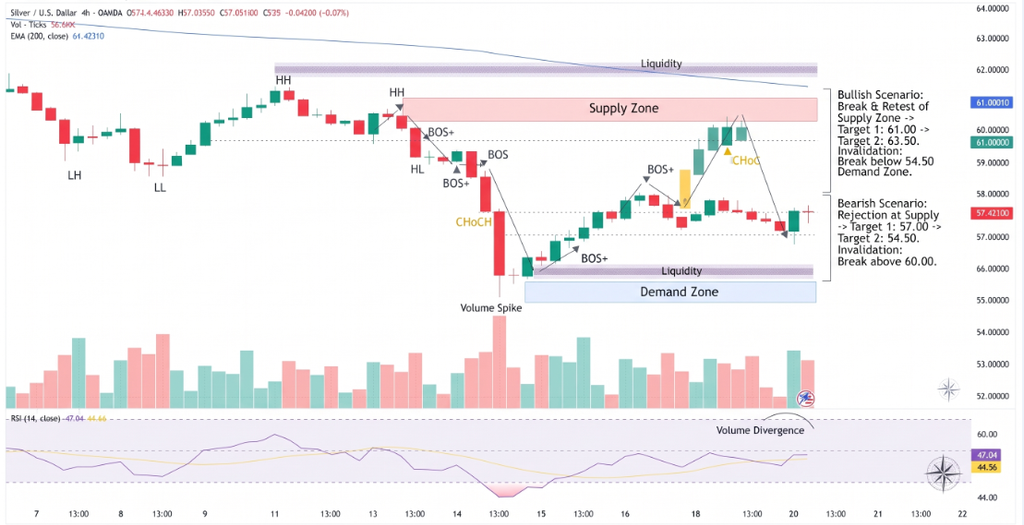
Conversely, repeated rejection near resistance would reinforce the prevailing downtrend. A decisive break below $55.56 could complete the bearish pattern and expose silver to further selling toward $54.00.
Conclusion
Silver remains vulnerable to renewed losses while it trades below the $58.60–$59.24 resistance zone. Improving momentum offers some support for a rebound, but declining volume and the broader bearish structure argue for caution. Traders should watch the $55.56 support level, volume near resistance and confirmation from momentum indicators before treating the current recovery as a lasting reversal.
Sources & Methodology
Primary-source standard: Market-moving facts should link to original data releases, regulator notices, company filings or official project announcements whenever available. Secondary reporting is used for additional context, not as a substitute for original evidence.
Page last reviewed: