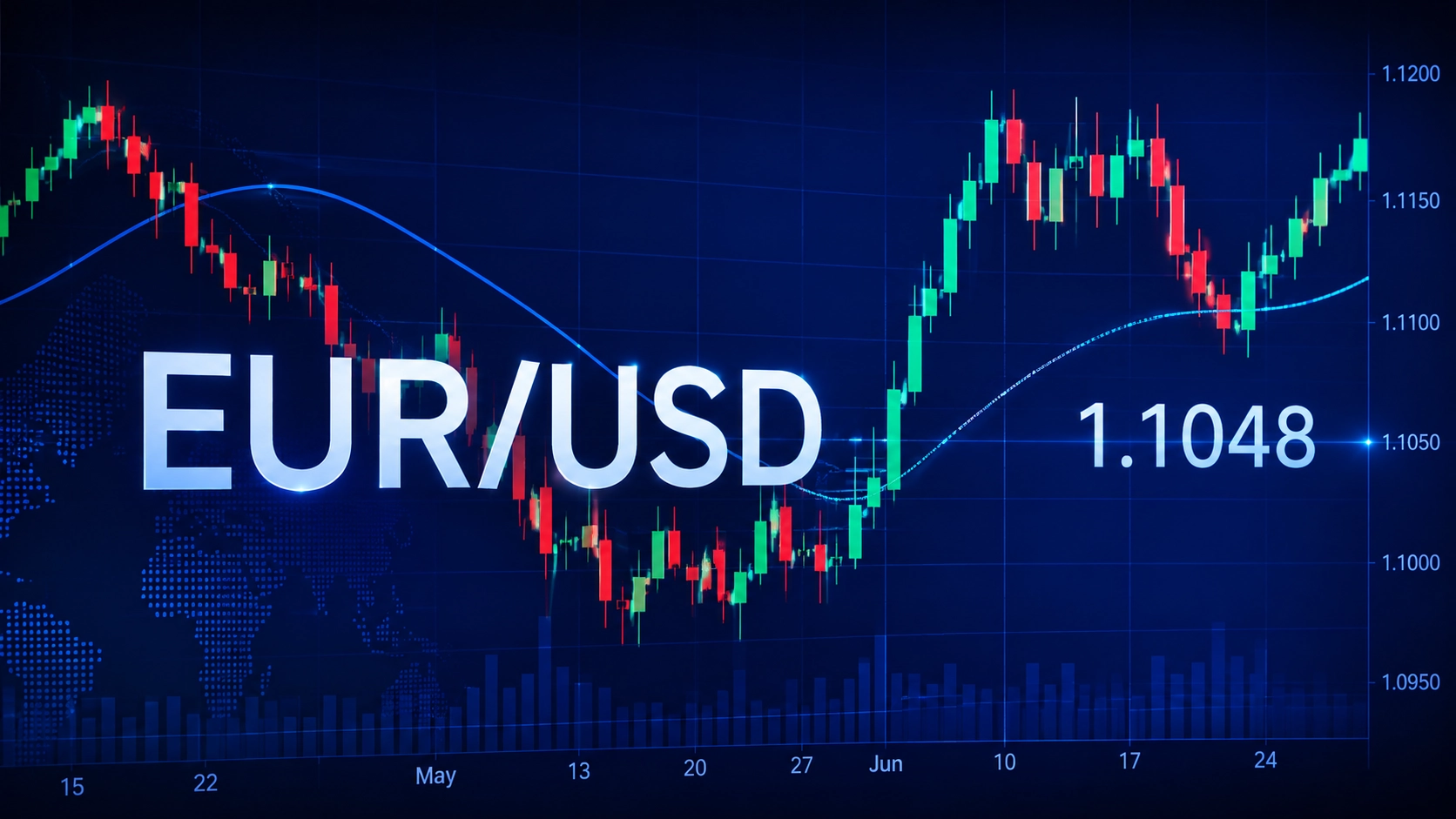
The EUR/USD currency pair traded near 1.1230 on Tuesday, gaining approximately 0.15% during Asian hours as the U.S. dollar weakened ahead of major technology earnings. However, the euro’s recovery remains vulnerable to political unrest in France, widening government-bond spreads and continuing tensions between Russia and Ukraine. Investors are also watching Meta’s third-quarter results on Wednesday for clues about whether heavy artificial-intelligence spending can deliver sustainable returns. Although a softer dollar is providing temporary support, the euro faces several obstacles that could limit further gains.
Dollar Weakness and Meta Earnings
The U.S. Dollar Index (DXY), which measures the dollar against six major currencies, slipped approximately 0.16% to 101.80 in the supplied market snapshot. Concerns about the sustainability of AI investment have weighed on sentiment toward U.S. technology companies and influenced currency-market positioning.
Meta’s earnings report, scheduled for October 21, will offer investors another indication of whether major technology companies can justify their substantial infrastructure commitments. According to estimates cited in the supplied report, Goldman Sachs expects five major AI hyperscalers to raise combined capital expenditure to approximately $1.2 trillion next year.
These investments cover data centers, advanced chips and other computing infrastructure needed to develop and operate AI systems. If earnings and guidance reinforce confidence in future returns, technology stocks and the dollar could regain support. Disappointing results or reduced spending plans could have the opposite effect.
For EUR/USD, the immediate direction will depend partly on whether dollar weakness continues. However, developments within the eurozone remain an independent source of downside risk.
French Fiscal Risks Pressure the Euro
Political unrest and concerns about France’s public finances have weakened investor confidence in French assets. Strategists at Scotiabank have highlighted protests over public services and affordability, alongside pressure on French equities and government bonds.
The spread between French and German government-bond yields has widened sharply. Reuters reported that French political unrest and budget concerns pushed the risk premium on French debt toward levels last seen during the eurozone debt crisis. A wider spread means investors demand additional compensation to hold French debt rather than comparatively safer German bonds.
Geopolitical uncertainty is adding another challenge. Continued Russia-Ukraine tensions and uncertainty surrounding potential diplomatic negotiations have reinforced caution toward European assets.
The euro’s near-term performance therefore depends on several competing forces: dollar weakness may support the pair, but French fiscal concerns and geopolitical risks could restrict its recovery.
EUR/USD Technical Analysis and Key Levels
On the daily chart, EUR/USD traded around 1.1232, below its 20-day exponential moving average (EMA) near 1.1274. This moving average represents a key resistance area that the pair must reclaim to improve its short-term outlook.
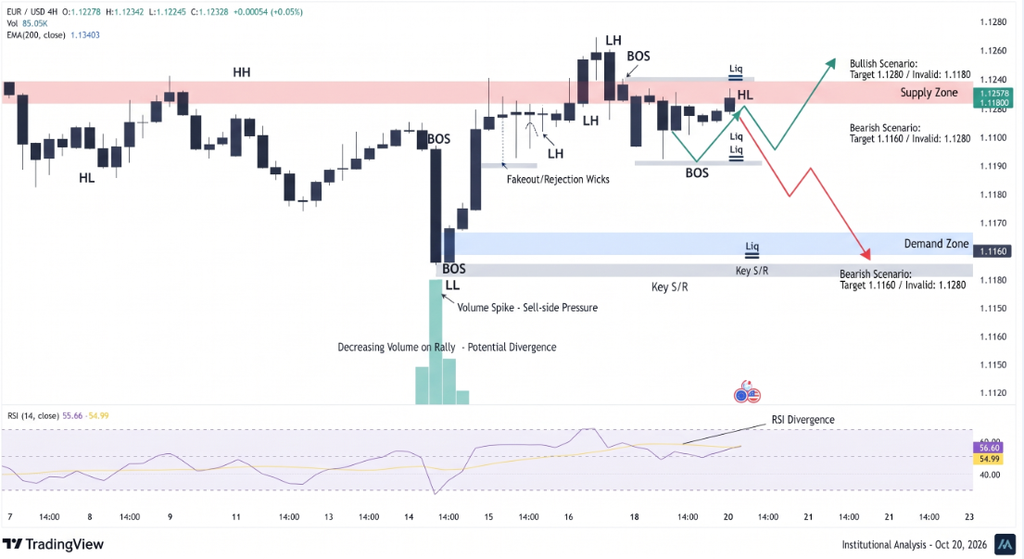
EUR/USD Price Chart – Source: Tradingview
The Relative Strength Index (RSI) stood at 40.28, recovering from oversold territory but remaining below the neutral 50 level. This suggests that selling pressure may be easing without confirming a bullish reversal.
Traders are watching three important technical signals:
- Resistance: 1.1274, near the 20-day EMA.
- Support: 1.1113, the October 14 low.
- Bullish signal: A sustained break above 1.1274 could strengthen recovery momentum.
Conclusion
EUR/USD remains exposed to downside risks despite its modest rebound toward 1.1230. French fiscal uncertainty, political unrest and Russia-Ukraine tensions continue to weigh on the euro, while Meta’s earnings could influence dollar demand through shifts in technology-market sentiment. A sustained move above 1.1274 would improve the technical outlook, but a renewed decline toward 1.1113 would reinforce the bearish case. Traders should monitor French bond spreads, U.S. market sentiment and price action around these levels before anticipating a lasting recovery.
Sources & Methodology
Primary-source standard: Market-moving facts should link to original data releases, regulator notices, company filings or official project announcements whenever available. Secondary reporting is used for additional context, not as a substitute for original evidence.
Page last reviewed: