
The US Dollar Index (DXY) is holding near 102.00 after recent gains, but traders are assessing whether the rally can extend. The index remains above its 50-day exponential moving average (EMA), while the nine-day EMA near 102.03 presents an immediate technical hurdle. The daily Relative Strength Index (RSI) at 58.17 points to positive momentum without signalling overbought conditions. Still, analysts at DBS Group Research caution that the market may be shifting from buying the dollar’s advance to questioning how sustainable it will be.
DXY Tests Resistance Near 102.03
The US Dollar Index measures the greenback against six major currencies: the euro, Japanese yen, British pound, Canadian dollar, Swedish krona and Swiss franc. The euro carries the largest weighting, making movements in the EUR/USD currency pair particularly influential in the index’s direction. ICE, which administers the benchmark, provides its composition and methodology.
On the supplied daily chart, DXY is trading within an ascending channel, a pattern defined by rising support and resistance boundaries. The index remains above its 50-day EMA at 100.91, keeping the broader technical structure constructive. However, the nine-day EMA at 102.03 is the immediate test for buyers.
A sustained move above 102.03 could open the way toward 102.94, the reported October 14 high and an 18-month peak. Beyond that, the chart identifies 103.80 as a potential resistance area near the upper boundary of the ascending formation.
The RSI reading of 58.17 supports the bullish case, as it sits above the neutral 50 level but below the commonly used overbought threshold of 70. The FXStreet Fed Sentiment Index reading is around 127.51. That reading may help track changes in policy expectations, but it does not independently confirm the dollar’s next move.
Dollar Support Levels Shape the Outlook
The immediate downside reference is the lower boundary of the ascending channel near 101.70. If sellers push DXY below this area, attention would shift to the 50-day EMA at 100.91. A deeper reversal could expose 98.56, the five-month low reported for August 20.
Key technical levels include:
- 102.03: Nine-day EMA and first resistance.
- 102.94: Recent 18-month high and potential upside target.
- 103.80: Upper channel boundary and further resistance.
- 101.70: Near-term channel support.
- 100.91: 50-day EMA and a broader trend reference.
- 98.56: Major historical downside level identified in the supplied analysis.
These levels are chart-based reference points, not guaranteed turning points. A break should be assessed alongside daily closes and the wider macroeconomic backdrop, including Federal Reserve interest-rate policy.
Can the Dollar Sustain Its Rally?
The dollar’s recent strength has been supported by inflation concerns and changing expectations for Federal Reserve policy. However, the outlook remains sensitive to economic data and signals from policymakers. A change in market expectations for interest rates can influence Treasury yields and demand for the dollar, particularly when investors compare the outlook for US monetary policy with that of other major economies.
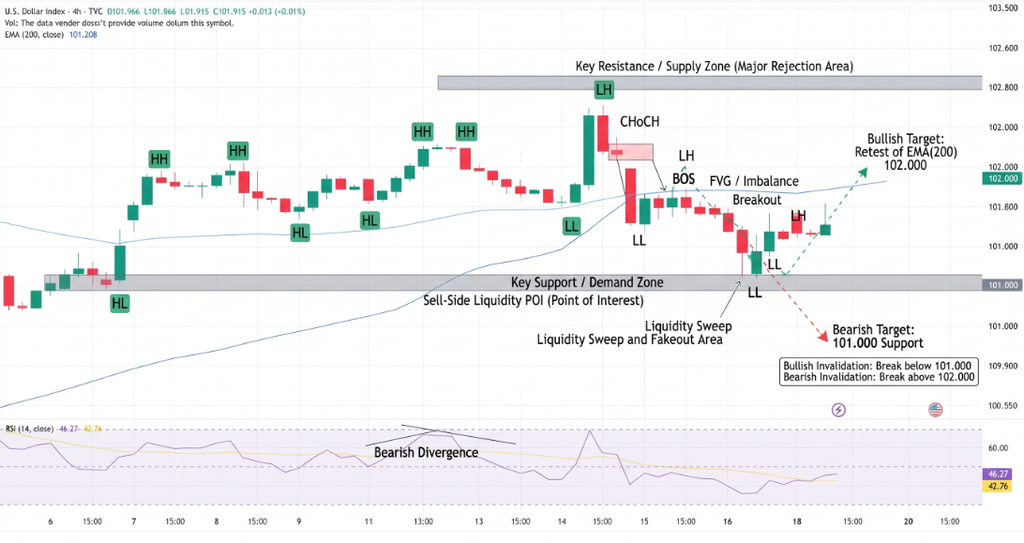
DBS Group Research has warned that investors may begin evaluating the durability of the dollar’s advance rather than simply extending bullish positions. If rate expectations stop providing fresh support, the index could struggle to clear resistance even while its technical structure remains positive.
Conclusion
DXY retains a constructive bias while holding above 101.70, but 102.03 is the immediate hurdle. A confirmed break higher could bring 102.94 and 103.80 into view. Failure at resistance, followed by a move below channel support, would increase the risk of a pullback toward 100.91. Traders should weigh technical signals against incoming US data and evolving Federal Reserve expectations.
Sources & Methodology
Primary-source standard: Market-moving facts should link to original data releases, regulator notices, company filings or official project announcements whenever available. Secondary reporting is used for additional context, not as a substitute for original evidence.
Page last reviewed: