
EUR/JPY trades around 179.85 during early European hours on Thursday, remaining below the 180.00 psychological level as traders monitor Japanese intervention risks and fresh German economic data. The cross continues to face technical resistance from its 100-day simple moving average (SMA), keeping the near-term bias tilted lower. Japan’s recent rate increase has done little to generate sustained yen strength, while official warnings and reported rate checks have kept intervention concerns in focus.
Yen Intervention Keeps EUR/JPY Under Pressure
Japanese authorities remain sensitive to rapid yen depreciation, particularly after recent reports of a rate check, a step markets often associate with heightened intervention monitoring. The yen has remained vulnerable despite the Bank of Japan (BoJ) raising its policy rate by 25 basis points to 1.25% on September 17, its highest level in 31 years.
The policy decision was widely expected, but the market response showed that a rate increase alone may not guarantee sustained yen appreciation. Two BoJ policymakers dissented from the decision, while Governor Kazuo Ueda said future increases would depend on inflation and economic developments.
The broader rate differential also continues to influence yen positioning and carry-trade demand. Any stronger signal that Japanese monetary policy will tighten further could alter those dynamics, while renewed intervention concerns may limit aggressive yen selling.
- BoJ policy rate: 1.25%
- EUR/JPY spot: around 179.85
- Immediate psychological level: 180.00
German Data Adds Near-Term Euro Risk
The euro side of the cross faces a fresh test from Germany’s ifo Business Climate Index, scheduled for September 24. The survey is a closely watched monthly indicator of corporate sentiment and economic conditions in Germany.
Germany’s ifo index increased to 88.8 in August from 86.7 in July, with companies reporting improved current conditions and stronger expectations. The September release could therefore influence expectations for the euro-area economy and the euro’s near-term performance.
A stronger-than-expected reading could provide some support for EUR/JPY, while a weaker result could reinforce selling pressure if investors reduce euro exposure. The cross remains particularly sensitive to shifts in both European growth expectations and Japanese monetary-policy expectations.
EUR/JPY Technical Levels to Watch
The daily technical structure remains cautious. EUR/JPY is trading below its 20-period Bollinger middle band and the 100-day SMA at 184.05. The Relative Strength Index (14) is around 40, indicating persistent downside momentum without reaching traditional oversold territory.
The 180.00 level is the first major hurdle. A sustained move above it would bring the Bollinger middle band near 180.70 into focus, followed by the 100-day SMA at 184.05.
On the downside, the September 17 low at 178.48 is the first support. A break below that level would expose the September 14 low at 177.45, while the lower Bollinger Band near 175.91 represents the next significant technical area.
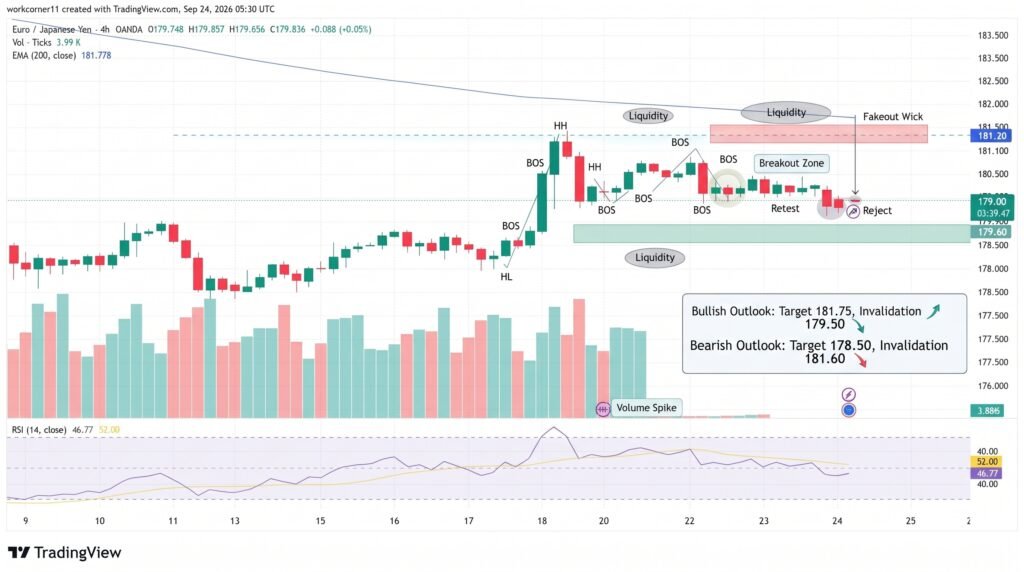
Key levels:
- Resistance: 180.00, 180.70, 184.05
- Support: 178.48, 177.45, 175.91
Conclusion
EUR/JPY remains below 180.00, with the 100-day SMA at 184.05 keeping the broader near-term technical structure under pressure. Japanese intervention risks and uncertainty over the pace of further BoJ tightening remain important for the yen, while Germany’s latest ifo data could influence euro demand. A break below 178.48 would strengthen the case for a deeper correction toward 177.45 and potentially 175.91.
Sources & Methodology
Primary-source standard: Market-moving facts should link to original data releases, regulator notices, company filings or official project announcements whenever available. Secondary reporting is used for additional context, not as a substitute for original evidence.
Page last reviewed: