USD/CAD trades near 1.4100 during early European hours on Thursday, with the pair holding above its 100-day moving average. The US Dollar has strengthened after stronger-than-expected US business activity data increased expectations for additional Federal Reserve tightening. At the same time, lower crude-oil prices have reduced support for the Canadian Dollar, leaving USD/CAD close to its recent highs. Markets are now watching further Fed commentary and developments in US-Iran diplomacy for fresh direction.
Strong US PMI Supports the Dollar
The latest S&P Global US PMI data showed a stronger expansion across the US private sector in September. The Composite PMI rose to 58.4 from 56.0, marking the fastest growth since July 2021. The Manufacturing PMI climbed to 57.0 from 53.9, while the Services PMI increased to 58.7 from 56.5.
The data also pointed to renewed price pressure. S&P Global reported that input-cost growth accelerated to a near four-year high, partly because of higher energy prices and capacity constraints. Payroll growth reached its strongest rate in more than four years, adding to evidence of resilient demand.
The combination of faster growth, stronger employment and elevated price pressures has kept US interest-rate expectations at the center of the currency market. A higher-for-longer Fed policy path can support the dollar by maintaining a relatively attractive yield on US assets.
- Composite PMI: 58.4
- Manufacturing PMI: 57.0
- Services PMI: 58.7
Oil Weakness Limits CAD Support
Crude oil remains an important variable for the Canadian Dollar, given Canada’s role as a major energy exporter. Recent declines in oil prices have therefore removed some external support for the CAD.
Oil prices have fallen as markets assess renewed diplomatic signals between the US and Iran. Reuters reported that Tehran remains open to diplomacy, although Washington and Tehran remain divided over the terms of a potential agreement. Earlier reports also showed that Brent crude had fallen toward $100 a barrel amid hopes that regional supply disruptions could ease.
The Bank of Canada is also balancing competing growth and inflation risks. Governor Tiff Macklem said on September 21 that renewed trade tensions and elevated energy prices were creating opposing pressures for Canada’s economy. The Bank of Canada held its policy rate at 2.25% on September 2 and said inflation risks had increased while the outlook for growth remained uncertain.
That policy backdrop leaves USD/CAD sensitive to changes in both US rate expectations and Canadian economic conditions.
USD/CAD Technical Levels to Watch
The daily chart maintains a constructive near-term structure. USD/CAD remains above the 100-day MA at 1.3960 and the 20-period Bollinger middle band near 1.3915. The Relative Strength Index (RSI) is around 69, showing strong upside momentum but also indicating that the advance is approaching stretched conditions.
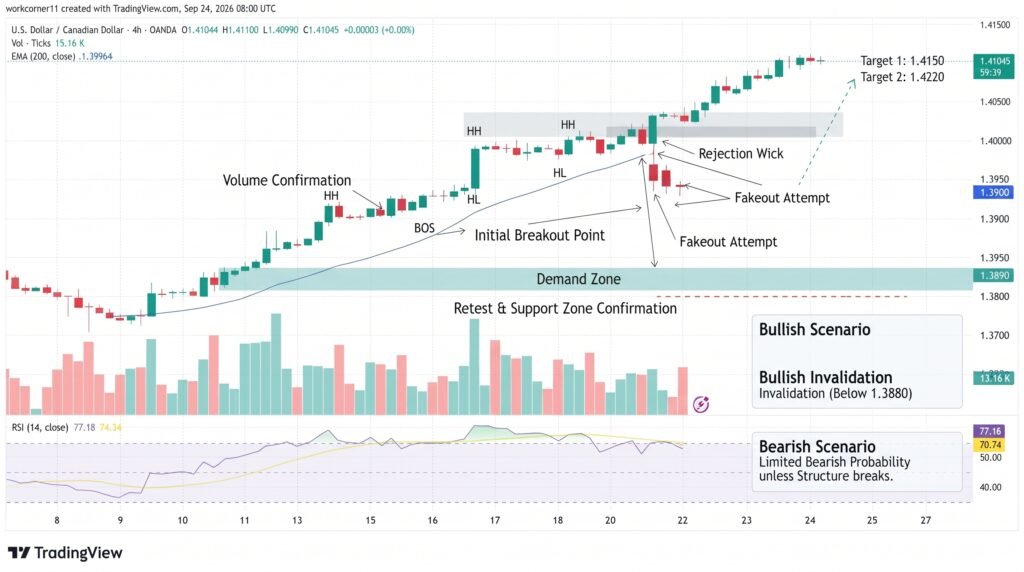
The first upside barrier is the upper Bollinger Band near 1.4115. A sustained move above that level would bring the June 24 high at 1.4248 into focus.
On the downside, the 100-day MA at 1.3960 provides the first major support. A break below it would shift attention to the 1.3915 middle band, while deeper selling could expose the lower Bollinger Band near 1.3715.
Key levels:
- Resistance: 1.4115 and 1.4248
- Support: 1.3960, 1.3915 and 1.3715
- RSI: around 69
Conclusion
USD/CAD remains near 1.4100 as stronger US activity data reinforce expectations around Federal Reserve policy, while softer oil prices reduce a source of support for the Canadian Dollar. The US Composite PMI reached 58.4 in September, its strongest reading since July 2021, while Canada’s central bank continues to weigh trade uncertainty against inflation risks. Technically, 1.4115 is the immediate resistance, followed by 1.4248, while 1.3960 and 1.3915 remain the main downside levels to monitor.
Sources & Methodology
Primary-source standard: Market-moving facts should link to original data releases, regulator notices, company filings or official project announcements whenever available. Secondary reporting is used for additional context, not as a substitute for original evidence.
Page last reviewed: