
EUR/USD traded near 1.1220 on Monday as falling US Treasury yields weakened the dollar, allowing the euro to edge higher. However, the currency pair’s broader technical outlook remained bearish because prices stayed below the 100-day simple moving average (SMA). Investors are preparing for policy decisions from the Federal Reserve on October 28 and the European Central Bank on October 29. Their guidance on inflation and future interest rates could determine whether the euro extends its recovery or resumes its decline.
Falling Treasury Yields Weigh on Dollar
US bond yields have become a key driver of currency-market sentiment. The 10-year Treasury yield fell to 4.97%, while the 30-year yield stood at 5.299%, according to the supplied market snapshot. Lower yields can reduce the relative appeal of dollar-denominated investments, putting pressure on the US currency and supporting EUR/USD.
The focus now shifts to the Federal Reserve’s two-day policy meeting on October 27–28. The market snapshot indicated a 90.6% probability of rates remaining unchanged in October, while the implied probability of a December rate increase stood at 79.4%. These are market expectations, not confirmed policy decisions, and can change as economic data and official comments emerge. The Fed’s October meeting calendar confirms the scheduled dates.
Fed Chair Kevin Warsh’s recent comments emphasized investment, artificial intelligence and financial stability without committing to a specific future rate path. That leaves investors looking for clearer signals about how policymakers will respond to persistent inflation.
The euro faces its own challenges. Political unrest and concerns about France’s budget position could undermine confidence in the shared currency. At Thursday’s ECB meeting, traders will examine the policy statement and President Christine Lagarde’s press conference for clues about the timing of future rate adjustments. No change in rates was expected in the supplied market outlook.
EUR/USD Technical Levels to Watch
On the daily chart, EUR/USD remains below its 100-day SMA, indicating that the broader recovery has yet to overcome a significant technical barrier. The Relative Strength Index (RSI) is around 40, pointing to weak momentum without showing an extreme oversold reading. The pair is also trading near the middle Bollinger Band, which may act as near-term resistance.
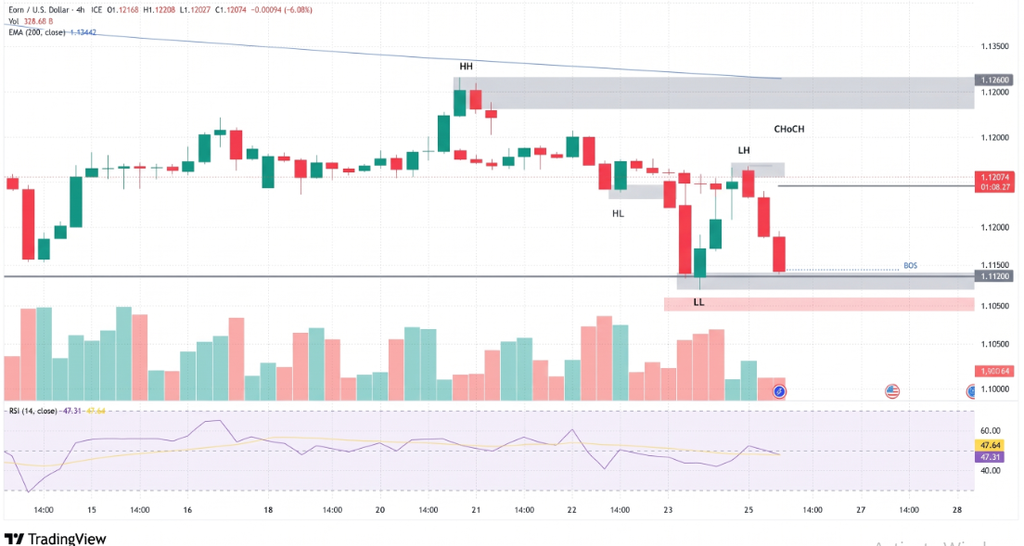
Key levels for traders include:
- 1.1270: Initial resistance at the October 16 high.
- 1.1315: Upper Bollinger Band and the next upside barrier.
- 1.1450: 100-day SMA; a break above it would ease bearish pressure.
- 1.1185: Initial support at the October 23 low.
- 1.1138–1.1100: Lower Bollinger Band followed by psychological support.
A sustained move above 1.1270 would improve the near-term picture, while a decisive break below 1.1185 could expose lower support.
Conclusion
EUR/USD is receiving temporary support from softer US Treasury yields, but the pair has not yet reversed its bearish technical structure. The Fed’s guidance on December policy and the ECB’s assessment of inflation will be central to the next move. A break above 1.1270 could open the way toward 1.1315, while a fall below 1.1185 would strengthen downside risks. Until the pair clears resistance or loses support decisively, traders face a market caught between short-term dollar weakness and lingering pressure on the euro.
Sources & Methodology
Primary-source standard: Market-moving facts should link to original data releases, regulator notices, company filings or official project announcements whenever available. Secondary reporting is used for additional context, not as a substitute for original evidence.
Page last reviewed: