European equities edged higher on Thursday, capturing a modest risk-on bid after an in-line U.S. inflation reading reinforced bets that the Federal Reserve will hold interest rates steady in September. The pan-European STOXX 600 Index advanced 0.2% to 660.49 points, retreating slightly from the record high it touched earlier in the week but continuing a broader rally driven by a strong corporate earnings season across the region.
In-Line CPI Data Eases Rate-Hike Fears
Equity desks drew relief from Wednesday’s U.S. Consumer Price Index report, which showed headline CPI rising 0.1% month-over-month in July and core inflation holding at 2.5% year-over-year, both matching economist forecasts. Coming after last week’s unexpected contraction in U.S. nonfarm payrolls, the on-target inflation print effectively neutralized near-term fears of additional Fed tightening. Money markets recalibrated quickly following the data, pricing in roughly a 40% to 44% probability of a rate move at the Fed’s September 16 meeting, down from odds that had run as high as 54% to 67% just a week earlier.
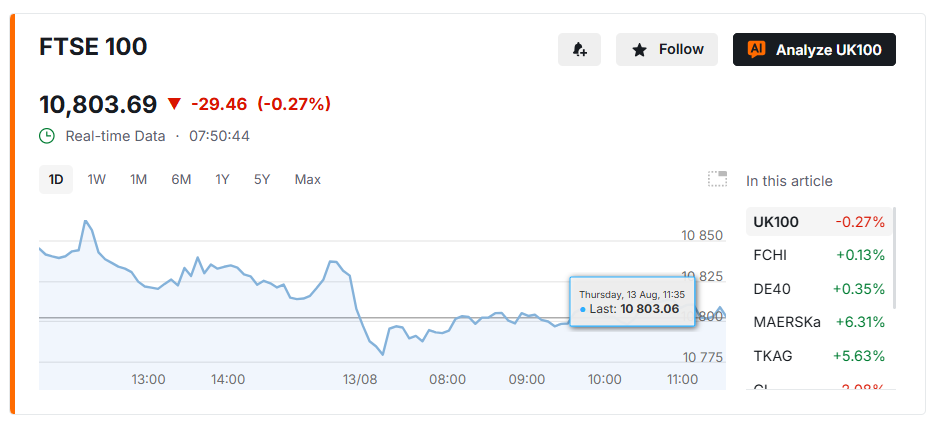
Gains across continental exchanges were broad-based. Germany’s DAX and France’s CAC 40 both advanced around 0.3%, benefiting primarily from reduced concern over further increases in U.S. borrowing costs, since lower Fed rate expectations tend to support equity valuations by easing interest-rate risk premia. London’s FTSE 100 moved in the opposite direction, falling 0.3% even after data showed the UK economy expanded 0.4% in the second quarter, matching consensus forecasts and offering some reassurance on the domestic growth outlook. The FTSE’s underperformance traced largely to weaker energy prices weighing on the index’s heavily weighted oil and gas constituents.
Oil Slips as Hormuz Standoff Persists
Crude oil prices slipped from multi-week highs on Thursday but remained elevated above $80 a barrel, with the decline driven partly by forecasters cutting their outlook for global oil demand this year amid the broader fallout from the Middle East conflict. Trading desks continued monitoring the diplomatic standoff between Washington and Tehran over shipping access through the Strait of Hormuz; despite ongoing mediation efforts, the two sides remain at an impasse over terms for a permanent peace agreement, keeping a persistent geopolitical risk premium embedded in global energy and freight costs.
Investors are turning attention to a fresh batch of European data due later Thursday, including Spain’s final July CPI figures and the eurozone’s industrial production report, both of which will give the European Central Bank additional evidence on whether regional disinflation and manufacturing momentum are tracking its policy projections heading into the autumn.
Earnings Continue to Drive Individual Stock Moves
Corporate results remained the dominant force behind individual stock performance. Adyen surged more than 10% after the Dutch payments processor raised its 2026 net revenue growth outlook to 21% to 23%, up from its previous forecast of 20% to 22%. Maersk rose approximately 7% to 8% after the Danish shipping group beat profit estimates and raised its full-year earnings guidance for the second time this year, reporting preliminary underlying EBITDA of $3 billion for the April-to-June period, well above the $2.04 billion analysts had forecast. Pandora gained roughly 3% after beating second-quarter estimates and raising its earnings outlook.
- Thyssenkrupp slipped about 1.5% despite narrowing and raising parts of its 2026 guidance, suggesting the revision fell short of expectations already priced into the stock
- Swissquote dropped roughly 10% after missing first-half expectations
Conclusion
Thursday’s session reflects a market balancing genuine earnings strength against a geopolitical risk that refuses to resolve. The STOXX 600’s pullback from record highs came alongside continued gains for individual outperformers like Adyen and Maersk, suggesting investors are still rewarding companies that beat estimates and raise guidance even as the index-level advance moderates. With the Strait of Hormuz standoff showing no sign of near-term resolution and oil prices still elevated above $80, European equities remain caught between a supportive earnings backdrop and an energy-driven inflation risk that could reverse the Fed’s dovish repricing if conditions escalate further.
Sources & Methodology
Primary-source standard: Market-moving facts should link to original data releases, regulator notices, company filings or official project announcements whenever available. Secondary reporting is used for additional context, not as a substitute for original evidence.
Page last reviewed: