
U.S. stock index futures advanced sharply on Monday as easing geopolitical tensions in the Middle East boosted investor sentiment and pushed oil prices lower. As reported by TradingView and CNBC, S&P 500 futures gained around 1% while Nasdaq futures outperformed ahead of a pivotal week featuring earnings from major technology companies and the Federal Reserve’s latest interest rate decision.
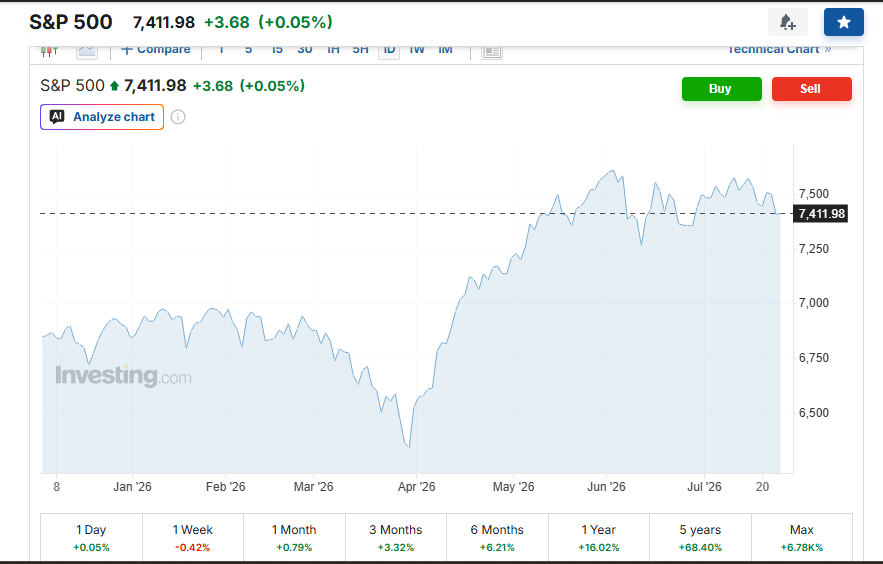
Source: investing.com
Key developments
- As reported by TradingView, S&P 500 futures rose 1%, Nasdaq futures gained 1.5%, and Dow Jones futures advanced 0.8% early Monday as investors embraced a return to risk assets.
- CNBC reported a similar move, with Dow futures climbing about 610 points (1.2%), S&P 500 futures gaining 0.9%, and Nasdaq-100 futures rising 1.4%.
- The rally followed a pause in military action between the United States and Iran, reducing concerns about further escalation in the Middle East.
- Oil prices declined sharply, with Brent crude falling more than 5% to around $91 per barrel, while West Texas Intermediate (WTI) dropped to approximately $84 per barrel, according to CNBC.
- Investors are preparing for quarterly earnings from Apple, Microsoft, Amazon, and Meta Platforms, four of the largest companies in the U.S. stock market.
- The Federal Reserve is also scheduled to announce its latest monetary policy decision on Wednesday, making it one of the busiest weeks for financial markets this quarter.
Why markets reacted
Investor sentiment improved after geopolitical risks eased over the weekend, encouraging traders to shift back toward equities. As reported by TradingView, the pause in fighting between the United States and Iran reduced demand for traditional safe-haven assets while easing fears that prolonged conflict could disrupt global energy supplies.
Lower oil prices also helped improve market confidence because declining energy costs reduce inflationary pressure on businesses and consumers. Technology stocks attracted additional attention as investors positioned ahead of earnings from Apple, Microsoft, Amazon, and Meta.
According to TradingView, Wall Street is focused on whether massive artificial intelligence investments are generating sufficient financial returns after Alphabet recently increased its capital spending outlook. CNBC noted that investors remain divided over continued AI spending. Ken Mahoney, CEO of Mahoney Asset Management, said companies face a difficult balancing act. Maintaining aggressive investment could pressure short-term profits, while reducing spending could disappoint investors expecting continued AI-driven growth.
The Federal Reserve is adding another layer of uncertainty. While most economists expect policymakers to leave interest rates unchanged this week, markets continue to price in a meaningful possibility of a surprise quarter-point rate increase, according to the CME FedWatch Tool, as cited by both TradingView and CNBC.
Background and context
U.S. equities enter the new trading week following a challenging period for investors. As reported by CNBC, the S&P 500 and Nasdaq Composite recorded their second consecutive weekly losses on Friday, while the Dow Jones Industrial Average posted its third straight weekly decline.
The recent weakness was driven by concerns over geopolitical tensions, pressure on semiconductor stocks, and uncertainty surrounding the outlook for artificial intelligence spending. Meanwhile, TradingView reported that European markets opened higher alongside the U.S. futures rally, while Asia delivered mixed performances. South Korea’s Kospi and Kosdaq posted gains, Japan’s Topix edged higher, and the Nikkei 225 finished slightly lower.
Lower crude oil prices could also influence inflation expectations in the coming weeks. Falling energy costs generally reduce transportation and manufacturing expenses, which may help ease broader price pressures if the trend continues.
However, geopolitical risks have not completely disappeared. CNBC reported that tensions resurfaced elsewhere after Ukraine allegedly struck an Iranian commercial vessel in the Caspian Sea, prompting Tehran to accuse Kyiv of carrying out a hostile attack.
What’s next
Investors will closely monitor earnings reports from Apple, Microsoft, Amazon, and Meta, with particular attention on AI-related spending, cloud growth, and corporate profit forecasts. Results from these companies could significantly influence broader market sentiment and technology sector valuations.
Attention will then shift to the Federal Reserve’s policy announcement and Chair Jerome Powell’s comments for clues about the outlook for interest rates through the remainder of the year.
Markets will also continue tracking developments in the Middle East and global energy prices, as renewed geopolitical tensions could quickly reverse the recent improvement in investor confidence.
Sources & Methodology
Primary-source standard: Market-moving facts should link to original data releases, regulator notices, company filings or official project announcements whenever available. Secondary reporting is used for additional context, not as a substitute for original evidence.
Page last reviewed: