
Gold prices held close to $4,400 an ounce on Monday as stronger-than-expected U.S. payrolls increased expectations for a Federal Reserve rate hike as early as next week. Renewed tensions around the Strait of Hormuz provided some support for bullion, but the prospect of higher U.S. interest rates limited the upside.
At 20:48 ET (00:48 GMT), XAU/USD was largely unchanged at $4,426.93 an ounce, while Gold Futures slipped slightly to $4,473.66. Silver rose 0.2% to $66.37 an ounce, while platinum fell 0.5% to $1,813.77. The U.S. Dollar Index declined 0.2% to 99.09.
The U.S. economy added 162,000 jobs in August, exceeding expectations, while the unemployment rate remained unchanged. The stronger labor-market data increased the probability of a Federal Reserve rate increase at its September 15-16 meeting.
Markets are now pricing roughly a 60% probability of a September rate hike. Higher interest rates can weigh on gold because the metal does not generate interest income, making yield-bearing assets comparatively more attractive.
Jobs data keeps pressure on bullion
The latest employment figures have become a key driver of the gold price forecast. A stronger labor market gives policymakers more room to maintain or raise interest rates, particularly if inflation remains above the Federal Reserve’s target.
The dollar is another important factor. A stronger U.S. currency generally makes dollar-denominated gold more expensive for international buyers, potentially reducing demand. Although the Dollar Index was lower Monday, it had strengthened on Friday following the jobs report.
Gold ended the previous week at about $4,429, down 0.6%, after trading on both sides of the $4,400 level as investors repeatedly adjusted expectations for monetary policy.
Key market levels and indicators include:
- XAU/USD: $4,426.93 an ounce
- Gold Futures: $4,473.66
- August payrolls: 162,000 jobs added
- September Fed hike odds: about 60%
- Gold 200-day moving average: near $4,526
The next major test for gold prices will come from U.S. inflation data. Consumer price figures due later this week could influence expectations for the Federal Reserve’s next decision and determine whether gold remains below its recent technical resistance.
Iran tensions provide safe-haven support
Geopolitical developments are providing an offset to the pressure from higher rate expectations. Iran said it had targeted three oil tankers in the Strait of Hormuz, along with several vessels linked to the United States, following American attacks on ships over the weekend.
The latest Iran tensions have renewed concerns about energy shipments through the strategic waterway. Brent crude was trading near $97 a barrel, raising concerns that higher energy prices could add to inflationary pressure.
That creates a difficult backdrop for the Federal Reserve. Higher oil prices can increase inflation expectations, potentially reducing the scope for monetary easing even as geopolitical uncertainty supports demand for safe-haven gold.
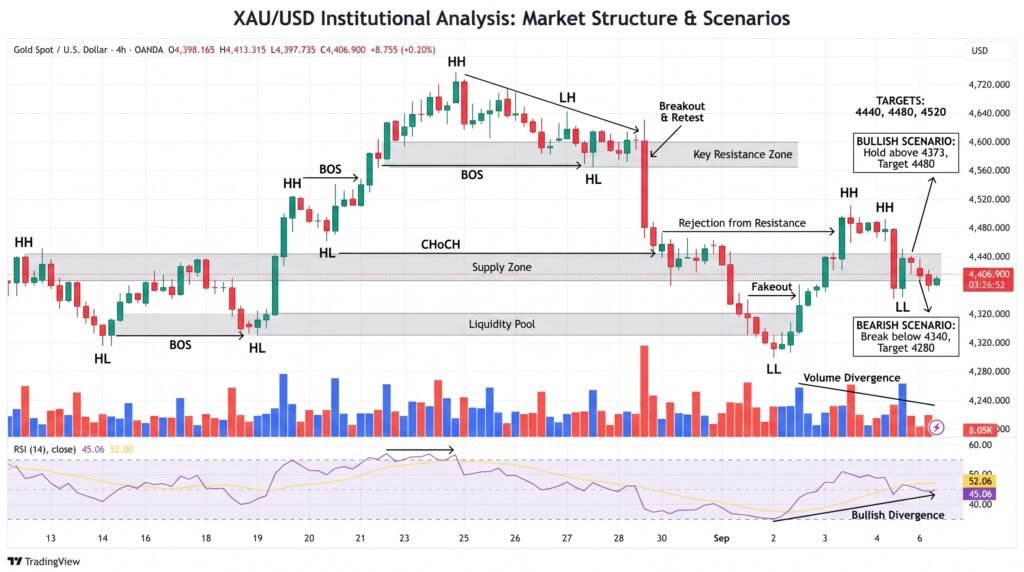
Gold has remained within a relatively narrow range since recovering from around $4,000 an ounce in July. Its break below the 200-day moving average near $4,526 last week created short-term technical weakness.
Tony Sycamore, senior market analyst at IG, said the break had not altered his medium-term view that gold established a base around the late-June low near $3,942. He continues to favor buying pullbacks and expects gold eventually to move toward $5,000.
Conclusion
Gold prices remain near $4,400 as stronger U.S. employment data increase expectations for a September Fed rate hike, while renewed Iran tensions support demand for bullion. The conflicting forces have kept gold within a relatively tight range after its recent decline below the 200-day moving average. The immediate focus is now on U.S. inflation data, which could significantly alter interest-rate expectations. If inflation remains firm, higher-rate bets could pressure gold further. If inflation moderates while geopolitical risks persist, bullion could regain momentum toward its previous highs.
Sources & Methodology
Primary-source standard: Market-moving facts should link to original data releases, regulator notices, company filings or official project announcements whenever available. Secondary reporting is used for additional context, not as a substitute for original evidence.
Page last reviewed: