
The gold price remained close to $4,500 an ounce on Friday after rising about 2% in the previous session, as investors reassessed the Federal Reserve’s interest-rate outlook before the release of August U.S. employment data.
Spot XAU/USD was around $4,468.27 an ounce, while December U.S. gold futures were near $4,514.60. The U.S. Dollar Index was around 99.4, reflecting continued weakness in the dollar after a sharp rise in the Japanese yen.
Gold’s advance followed comments from Federal Reserve Governor Christopher Waller, who said he could support leaving interest rates unchanged at the Fed’s September 15-16 meeting if incoming data confirm that inflation is continuing to moderate. Waller did not rule out a rate increase, saying a renewed acceleration in inflation could change his view.
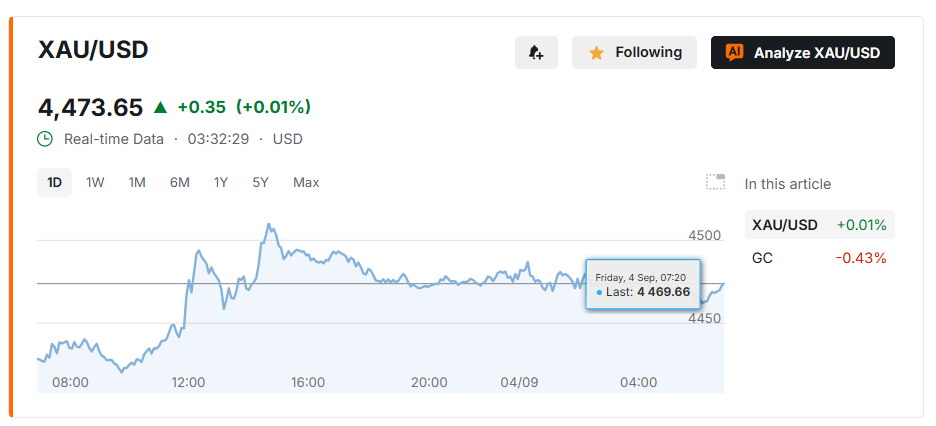
His remarks helped push market expectations for a September rate hike lower. Reuters reported that traders were pricing roughly a 50% probability of an increase, down from around 63% previously.
Because gold generates no interest income, lower expectations for borrowing costs and falling Treasury yields can make bullion relatively more attractive. A weaker dollar also supports dollar-priced gold by reducing the cost for buyers using other currencies.
Jobs report becomes the key test
The U.S. nonfarm payrolls report is now the market’s main focus. A Reuters survey expects employers to have added 56,000 jobs in August, following a decline of 23,000 in July. The unemployment rate is forecast to remain at 4.1%.
The employment picture has already shown signs of slowing. The ADP Employment Report showed private employers added only 38,000 jobs in August, below the 48,000 increase economists had expected. July’s gain was revised to 46,000.
The ADP figure does not reliably predict the government payrolls number, so traders will be looking for confirmation from the official report. A weaker-than-expected result could reduce expectations for a September rate increase and put further downward pressure on yields.
A stronger report could reverse that move by reinforcing the case for tighter monetary policy.
Several factors could make the payrolls release less straightforward than the headline number suggests. Reuters notes that slower labor-force participation, retirements, lower immigration and higher energy costs are affecting employment growth. Wage gains are also becoming an important part of the Fed’s assessment because slower wage pressure could help moderate services inflation.
The main scenarios are:
- Weak payrolls: Lower yields could support gold.
- Strong payrolls: Higher yields could pressure XAU/USD.
- Higher unemployment: Could reinforce expectations for steady rates.
$4,500 tests the technical structure
Gold’s move back toward $4,500 puts the psychological level at the center of the near-term chart. Reuters reported that analysts are watching $4,500 as an important upside level, with $4,700 potentially next if gold holds above the $4,400 region.
The recovery follows a significant selloff earlier in the week. Gold dropped to around $4,282, its lowest level in nearly four weeks, before reversing higher as Treasury yields and the dollar eased.
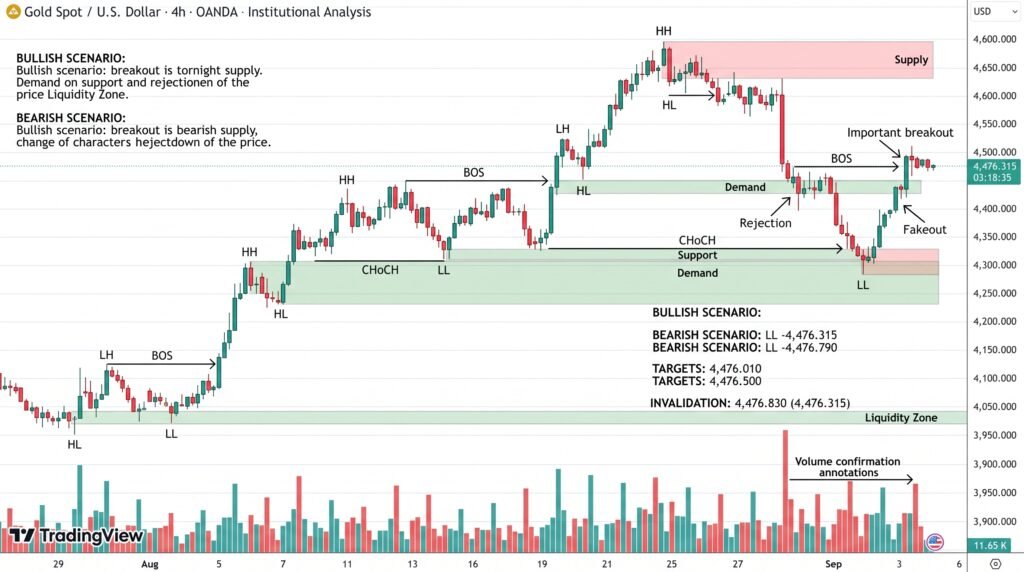
GOLD Price Chart – Source: Tradingview
The 200-day moving average near $4,526 remains an important technical reference. Gold’s earlier break below that average damaged the short-term technical structure, but analysts cited by Reuters said the broader medium-term trend remained supported by the price holding above the late-June low near $3,942.
The next move will depend on whether gold can reclaim and hold above the 200-day average. A sustained break above $4,526 would improve the technical picture, while failure near that level could leave the metal vulnerable to another correction.
Gold also remains sensitive to energy prices and Middle East developments. Earlier gains in oil increased inflation concerns and strengthened the case for restrictive monetary policy. A moderation in energy prices has recently reduced some of that pressure, helping gold recover alongside lower yields.
Next week’s U.S. inflation data will provide another major test. Even if payrolls are weak, persistent inflation could limit the Federal Reserve’s ability to ease policy aggressively. Conversely, softer inflation combined with weaker employment would strengthen the argument for keeping rates unchanged.
Conclusion
Gold is holding near $4,500 after a 2% rally as Christopher Waller’s comments reduce expectations for a September Federal Reserve rate increase. The immediate test is the U.S. payrolls report, with markets expecting 56,000 new jobs and a 4.1% unemployment rate. A weak report could push Treasury yields lower and support XAU/USD, while stronger hiring could restore pressure on bullion. Technically, $4,500 and the 200-day moving average near $4,526 are key levels. The next major direction will depend on employment data, inflation and the Fed’s response to both.
Sources & Methodology
Primary-source standard: Market-moving facts should link to original data releases, regulator notices, company filings or official project announcements whenever available. Secondary reporting is used for additional context, not as a substitute for original evidence.
Page last reviewed: