
Gold prices turned lower on Thursday as investors reassessed Federal Reserve Chair Kevin Warsh’s inflation message after the central bank left rates steady. Spot gold (XAU/USD) fell about 0.4% to near $4,050 an ounce after earlier climbing to a one-week high around $4,100 following the Fed decision. A firmer U.S. dollar and recovering Treasury yields weighed on bullion, while silver and platinum also declined.
Gold Slides 0.4% Following Fed Hold, Markets Eye September Rate Hike
At around 00:44 ET (04:44 GMT) on July 30, XAU/USD was down roughly 0.4% near $4,049–$4,059 an ounce after touching highs near $4,100.42 earlier in the session. Gold futures were modestly higher at around $4,047–$4,051. Silver (XAG/USD) slipped about 0.6% toward $57.32–$57.50. Platinum (XPT/USD) fell around 1.3% near $1,597–$1,600.
The Federal Open Market Committee voted 9-3 on July 29 to keep the federal funds rate in the 3.50%–3.75% range for a fifth consecutive meeting. Cleveland Fed President Beth Hammack, Minneapolis Fed President Neel Kashkari and Dallas Fed President Lorie Logan dissented in favor of a 25-basis-point increase.
Gold initially rallied after the decision as Treasury yields retreated and the U.S. Dollar Index weakened, boosting non-yielding bullion. Gains faded once investors digested Warsh’s remarks reiterating the Fed’s commitment to returning inflation to its longstanding 2% target. The Dollar Index traded near 100.7–101, while benchmark yields recovered from post-decision lows.
CME FedWatch data showed markets pricing roughly a 59–64% probability of a September rate hike, down from higher levels before the announcement in some readings.
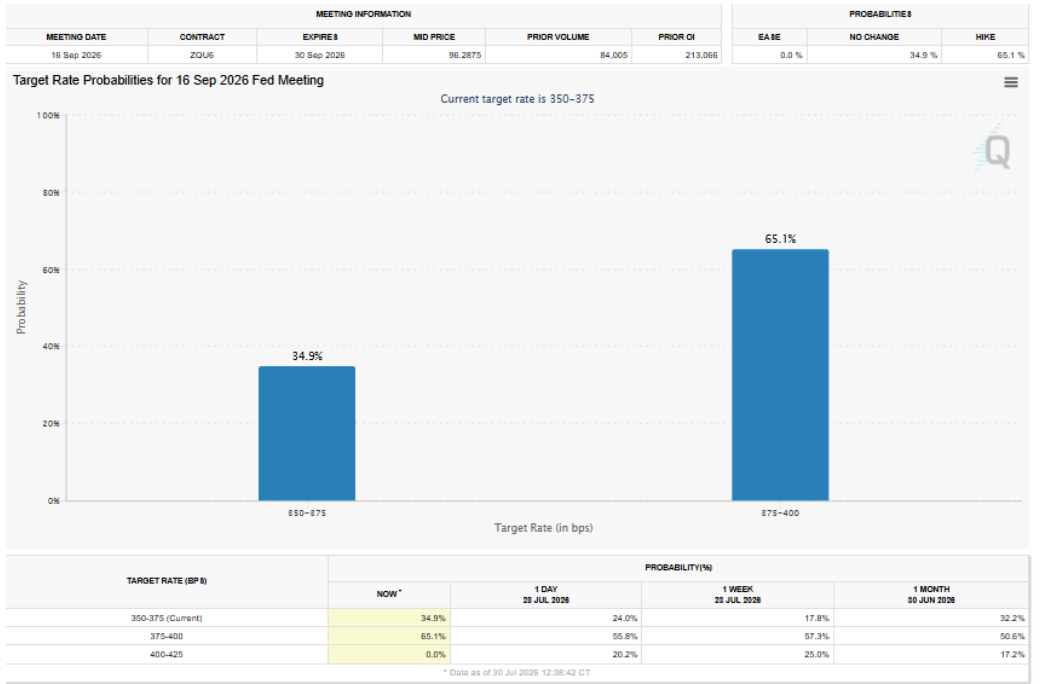
Hawkish Fed Signals Erase Gold’s Post-Decision Rally
The initial boost for gold stemmed from the rate pause, which reduced the opportunity cost of holding non-yielding assets as yields dipped and the dollar softened briefly. The subsequent fade reflected Warsh’s hawkish tone on inflation persistence after more than five years above target, plus the three dissents signaling internal pressure for tighter policy. A recovering dollar and higher yields then limited further upside for bullion. Persistent Middle East tensions and elevated energy prices added to inflation concerns, complicating any near-term easing path.
Gold Trades in $3,950–$4,200 Range as Fed Stays Hawkish, Inflation Hits 4.1%
Warsh, in his second meeting as Fed chair, has repeatedly stressed “no tolerance” for elevated inflation and removed forward guidance from statements. Inflation has remained above the 2% goal for over five years; recent PCE data showed headline inflation at 4.1% year-over-year in May and core at 3.4%.
Renewed U.S. strikes against Iranian targets overnight, described by U.S. Central Command as a response to attempted Iranian attacks on American forces, kept oil prices elevated. Shipping risks intensified after Iran-backed Houthis warned they would target Saudi vessels. These developments have reinforced sticky inflation risks and supported higher energy costs that feed into broader price pressures.
Gold has traded in a roughly $3,950–$4,200 range in recent weeks after earlier peaks near $5,600 amid the prolonged Middle East conflict. Silver and platinum have moved in sympathy with gold and energy-related volatility.
What’s next
Investors await Thursday’s U.S. Personal Consumption Expenditures price index (the Fed’s preferred inflation gauge) for June data, due at 8:30 a.m. ET, for fresh clues on the inflation outlook and rate path. Attention also turns to policy decisions from the Bank of England and Bank of Japan later this week; both are expected to leave rates unchanged. Further developments in Middle East tensions and oil markets will remain key drivers for precious metals and inflation expectations.
Sources & Methodology
Primary-source standard: Market-moving facts should link to original data releases, regulator notices, company filings or official project announcements whenever available. Secondary reporting is used for additional context, not as a substitute for original evidence.
Page last reviewed: