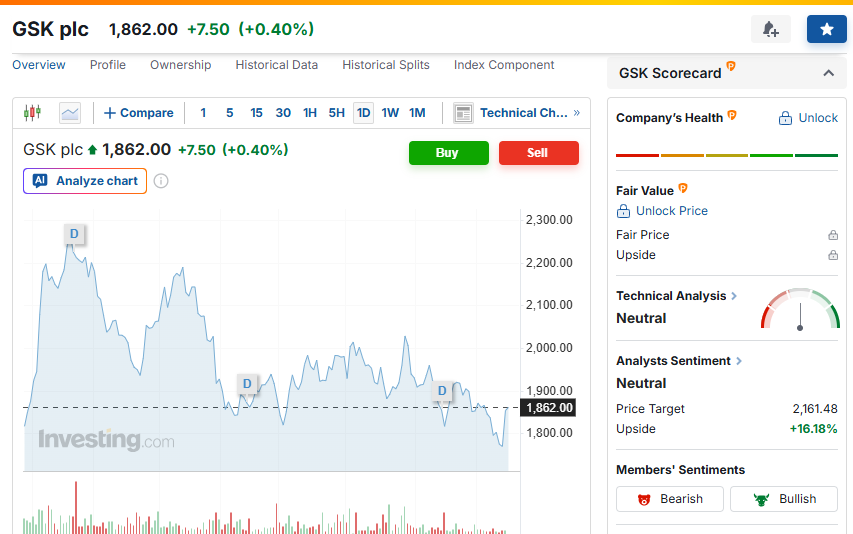
British pharmaceutical giant GSK saw its shares rise 0.4% to £18.62 in early London trading on Tuesday after Berenberg upgraded the stock to “Buy” from “Hold” and raised its price target to £22 from £20. The broker highlighted stepped-up dealmaking, a stronger late-stage pipeline and an overly deep valuation discount relative to European peers as key reasons for the more constructive stance, as reported by market sources including MarketScreener and dpa-AFX.
Berenberg Upgrades GSK to Buy, Citing Stronger Pipeline and Undervalued Shares
Berenberg analyst Kerry Holford upgraded GSK, noting the company trades at 9.6 times 2027 adjusted earnings — a 23% discount to European pharmaceutical peers at 12.4 times. The broker argued this gap is no longer justified given improving pipeline breadth and stronger returns on research and development.
According to Berenberg, 10 of GSK’s 11 novel Phase 3 assets were sourced externally. Six of those late-stage assets are each capable of generating at least £2 billion in peak annual sales. The broker forecasts 2031 sales of about £39 billion, above consensus of roughly £36 billion and closer to GSK’s own guidance of more than £40 billion. Newly launched products such as Exdensur (depemokimab) and Blenrep are expected to contribute, alongside further potential from bepirovirsen, Nuvalent’s lung-cancer assets (including neladalkib) and oncology antibody-drug conjugates developed with Hansoh.
Berenberg also pointed to GSK’s cost-saving programme, which targets £1.9 billion of annual savings by 2029. This is expected to support research spending and help keep margins stable to improving despite the erosion of high-margin oral HIV products (notably those based on dolutegravir) from 2028. A recent Berenberg analysis of the sector ranked GSK fourth for return on research investment (RORI) at 11%, above the industry average of 9%.
Near-term catalysts include expected U.S. regulatory decisions on bepirovirsen for hepatitis B by 26 October and on neladalkib for second-line ALK-positive lung cancer by 27 November. Additional Phase 3 and proof-of-concept data are due over the next 12 months across programmes in small-cell lung cancer, HIV, asthma, food allergy and bronchiectasis. On the same day, GSK also announced a deal to acquire a T-cell engager programme from Chimagen Biosciences for up to $750 million, further bolstering its oncology pipeline.
Shares Rise 0.3–0.4% to £18.60–£18.62 as Upgrade Eases Valuation and Pipeline Concerns
Investors responded positively to the upgrade because it directly addresses long-standing concerns over GSK’s valuation discount and the ability of its pipeline to offset patent losses in HIV. Shares rose modestly in early trading (around 0.3–0.4% to the £18.60–£18.62 area, with some real-time quotes near 1,860–1,861p), reflecting cautious optimism rather than a sharp rally. The upgrade from a previously neutral stance, combined with concrete peak-sales estimates for multiple assets and a clearer path to £39–40 billion in 2031 sales, reduced perceived risk around the post-2028 growth profile. The simultaneous news of the Chimagen deal reinforced the narrative of active pipeline replenishment through business development.
GSK Rebuilds Pipeline via External Deals, Targets >£40bn Sales by 2031 Amid £1.9bn Cost Savings
GSK has spent recent years rebuilding its pipeline after the spin-off of its consumer healthcare business and amid pressure from patent expiries, particularly in its large HIV franchise. The company has leaned heavily on external sourcing — in-licensing, acquisitions and partnerships — to fill late-stage gaps. This includes the Nuvalent transaction that brought lung-cancer assets such as neladalkib (PDUFA date expected in November 2026 for pre-treated ALK-positive NSCLC) and zidesamtinib/Jideytro, as well as collaborations on antibody-drug conjugates.
Exdensur (depemokimab), an ultra-long-acting anti-IL-5 biologic, and Blenrep (belantamab mafodotin) are among the key newly launched or expanding products expected to drive nearer-term growth. Bepirovirsen, an antisense oligonucleotide for chronic hepatitis B, has delivered positive Phase 3 functional-cure data and faces regulatory decisions later in 2026. GSK’s broader late-stage portfolio includes multiple assets in oncology, respiratory and infectious disease, with the company previously highlighting confidence in reaching more than £40 billion in sales by 2031. Cost discipline remains central, with the £1.9 billion annual savings target by 2029 designed to protect margins while funding R&D. Analyst consensus has generally been more cautious (often Hold), making Berenberg’s shift to Buy notable.
Key Catalysts Ahead: Bepirovirsen US Decision by 26 Oct, Neladalkib by 27 Nov
Attention now turns to the near-term regulatory catalysts: the U.S. decision on bepirovirsen expected by 26 October and on neladalkib by 27 November. Further Phase 3 and proof-of-concept readouts over the coming 12 months in small-cell lung cancer, HIV, asthma, food allergy and bronchiectasis will be closely watched for evidence that the pipeline can deliver the forecast sales uplift. Investors will also monitor progress on the cost-saving programme, commercial execution of Exdensur and Blenrep, and any additional business-development activity. Successful outcomes could help close the valuation gap to peers and support the case for sustained growth through and beyond the HIV patent cliff.
Sources & Methodology
Primary-source standard: Market-moving facts should link to original data releases, regulator notices, company filings or official project announcements whenever available. Secondary reporting is used for additional context, not as a substitute for original evidence.
Page last reviewed: