
Bitcoin slipped below $77,000 on Tuesday as investors reduced risk ahead of two events that could reshape the cryptocurrency market: the U.S. Senate’s vote on the CLARITY Act and the Federal Reserve’s policy decision. BTC fell about 1.4% to $76,921, while higher Treasury yields and rising oil prices added to pressure across speculative assets.
The market is facing a particularly important 48-hour window. The Federal Reserve is widely expected to raise interest rates by 25 basis points Wednesday, while the Senate is testing whether the CLARITY Act can secure the 60 votes required to advance.
CLARITY Act Faces Senate Test
The Senate vote is the immediate regulatory catalyst for Bitcoin and the wider digital-asset market. The legislation seeks to establish a broader U.S. framework for digital assets and clarify the respective roles of the Securities and Exchange Commission and the Commodity Futures Trading Commission.
Republican lawmakers have worked to attract Democratic support after disagreements emerged over ethics provisions, stablecoin rewards and the treatment of decentralized finance. The latest draft contains changes intended to address several objections, including restrictions aimed at preventing public officials from benefiting improperly from crypto activities.
The vote does not make the legislation law. It is a procedural test of whether supporters can reach the 60-vote threshold and move the measure forward for additional debate and amendments.
A successful advance could reduce regulatory uncertainty for crypto businesses and potentially improve institutional confidence. Failure would extend uncertainty around the U.S. market-structure framework.
Fed Policy Keeps BTC Under Pressure
Monetary policy is providing the stronger near-term headwind. A Reuters poll found 85% of economists expected the Fed to raise its benchmark rate by 25 basis points to 3.75%–4.00% at the September 15–16 meeting. Markets have priced the probability even higher at roughly 94%.
The latest U.S. inflation data have strengthened the case for tighter policy. August consumer inflation increased 0.4% month over month and 3.4% year over year, while producer prices rose 0.4% monthly and 5.4% annually.
Higher rates can weigh on Bitcoin by lifting bond yields and the dollar, reducing the appeal of riskier assets. That pressure has intensified as the 10-year Treasury yield climbed above 5%, its highest level since 2007.
Oil’s surge is adding to the problem. Brent crude has moved above $107 a barrel, while WTI has traded above $102 as Middle East supply disruptions reinforce inflation concerns.
Altcoins Follow Bitcoin Lower
The broader cryptocurrency market also weakened as investors reduced exposure ahead of the policy events. Ethereum fell about 2% to $2,474.97, while XRP declined about 0.4%.
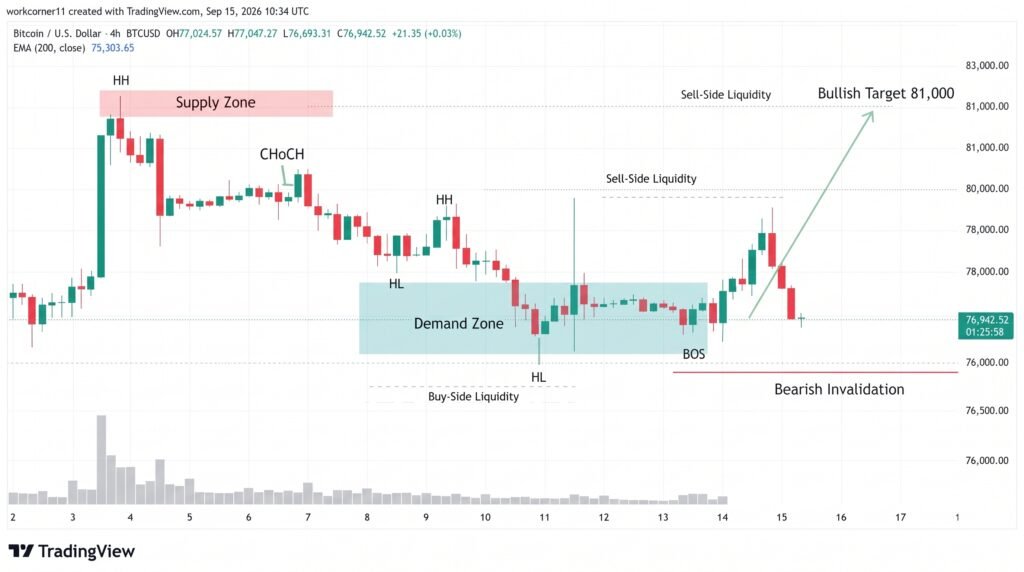
Other major tokens also moved lower:
- Solana, Cardano and BNB fell roughly 1%–3.5%.
- Dogecoin dropped about 2.2%.
- Official Trump-linked token $TRUMP declined about 1.4%.
The broad weakness suggests Tuesday’s decline is not isolated to Bitcoin. Instead, investors appear to be reducing exposure ahead of potentially market-moving policy and regulatory decisions.
Conclusion
Bitcoin is entering a pivotal period near $77,000, with monetary policy and U.S. crypto legislation pulling sentiment in different directions. The CLARITY Act could reduce regulatory uncertainty if it clears the Senate’s 60-vote hurdle, while a Fed rate hike and Treasury yields above 5% create a significant near-term headwind. Until those catalysts pass, BTC is likely to remain sensitive to shifts in rates, the dollar and broader risk appetite. A successful regulatory vote could improve sentiment, but tighter financial conditions could continue to cap Bitcoin’s recovery.
Sources & Methodology
Primary-source standard: Market-moving facts should link to original data releases, regulator notices, company filings or official project announcements whenever available. Secondary reporting is used for additional context, not as a substitute for original evidence.
Page last reviewed: