
The NZD/USD pair is attempting to stabilize above 0.5700 after New Zealand’s economy delivered a stronger-than-expected second-quarter growth reading. Statistics New Zealand reported GDP growth of 0.2% quarter over quarter in the June 2026 quarter, beating the 0.1% forecast and following a 0.9% expansion in the March quarter. Despite the positive domestic data, the Kiwi remains under pressure after the Federal Reserve raised rates to 3.75%-4.00% and indicated another increase could come before year-end.
GDP Beats Forecasts, Kiwi Still Lags
New Zealand’s economy grew 0.2% in Q2, while annual growth reached 2.6%, according to Reuters, exceeding the 2.2% market expectation. Construction was among the main contributors, rising 2.7%, although weakness in transport, postal and warehousing activity limited the overall gain.
The stronger GDP figure initially helped the New Zealand dollar recover from a two-month low near 0.5735. However, the rebound has struggled to develop into a broader recovery. FXStreet reported NZD/USD trading around 0.5725 early Thursday, showing that the market remains focused on the wider U.S. dollar backdrop.
The main external pressure is the renewed strength of the greenback following the Fed’s September decision. The central bank raised rates by 25 basis points on September 16, its first increase since 2023, and projections showed most policymakers expect at least one additional hike this year.
- Q2 GDP growth: 0.2%
- Annual GDP growth: 2.6%
- Recent NZD/USD low: 0.5735
- Key Fibonacci support: 0.5706
Technical Levels Keep Bias Bearish
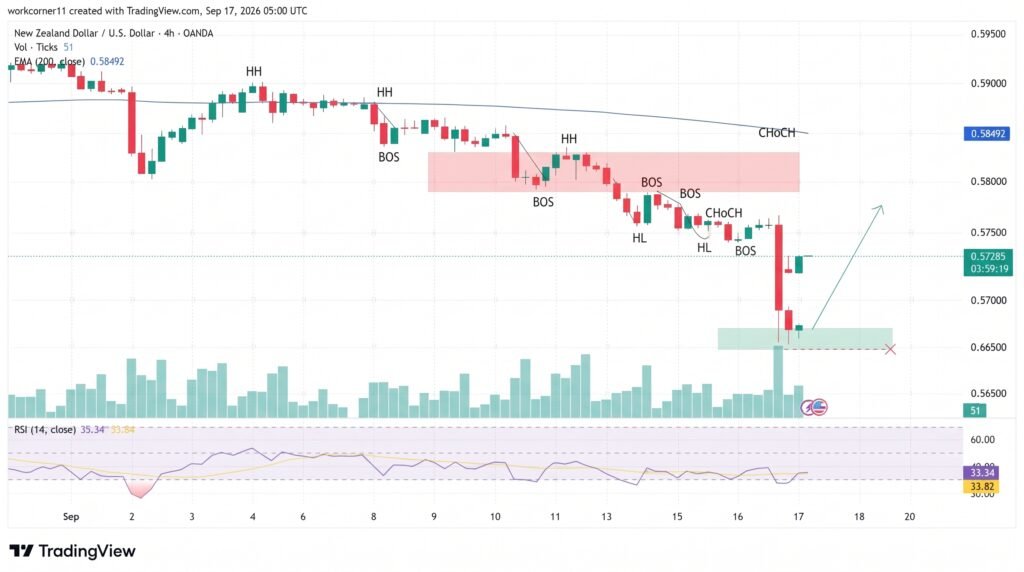
The technical structure remains weak after NZD/USD failed to sustain its recovery toward 0.6000. The pair has traded beneath the broader moving-average resistance zone, with the supplied setup placing the 200-day SMA near 0.5855.
The MACD remains below zero, confirming negative momentum, while the RSI is close to oversold territory. That combination points to persistent selling pressure, although a deeply weak RSI can also increase the probability of short-term rebounds.
The immediate resistance zone begins at the 61.8% Fibonacci retracement near 0.5767. Above that, the 50% retracement at 0.5811 and the 38.2% level near 0.5850 create a broader barrier.
A sustained recovery above 0.5854 would weaken the immediate bearish structure and expose 0.5907, followed by the cycle-high region near 0.5994.
Fed Strengthens the Dollar Advantage
The Federal Reserve’s latest policy shift has changed the interest-rate backdrop for NZD/USD. The central bank lifted the federal funds target range to 3.75%-4.00%, while its September projections pointed to another increase in 2026.
That policy path can keep the U.S. dollar supported against higher-beta currencies such as the Kiwi. The dollar also received a broader boost after the Fed announcement, while market attention remains fixed on inflation, U.S. Treasury yields and the possibility of further tightening.
For NZD/USD, 0.5706 remains the immediate downside reference. A decisive break below that level would expose the recent swing low around 0.5627. Conversely, a move above 0.5767 would provide the first indication that sellers are losing control.
Conclusion:
NZD/USD has gained some support from New Zealand’s stronger-than-expected 0.2% Q2 GDP growth, but the recovery remains fragile after the Federal Reserve delivered a 25-basis-point rate hike and kept the prospect of another increase alive. Technically, 0.5767 and 0.5811 are the first recovery hurdles, while 0.5706 and 0.5627 remain the key downside levels. A sustained break above 0.5854 would be needed to materially weaken the current bearish structure.
Sources & Methodology
Primary-source standard: Market-moving facts should link to original data releases, regulator notices, company filings or official project announcements whenever available. Secondary reporting is used for additional context, not as a substitute for original evidence.
Page last reviewed: