
- Pi Network (PI) dropped about 14% in 24 hours, falling toward $0.08 as the broader crypto market weakened.
- The U.S. Senate failed to advance the CLARITY Act, adding to risk-off sentiment across Bitcoin, Ethereum and smaller cryptocurrencies.
- Pi’s protocol v27 upgrade is underway, while traders are watching the $0.075–$0.085 region for signs of stabilization.
Pi Network suffered one of the sharpest losses among major cryptocurrencies on September 16, with PI falling roughly 14% toward $0.08–$0.083. The decline followed a broader digital-asset sell-off after the U.S. Senate failed to advance major crypto market-structure legislation. Despite the immediate weakness, PI is approaching an important technical support region, while the network continues its protocol v27 upgrade. The combination puts attention on whether buyers can defend the recent lows and eventually push PI back above the psychologically important $0.10 level.
CLARITY Vote Adds Pressure to Crypto
The wider sell-off followed the Senate’s failure to advance the Digital Asset Market Clarity Act. Official Senate records show the cloture motion on proceeding to H.R. 3633 was rejected 49–50 on September 15. The measure needed 60 votes to advance. The result therefore represented a procedural setback rather than a final rejection of the legislation itself.
Bitcoin subsequently traded below $76,000 during the broader market reaction, while crypto-related equities also came under pressure. PI experienced a considerably larger percentage decline, falling toward levels last seen around early August. The move also pushed its market capitalization below the $1 billion threshold, according to market data cited in reports.
Pi Network Continues Protocol v27 Upgrade
The price decline comes while Pi Network is implementing another technical update. Pi Network’s official Node page confirms that the Mainnet blockchain protocol is undergoing an upgrade and Mainnet nodes must move to v27.
Protocol 27 had already been undergoing testing before the latest Mainnet transition. Earlier network measurements showed one Pi testnet running protocol 27 while Mainnet remained on protocol 26, illustrating the staged nature of the rollout.
The upgrade is important for the network’s infrastructure, but it does not guarantee higher PI prices. Token performance will continue to depend on liquidity, demand, broader crypto conditions and adoption of the Pi ecosystem.
Can PI Recover Above $0.10?
From a technical perspective, the $0.075–$0.085 area has become the immediate zone to watch following the sharp decline. Some traders are monitoring the chart for a possible double-bottom structure, but such a formation requires confirmation. Simply touching support twice does not establish a bullish reversal.
A recovery above $0.10 would be the first significant sign that buyers are regaining short-term control. Sustained strength above that threshold could bring higher resistance levels, including the $0.12–$0.14 region, back into consideration.
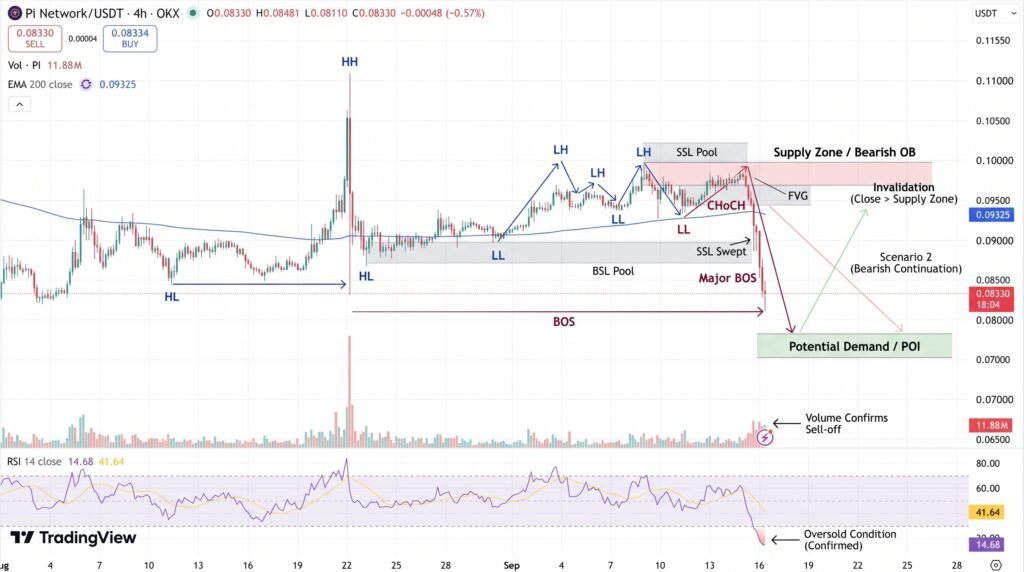
On the downside, failure to defend roughly $0.075 would weaken the recovery scenario and expose PI to another price-discovery phase. Momentum indicators also show heavily stretched conditions. An RSI reading in the low 20s would normally qualify as oversold, but oversold conditions can persist during strong downtrends and should not be treated as confirmation that a bottom has formed.
Conclusion
Pi Network’s 14% decline reflects both broader crypto-market weakness and PI’s relatively high volatility. The CLARITY Act setback added uncertainty across digital assets, while Pi’s ongoing protocol v27 upgrade provides a separate fundamental development for the network.
For price action, $0.075–$0.085 is the immediate support region, while $0.10 is the key recovery threshold. Holding support and reclaiming $0.10 would improve the technical structure; losing the lower end of the support range would keep downside risk elevated.
Sources & Methodology
Primary-source standard: Market-moving facts should link to original data releases, regulator notices, company filings or official project announcements whenever available. Secondary reporting is used for additional context, not as a substitute for original evidence.
Page last reviewed: