The Canadian dollar strengthened modestly against its US counterpart on Tuesday as recovering crude prices helped push USD/CAD toward 1.3990. West Texas Intermediate (WTI) crude rebounded to around $95.80 a barrel after falling nearly 7% in the previous session, offering support to Canada’s commodity-linked currency. However, uncertainty surrounding US-Iran negotiations and the US midterm elections is limiting the dollar’s decline. Investors are also monitoring shifting Federal Reserve rate expectations for clues about the next direction in the currency pair.
Oil recovery supports the Canadian dollar
USD/CAD edged lower during Tuesday’s Asian session after recording modest gains a day earlier. The move followed a partial recovery in oil prices, which remain an important influence on the Canadian dollar because Canada is the largest crude oil exporter to the United States.
WTI crude traded near $95.80 per barrel, recovering part of its previous session’s decline of almost 7%. Higher oil prices can improve Canada’s export revenues and strengthen demand for the Canadian dollar, putting downward pressure on USD/CAD.
The recovery remains vulnerable to developments in the Middle East. Iran has confirmed that indirect discussions with Washington are continuing, with Qatar helping mediate the negotiations. The latest consultations have produced revised proposals, but no major breakthrough has been announced.
Iranian Foreign Minister Abbas Araqchi said Tehran had presented its conditions and that further progress depended on political decisions in Washington. US President Donald Trump had previously indicated that he would avoid military action against Iran before the midterm elections. Any diplomatic progress could ease concerns about potential supply disruptions and limit further gains in crude prices.
US elections and Fed expectations
The US midterm elections are adding another layer of uncertainty for currency markets. Polling ahead of Election Day broadly favored Democrats in the contest for the House of Representatives, while control of the Senate remained less certain. Investors are watching the outcome for potential implications for fiscal policy, government spending and the political outlook.
The uncertainty may support demand for the US dollar as a safe-haven currency, limiting the Canadian dollar’s advance. At the same time, expectations for Federal Reserve policy have shifted.
Market pricing indicated roughly a 73% probability of another 25-basis-point rate increase in December, down from about 80% a week earlier. These probabilities reflect market expectations rather than a commitment by policymakers.
Strategists at Brown Brothers Harriman said the dollar and short-term Treasury yields had weakened as Fed Chair Kevin Warsh adopted a patient tone despite limited progress on inflation. They also cited concerns about a possible slowdown in artificial-intelligence investment, which could weigh on the US growth outlook and reduce pressure for further monetary tightening.
USD/CAD outlook: Key drivers ahead
The pair’s immediate direction depends on whether oil’s recovery can continue and whether election-related demand for the dollar strengthens.
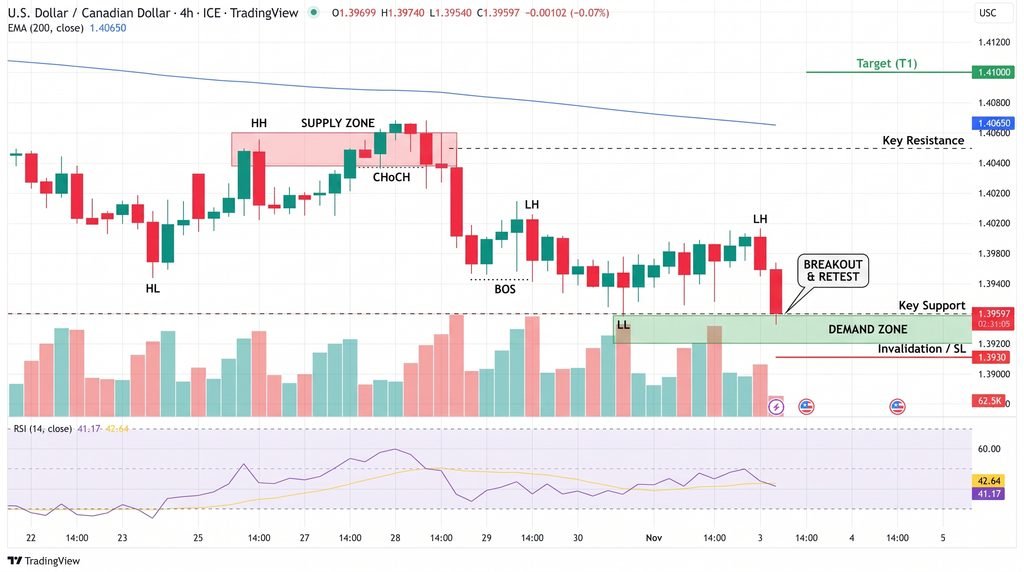
Traders are monitoring several factors:
- WTI crude: Around $95.80 after a nearly 7% previous-session decline.
- USD/CAD: Near 1.3990 during Tuesday’s Asian session.
- Fed expectations: Approximately 73% probability of a December rate hike.
- Geopolitics: Progress in US-Iran talks could influence energy prices.
- US elections: The result may affect fiscal expectations and dollar demand.
Conclusion
The Canadian dollar is receiving near-term support from recovering oil prices, but the currency’s gains face competing pressures from geopolitical uncertainty and demand for the US dollar. Continued crude strength could keep USD/CAD under pressure around 1.3990, while renewed oil weakness or stronger safe-haven demand could help the pair recover. The next significant moves in oil, US policy expectations and election-related sentiment will be central to the currency pair’s direction.
Sources & Methodology
Primary-source standard: Market-moving facts should link to original data releases, regulator notices, company filings or official project announcements whenever available. Secondary reporting is used for additional context, not as a substitute for original evidence.
Page last reviewed: