
The USD/JPY exchange rate extended its V-shaped recovery toward 157.90 on Wednesday, October 28, 2026, as the US dollar strengthened ahead of the Federal Reserve’s interest-rate decision. The US Dollar Index (DXY), which measures the greenback against six major currencies, traded near 102.50, close to its highest level in more than a week. The pair’s rebound has restored a modest bullish bias, although momentum remains limited. Investors are also preparing for the Bank of Japan’s policy announcement on October 30, which could influence the yen’s next move.
Fed Policy Keeps Dollar in Focus
The Federal Reserve’s October 27–28 meeting is the immediate focus for currency markets. Investors are assessing whether policymakers will keep interest rates unchanged and how their comments might shape expectations for December. A more hawkish outlook could support the dollar by increasing the appeal of US assets relative to Japanese investments.
Strategists at OCBC have previously emphasized the importance of the Fed’s future policy guidance. However, references in older market commentary to December 2024 should not be treated as current forecasts. The relevant question in October 2026 is whether inflation and economic growth will prompt the Fed to maintain, ease or tighten policy in subsequent meetings.
The dollar’s recent strength has helped USD/JPY recover from lower levels. The pair reflects how many Japanese yen are required to purchase one US dollar. When the exchange rate rises, the dollar strengthens against the yen; when it falls, the yen gains ground.
Attention will then shift to the Bank of Japan, which is scheduled to meet on October 29–30. The BOJ’s current policy rate is around 1.25%, following its September adjustment, according to its official website. Any indication of further rate increases could support the yen and limit USD/JPY’s advance.
USD/JPY Technical Outlook Turns Positive
On the daily chart, USD/JPY trades near 157.90, slightly above its 20-day exponential moving average (EMA) at 157.75. The EMA gives greater weight to recent prices and can help traders assess short-term direction.
The Relative Strength Index (RSI) stands at 51.45, close to the neutral midpoint of 50. This suggests that buying momentum has improved but does not yet indicate a strong directional trend.
Three levels are particularly important:
- 157.75: The 20-day EMA and immediate support.
- 156.00: A potential downside target if support fails.
- 159.00: Resistance near the September 24 high.
A daily close below 157.75 could weaken the recovery and expose 156.00. Conversely, a decisive break above 159.00 would strengthen the bullish case and potentially open the way to further gains.
Fed and BOJ Risks Could Shift Momentum
The interest-rate gap between the United States and Japan remains an important driver of USD/JPY. Higher US yields relative to Japanese yields can encourage investors to favor dollar-denominated assets, although exchange rates also respond to economic data, risk appetite and changing expectations.
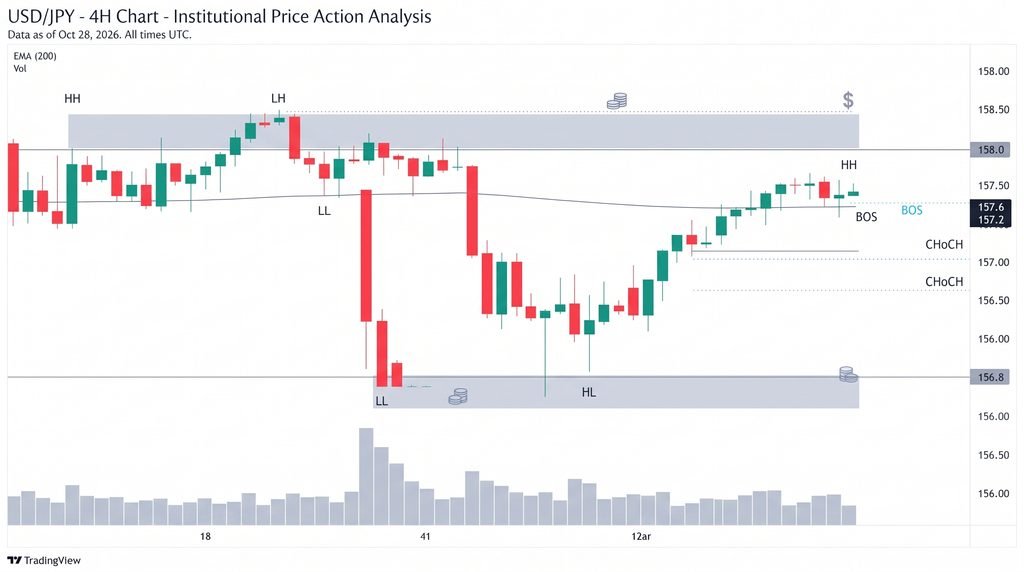
The upcoming decisions create risks in both directions. A hawkish Fed message combined with a cautious BOJ stance could support the pair. Conversely, a less hawkish Fed or stronger signals of Japanese monetary tightening could trigger a yen recovery.
Conclusion
USD/JPY’s rebound toward 158.00 has improved its short-term technical outlook, but the RSI points to only moderate momentum. Holding above 157.75 would keep the recovery intact, while a break below could expose 156.00. A sustained move above 159.00 is needed to establish a stronger bullish case. The Fed’s guidance and the BOJ’s policy decision are likely to determine the pair’s next direction.
Sources & Methodology
Primary-source standard: Market-moving facts should link to original data releases, regulator notices, company filings or official project announcements whenever available. Secondary reporting is used for additional context, not as a substitute for original evidence.
Page last reviewed: