XRP surged to $1.30 on August 20, extending a rapid recovery from the $1 area as large-holder accumulation and a broader cryptocurrency rebound strengthened demand. The token gained roughly 25%–30% during the advance, while Bitcoin climbed above $72,000, lifting sentiment across the crypto market. The move was notable because XRP had recently fallen below $1, with traders watching substantially lower support levels. Current data points to whale accumulation as an important contributor, although it does not establish that large holders alone caused the rally.
XRP Whales Accumulate 300M Tokens
The clearest evidence of increased large-holder activity came from on-chain data highlighted by crypto analyst Ali Martinez. Whale wallets accumulated more than 300 million XRP within 96 hours, according to data he shared as XRP accelerated from around $1 toward $1.30.
That buying followed another accumulation period on August 13, when whales reportedly acquired more than 72 million XRP in 24 hours while the token remained near $1.
The sequence is important because major holders were increasing exposure before the sharp price breakout rather than chasing XRP only after prices had risen.
Market observer Vincent Van Code separately reported that transaction activity during the rally was heavily weighted toward larger orders:
- 53% of the measured activity came from large orders.
- 35% was classified as medium-sized activity.
- 12% was attributed to smaller orders.
Those figures support the argument that larger participants played a substantial role. However, order-size data cannot reliably identify every buyer as an institution, fund or professional investor.
XRP whale accumulation data therefore provides evidence of concentrated buying, but not definitive proof of who controlled the rally.
XRP ETF Demand Returns
U.S. spot XRP ETFs have also returned to positive flows. The funds recorded approximately $5.81 million of net inflows on August 18, while cumulative flows stood near $1.52 billion by that date.
ETF demand, however, remains much weaker than immediately after the products began trading in November 2025. July brought about $27.29 million in net inflows, marking a fourth consecutive positive month but representing a sharp slowdown from the initial launch period.
That makes ETFs a secondary source of support rather than sufficient evidence that fund buying produced the entire 30% move. XRP also has an established utility beyond trading. It is the native digital asset of the XRP Ledger and can function as a bridge asset for settlement and liquidity. Ripple says XRP-enabled transactions can settle in seconds.
XRP Outlook After the $1.30 Breakout
The rally has encouraged aggressive forecasts. Crypto analyst Patel has argued that $10–$20 could eventually become possible, while other traders have cited resistance breakouts and Ichimoku signals as evidence of a changing trend. These are analyst projections, not established price targets.
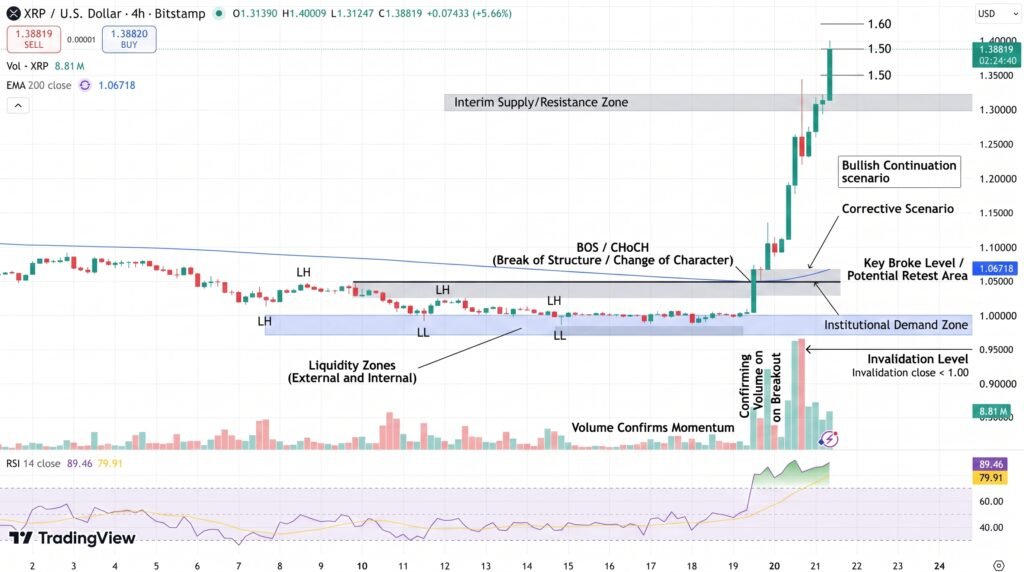
The mathematics shows how ambitious they are. Moving from $1.30 to $10 requires roughly a 669% increase, while $20 would require a gain of about 1,438%.
For now, the measurable development is simpler: XRP recovered sharply from the $1 region, large holders accumulated hundreds of millions of tokens, Bitcoin strengthened, and ETF flows remained positive. The next test is whether XRP can hold its breakout after the 30% advance. Sustained buying above former resistance would strengthen the recovery case; a return toward $1 would indicate that the surge moved faster than underlying demand could support.
Sources & Methodology
Primary-source standard: Market-moving facts should link to original data releases, regulator notices, company filings or official project announcements whenever available. Secondary reporting is used for additional context, not as a substitute for original evidence.
Page last reviewed: