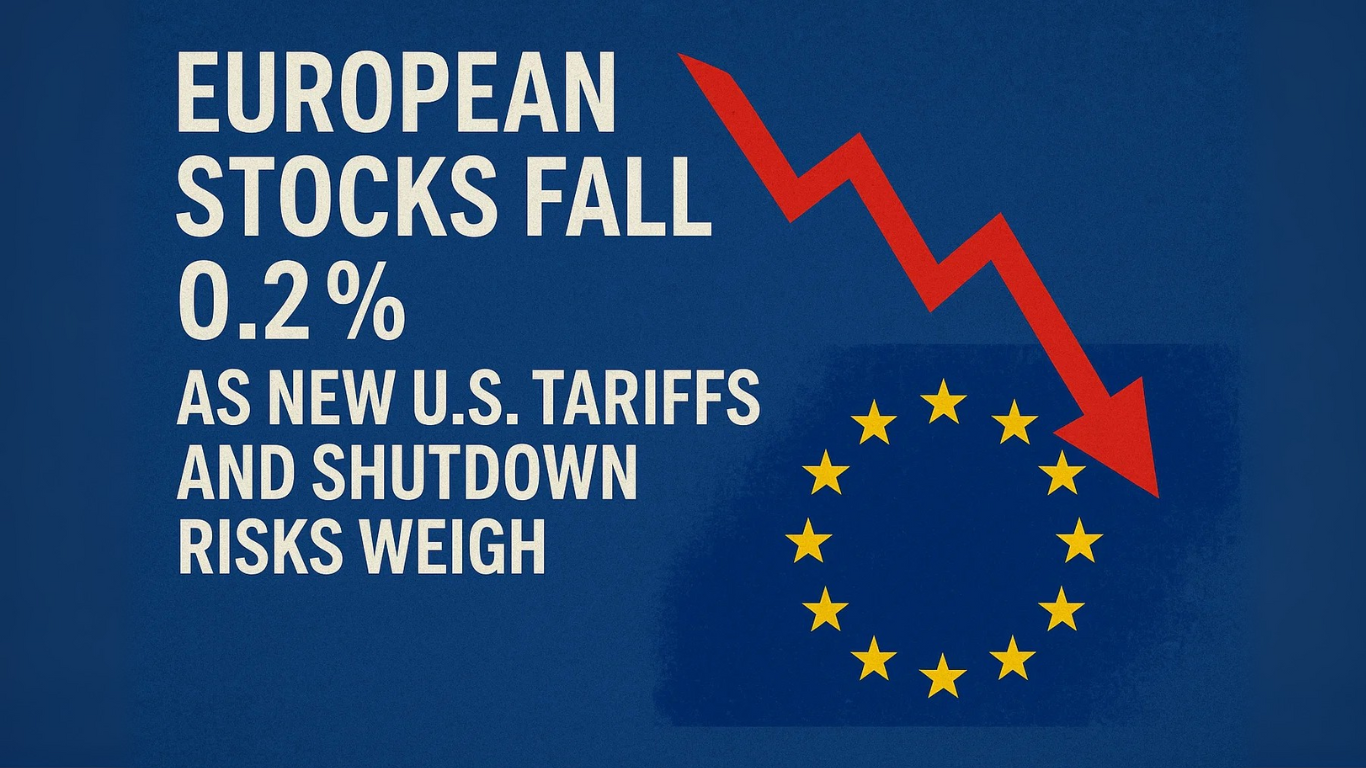
European equities edged lower Tuesday as investors reacted to fresh U.S. tariff measures and mounting fears of a government shutdown in Washington.
By 07:02 GMT, Germany’s DAX fell 0.2%, France’s CAC 40 slipped 0.2%, while the U.K.’s FTSE 100 managed a 0.1% gain. The weakness mirrored broader global unease over trade and political headwinds.
U.S. President Donald Trump on Monday announced tariffs effective October 14, including:
- 10% on softwood lumber and timber imports
- 25% on kitchen cabinets and vanities
- 25% on upholstered wooden products
The announcement followed a 100% tariff on pharmaceutical imports unveiled last week, part of Trump’s push to curb reliance on foreign goods.
Meanwhile, Asian data reinforced trade-related pressures. China’s manufacturing activity contracted for a sixth consecutive month in September, while Japan’s factory output dropped more than expected in August.
In Europe, fresh figures showed German import prices fell 1.5% year-on-year in August, while U.K. GDP grew 0.3% in Q2, a slowdown from the previous quarter’s 0.7% pace.
U.S. Shutdown Risks Loom
Markets are increasingly focused on Washington, where bipartisan talks failed to secure a budget agreement. Without a resolution, the U.S. government could shut down after September 30.
A shutdown would:
- Delay the September nonfarm payrolls report, a key indicator for Federal Reserve policy
- Disrupt upcoming economic data releases
- Weigh on investor confidence at a fragile moment for global markets
Traders are watching today’s JOLTS job openings data for signals on labor demand, especially after the Fed delivered its first rate cut of the year earlier this month.
Corporate Moves and Oil Weakness
In corporate Europe, Danish jewelry maker Pandora said CEO Alexander Lacik will retire in March 2026, with Chief Marketing Officer Berta de Pablos-Barbier set to succeed him.
Scottish soft drinks firm A.G. Barr reported a 20% jump in adjusted pretax profit in the first half, lifted by strong demand for its Boost brand and margin improvements.
Energy markets added to the cautious tone. Brent crude fell 0.5% to $66.76, while WTI dropped 0.4% to $63.20 by 07:02 GMT, leaving both benchmarks on track for monthly losses of more than 1%.
OPEC+ is set to meet on October 5 to discuss raising output by at least 137,000 barrels per day in November, following a scheduled increase for October. The group is gradually shifting from deep cuts to modest production growth as it seeks to defend market share.
Sources & Methodology
Primary-source standard: Market-moving facts should link to original data releases, regulator notices, company filings or official project announcements whenever available. Secondary reporting is used for additional context, not as a substitute for original evidence.
Page last reviewed: