
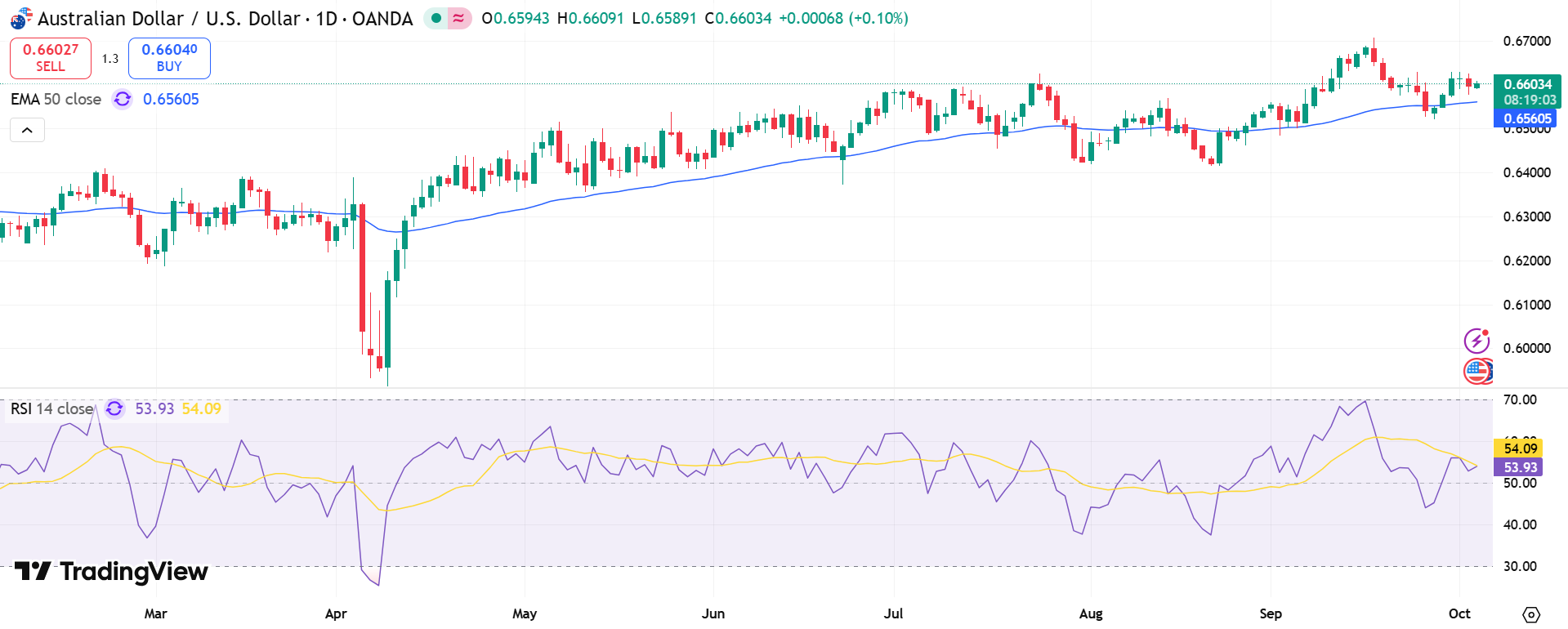
The Australian dollar edged higher Friday, with AUD/USD trading near 0.6590, as traders pared expectations for a November rate cut by the Reserve Bank of Australia (RBA). The pair tested the psychological 0.6600 level, reinforcing bullish momentum.
Daily chart analysis shows the pair moving within an ascending channel, with the 14-day Relative Strength Index (RSI) above 50, suggesting continued upward pressure.
Key levels to watch:
- Resistance: 0.6600 (psychological), 0.6707 (12-month high, Sept. 17), 0.6760 (channel top)
- Support: 0.6595 (9-day EMA), 0.6560 (50-day EMA), 0.6550 (channel base), 0.6414 (four-month low, Aug. 21)
A sustained break above 0.6600 could pave the way toward 0.6700, while a fall below 0.6550 would shift momentum bearish.
Weak Data Clouds Fundamentals
Economic figures released this week highlighted pockets of weakness across the Australian economy.
- Services PMI: slowed to 52.4 in September from 55.8 — still expanding, but at the weakest pace since June.
- Trade Surplus: narrowed sharply to 1.83B AUD, far below forecasts of 6.5B. Exports fell 7.8% MoM, led by weaker gold shipments, while imports rose 3.2% MoM.
- Manufacturing PMI: slipped to 51.4 from 53.0, signaling slower growth.
- AiG Industry Index: improved to –13.2 but remained in contraction.
In its Financial Stability Review, the RBA flagged risks tied to elevated asset prices, rising leverage in non-bank finance, and stress from China’s faltering property sector. While the RBA kept its cash rate at 3.6% in September, Governor Michele Bullock warned that inflationary pressures remain sticky.
Global Drivers and U.S. Labor Signals
External dynamics also weighed on sentiment. Reports that China’s state-run CMRG had asked steelmakers to halt iron ore purchases from BHP briefly pressured the Aussie, though the rumor was later disputed by commodity firm Mysteel.
China’s official Manufacturing PMI improved to 49.8, while the Non-Manufacturing PMI edged down to 50.0, pointing to mixed growth.
Meanwhile, the U.S. dollar extended gains, with the DXY at 97.90, as investors awaited U.S. services PMI data. The shutdown-delayed nonfarm payrolls report heightened reliance on private indicators:
- ADP payrolls (Sept): –32,000 jobs, annual pay growth 4.5%
- Job openings: rose slightly to 7.23M, though hiring slowed to its weakest since June 2024
- Fed rate cut odds: 99% chance of a 25 bps cut in October, 87% for December (CME FedWatch)
Amid these cross-currents, AUD/USD remains supported by reduced RBA cut expectations but vulnerable to shifts in China’s demand outlook and U.S. rate policy.
Sources & Methodology
Primary-source standard: Market-moving facts should link to original data releases, regulator notices, company filings or official project announcements whenever available. Secondary reporting is used for additional context, not as a substitute for original evidence.
Page last reviewed: