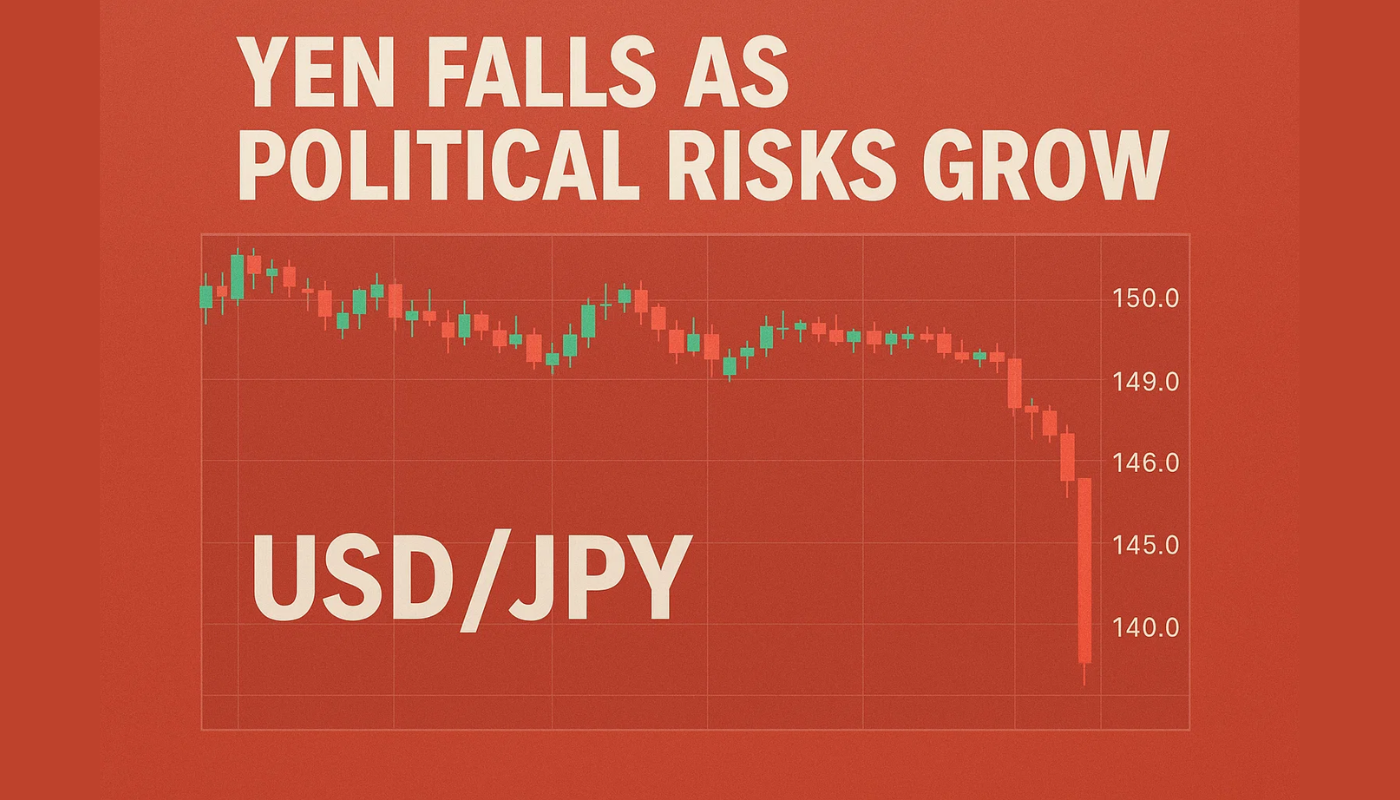
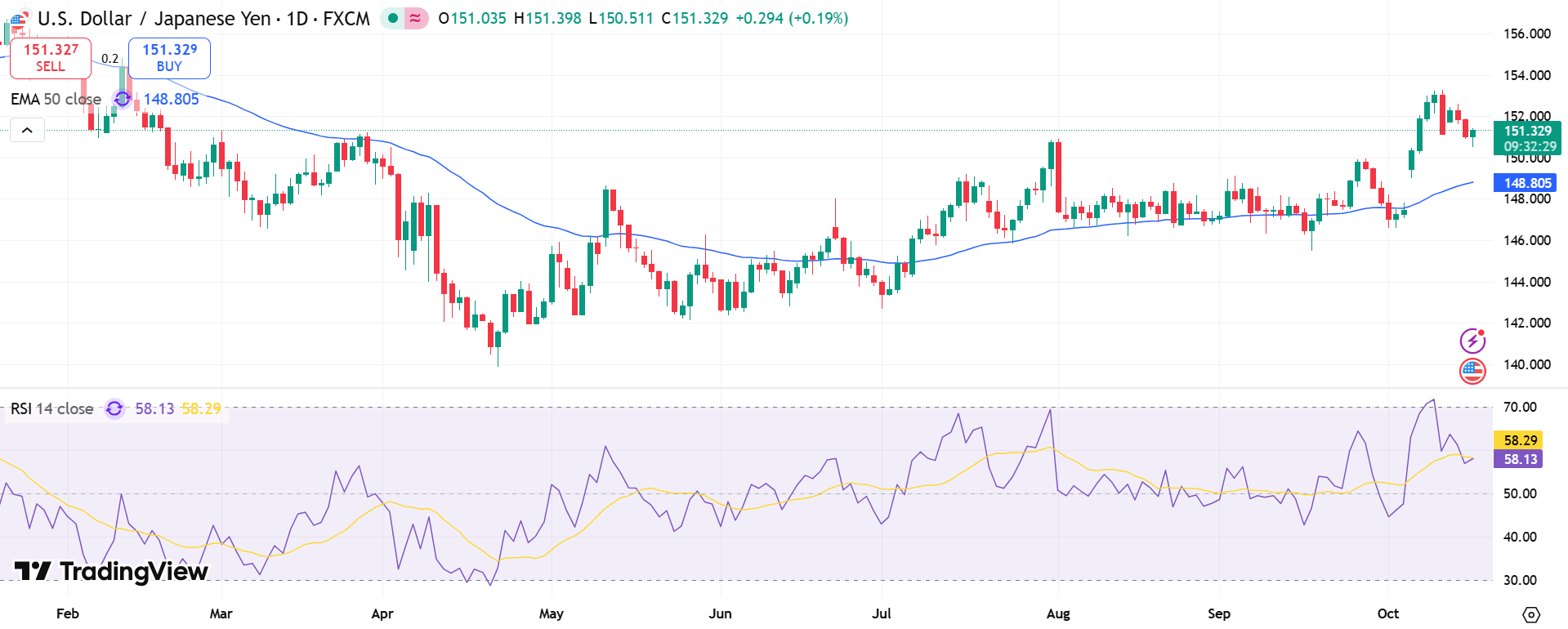
The Japanese Yen slipped on Thursday, extending losses after a brief Asian session rebound, as political instability in Tokyo fueled speculation that the Bank of Japan (BoJ) may delay its next interest rate hike. The USD/JPY pair recovered from a one-week low, climbing back above 151.00, aided by renewed demand for the U.S. dollar.
Traders viewed the ongoing Liberal Democratic Party (LDP)–Komeito coalition split as a major factor complicating Japan’s policy outlook. The breakup threatens to derail Sanae Takaichi’s bid to become Japan’s first female Prime Minister and may stall fiscal reforms that had previously reassured investors about the nation’s debt sustainability.
The Yen’s decline comes after the USD/JPY briefly dipped below the 200-hour Simple Moving Average, touching the 38.2% Fibonacci retracement level near 150.70 before rebounding. Analysts see immediate support around 150.00, while resistance remains capped near 151.65, a confluence of the 23.6% retracement and 200-hour SMA.
Political Rift Delays BoJ Policy Momentum
The collapse of the LDP-Komeito alliance has created a political vacuum that may delay any decisive monetary tightening from the BoJ. Japan’s parliament has yet to schedule a vote on the new Prime Minister, as opposition parties scramble to form their own alliances. This gridlock could postpone critical fiscal decisions and undermine confidence in near-term policy direction.
Takaichi, a proponent of Shinzo Abe’s stimulus-driven “Abenomics”, supports heavy government spending and ultra-loose monetary policy—stances that suggest continuity rather than reform. Despite short-term market jitters, these policies temporarily eased fiscal worries and lent modest support to the Yen.
Complicating the picture further are rising U.S.-China trade tensions and wider geopolitical risks, both of which have driven safe-haven demand for the Japanese currency.
Key developments influencing investor sentiment include:
- The U.S. expanding technology restrictions and China tightening rare earth export controls.
- Tit-for-tat port fees between Washington and Beijing fueling trade war concerns.
- Heightened rhetoric over the Russia-Ukraine conflict, with U.S. officials warning of escalation.
Divergent Central Bank Paths Ahead
Comments from BoJ board member Naoki Tamura suggested that Japan’s economy is resilient, with growth likely to accelerate in the coming quarters. Tamura hinted that the BoJ should gradually move rates toward neutral levels, signaling that policymakers remain cautious but not entirely dovish.
This stands in contrast to growing expectations that the U.S. Federal Reserve will implement two 25-basis-point rate cuts—one in October and another in December—as U.S. data softens. Meanwhile, the ongoing government shutdown continues to weigh on sentiment, with court rulings and funding impasses paralyzing Washington.
Investors will closely monitor upcoming speeches from FOMC officials for additional clues on U.S. rate policy. Their remarks, combined with Japan’s political volatility, are expected to steer the USD/JPY pair in the sessions ahead.
Sources & Methodology
Primary-source standard: Market-moving facts should link to original data releases, regulator notices, company filings or official project announcements whenever available. Secondary reporting is used for additional context, not as a substitute for original evidence.
Page last reviewed: